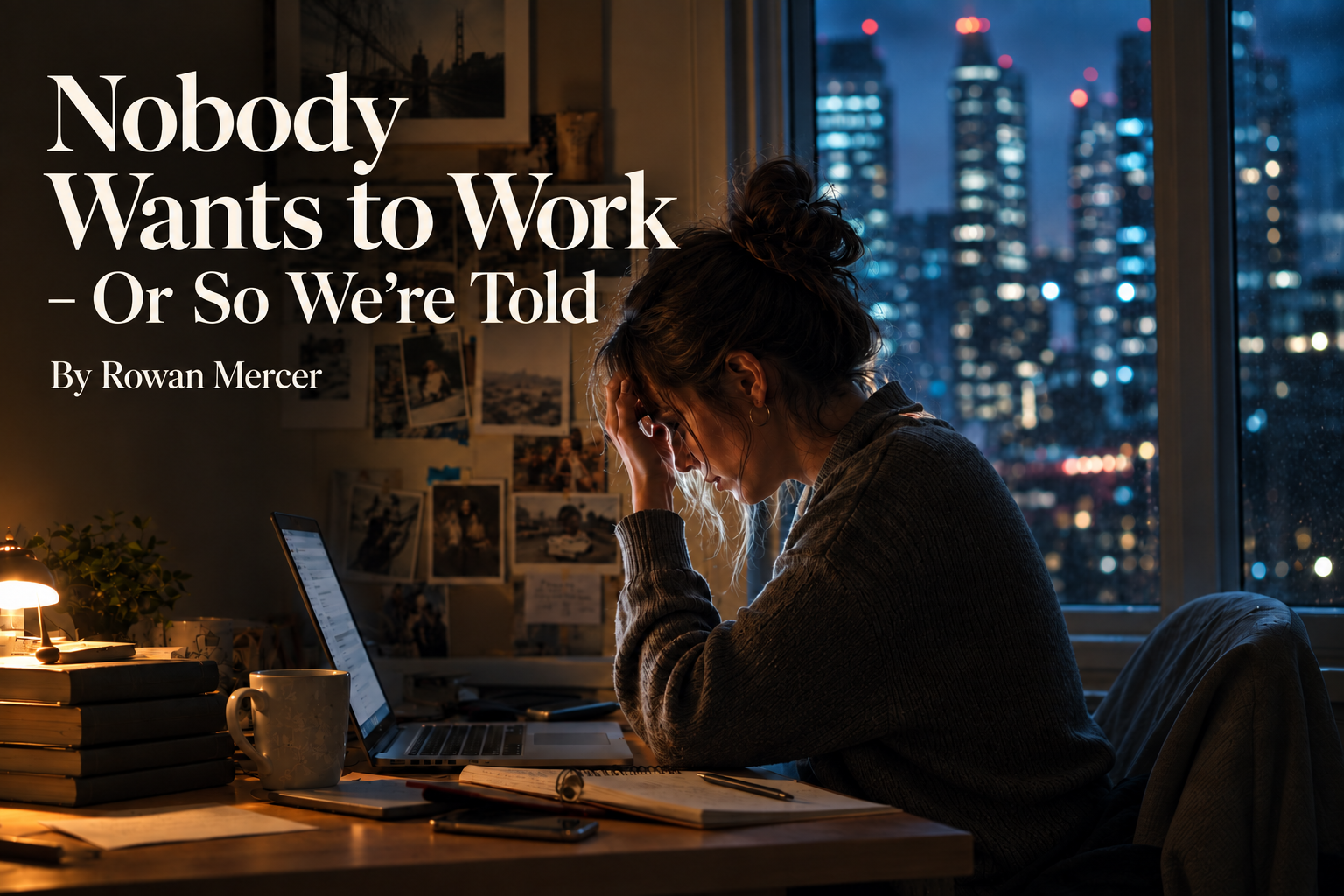
Nobody Wants to Work — Or So We’re Told
The Generation That Stopped Believing the Promise
By Rowan Mercer
There is a particular kind of exhaustion that emerges when an entire generation is raised to believe in the moral virtue of hard work, only to discover, gradually and then with devastating clarity, that labour no longer reliably guarantees stability, dignity, or even survival; it is an exhaustion that moves beyond tiredness into the nervous system itself, altering not only how people imagine the future, but how they understand adulthood, ambition, safety, and the price of remaining functional inside a world that keeps asking for more.
Much has been written in recent years about younger generations “not wanting to work,” usually by commentators who speak about modern labour with the nostalgic certainty of people still emotionally attached to a world that no longer exists. The accusation arrives so frequently now that it has hardened into cultural reflex: Gen Z, Millennials, and the emerging workforce behind them are entitled, unmotivated, fragile, unwilling to sacrifice. Yet beneath that accusation lies a more uncomfortable possibility — that they are not rejecting work itself so much as rejecting the increasingly punishing conditions under which work is now expected to consume human life.
For clarity, when this article speaks of generations, it does so in broad cultural terms rather than as rigid psychological categories: Baby Boomers are generally understood as those born between 1946 and 1964, Generation X between 1965 and 1980, Millennials or Generation Y between 1981 and 1996, Generation Z between 1997 and 2012, and Generation Alpha between 2010 and 2024. These boundaries are imperfect, but they offer a useful frame for understanding how different age groups encountered work, technology, stability, and adulthood under profoundly different historical conditions.
From my perspective as a millennial, I find myself increasingly unable to blame Gen Z.
I grew up during the 1990s in what would once have been described as an ordinary working family. My parents met in the RAF long before I was born — neither of them occupying glamorous or particularly influential roles. My father drove trucks and assisted with fire service duties; my mother drove ambulances. Eventually they left military life behind, married, had children, and entered civilian work that was modest, practical, and relentless in the way many working-class and lower-middle-class jobs quietly are. My father became an HGV driver and my mother worked in hospital administration. There was nothing remarkable about our upbringing in the romanticised sense people often attach to hardship retrospectively. We were not wealthy. We were not especially deprived. We simply existed inside the ordinary arithmetic of working life in Britain: wages coming in, bills going out, occasional small comforts balanced precariously against permanent financial pressure.
Then my parents divorced.
My father gradually became an every-other-weekend presence while my mother worked multiple jobs simultaneously to hold our lives together. We always had the essentials — food in cupboards, school uniforms, heating when possible — though often through extraordinary effort invisible to outsiders. Work ethic was not merely encouraged in our household; it was treated almost as moral law. The message was simple and deeply familiar to many people raised during that period: take whatever work you can find, work harder than everyone around you, accept discomfort without complaint, and eventually stability will arrive.
I believed that for years.
Like many millennials, I entered the workforce young and remained in it almost continuously. I worked multiple jobs at once, moved between part-time and full-time employment, accepted poor conditions because that was supposedly how adulthood functioned, and spent years attempting to outrun financial insecurity through sheer endurance. Yet the harder I worked, the more elusive stability became. What accumulated instead was debt, anxiety, chronic stress, exhaustion, stomach ulcers, and eventually a psychological collapse so severe it permanently altered the course of my life.
And this is where generational conversations about work become painfully dishonest, because people often speak about labour purely in economic terms while ignoring what modern work environments are doing to human beings psychologically and physiologically.
The mythology surrounding professional life rarely resembles its reality. Beneath the polished language of productivity, teamwork, resilience, and ambition often sits an ecosystem saturated with bullying, performative management, emotional exhaustion, and quiet humiliation. Office culture in particular can become psychologically corrosive in ways difficult to explain to people who have never experienced it. Entire hierarchies are frequently sustained not through competence but through personalities drawn toward authority itself — insecure middle managers weaponising minor power, workplaces normalising subtle degradation, cultures where emotional aggression becomes indistinguishable from professionalism. Managing the emotional fallout from full-time employment gradually became a part-time job in itself.
I watched this happen not only to myself, but to countless people around me.
And importantly, Baby Boomers and Gen X watched it too.
This is where the conversation becomes more complicated than simple generational blame. Baby Boomers and Gen X are often portrayed either as privileged beneficiaries of a vanished economic order or as reactionary critics incapable of understanding the struggles faced by Millennials and Gen Z. Reality is far less convenient than that. Many older people are themselves exhausted, frightened, and disillusioned. They speak openly now about being unable to retire, about pensions stretched beyond viability, about rising costs eroding decades of work, about children unable to afford homes despite working constantly. Many spent forty or fifty years believing the system would eventually care for them in return for their labour, only to discover late in life that the promises made to them were conditional all along.
Their anger is understandable.
What is tragic is where that anger is often directed.
Instead of recognising that multiple generations have been failed by increasingly unsustainable economic and political systems, people are encouraged to blame one another for conditions none of them individually created. Gen Z workers are accused of fragility while Baby Boomers and Gen X are dismissed as out-of-touch relics who “had it easier.” In truth, most generations have simply suffered differently. Baby Boomers and Gen X endured forms of hardship Millennials and Gen Z may struggle to imagine; Millennials and Gen Z now face psychological, technological, and economic pressures previous generations never encountered in remotely the same configuration.
The conflict itself increasingly feels manufactured — a social pressure valve designed to keep ordinary people resentful toward one another rather than questioning the systems producing widespread instability in the first place.
Still, Gen Z observed millennials with extraordinary clarity. They watched an entire age group obey the rules they had been given only to emerge burned out, financially unstable, emotionally depleted, and unable to access many of the milestones once associated with adulthood itself. Millennials were told stability would follow sacrifice. Many discovered the sacrifice became permanent while the stability never arrived.
We became the cautionary tale.
This is why I struggle to condemn Gen Z for questioning the legitimacy of work culture as it currently exists. They inherited a world in which housing became increasingly unattainable, wages stagnated against inflation, burnout became normalised, and technological saturation dissolved the boundary between labour and private life almost entirely.
Baby Boomers and Gen X could often leave work physically and psychologically behind at the end of the day. The modern world no longer permits that separation with the same consistency. Now the office follows people home inside phones, inboxes, notifications, messaging platforms, performance metrics, social comparison, and algorithmic surveillance masquerading as convenience. The world exists permanently in one’s pocket. There is no longer a meaningful distinction between public and private consciousness.
Gen Z and Generation Alpha were not gradually introduced to this reality. Many were born directly into it.
And I do not believe society has fully reckoned with what that means neurologically, emotionally, or socially.
Millennials occupied an unusual transitional space. Many of us remember childhoods before smartphones colonised every hour of existence, before social media transformed identity into performance, before algorithms learned to monetise attention itself. Even our entertainment functioned differently. Earlier video games, primitive though they now appear, still contained finality: limited lives, fixed endings, definitive failure states. If you failed, you started again. There were boundaries, pauses, conclusions. Contemporary digital life increasingly operates through endless continuation — infinite scrolling, permanent engagement, endless reward loops, constant stimulation without psychological closure. The nervous system never fully disengages.
This matters because modern labour now exists within that same architecture of endlessness.
Burnout today is not merely occupational. It is civilisational.
Gen Z are growing up amid relentless informational exposure unlike anything previous generations experienced: climate anxiety, economic precarity, political instability, algorithmically amplified outrage, social comparison operating at planetary scale, and constant exposure to traumatic events through devices specifically engineered to retain human attention for profit. Even childhood no longer reliably protects people from the adult world. There is nowhere left to psychologically retreat.
Meanwhile, the material realities of modern life continue deteriorating beneath the polished language of corporate progress. In Britain, recent reporting drawing upon research from IPPR and Action for Children found that almost three-quarters of children living in poverty were in households where at least one parent worked, while hundreds of thousands were growing up in households where every adult worked full-time and still remained at risk of poverty. Work alone no longer guarantees security. That fact should fundamentally alter how we discuss labour, responsibility, and survival.
The contradictions deepen further for women entering the workforce.
Gen Z and Millennial women were raised on the language of equality, fairness, and empowerment, encouraged to advocate for themselves and believe professional life would reward merit over prejudice. Yet the structures they entered frequently failed to reflect those promises in practice. Official UK figures published by the Office for National Statistics showed that in 2025 women’s median earnings across all employees remained 12.8% lower than men’s. Even among full-time workers, the gap persisted at 6.9%.
Statistics alone cannot fully capture the emotional effect of entering adulthood already aware that many institutions speaking most confidently about equality continue quietly reproducing inequality beneath the surface. Younger women, particularly those among Millennials and Gen Z, are expected to invest emotionally in workplaces while simultaneously recognising the persistence of disparities those workplaces publicly insist they are solving. It creates a profound institutional distrust difficult to articulate to people who still fundamentally believe systems function more fairly than they often do.
And yet despite all this, society continues demanding greater resilience from Gen Z while offering diminishing protection in return.
By my late twenties, my body simply gave out.
Years of chronic stress, overwork, psychological strain, toxic workplaces, and unresolved trauma culminated in a complete nervous breakdown accompanied by severe physical illness that permanently changed the structure of my life. I developed chronic conditions requiring ongoing management, including spinal injuries, long-term gastrointestinal damage linked to stress, complex post-traumatic stress disorder, chronic fatigue, hypermobile Ehlers-Danlos syndrome, mast cell activation syndrome, and postural orthostatic tachycardia syndrome. Some conditions were likely pre-existing vulnerabilities worsened catastrophically by sustained stress and burnout; others emerged through the physiological collapse that follows years spent forcing the body beyond its limits.
And then came another brutal realisation: modern systems are often extraordinarily hostile toward people whose productivity becomes inconsistent.
Any request for flexibility, accommodation, or humane adjustment was treated less as a practical necessity and more as evidence of burden. Despite government frameworks theoretically existing to support disabled workers, many workplaces remained structured around an older model of labour that assumes bodies and minds should function identically under identical conditions regardless of individual circumstances. If you could not perform according to those expectations, exclusion frequently arrived disguised as professionalism.
What followed was not liberation from work but a long, humiliating reconstruction of existence itself.
I had to relearn how to survive financially, psychologically, and physically within a society that increasingly treats dependency as moral failure while simultaneously producing the conditions driving people into collapse. I returned to education through the Open University because conventional routes were no longer physically accessible to me. I slowly rebuilt a working life online, remotely, in fragmented and cautious ways that accommodated my limitations rather than denying them. Even that process took years.
And throughout all of this sits another quiet cruelty embedded within many modern welfare structures: disabled people are often subtly punished for attempting to build ordinary lives. Relationships, cohabitation, marriage, family formation — all become economically dangerous calculations when financial survival depends upon systems capable of withdrawing support the moment another adult enters the household. The result is a strange form of suspended adulthood in which people are expected simultaneously to recover, remain financially independent, and avoid becoming too humanly connected in ways that threaten bureaucratic eligibility.
These are not fringe experiences anymore.
Increasing numbers of people are living with chronic illness, burnout, mental-health conditions, nervous-system dysregulation, exhaustion, and economic instability shaped not simply by individual weakness but by the conditions of modern life itself. Society is producing these outcomes while continuing to moralise them as personal failures afterward.
This is why simplistic accusations that Gen Z “do not want to work” feel so intellectually and morally empty.
Of course people still want meaning, purpose, dignity, contribution, creativity, community, and financial security. Human beings require all of those things. But Gen Z are increasingly unwilling to disappear entirely inside systems that seem incapable of reciprocating loyalty with protection, sacrifice with stability, or productivity with humane conditions.
And frankly, I understand why.
Perhaps some Baby Boomer or Gen X readers will scoff at this argument. Perhaps they will insist they survived without flexible work, mental-health protections, or conversations about burnout, and therefore Gen Z should simply endure as they did. There is a familiar instinct embedded in that response — a subtle belief that suffering acquires moral legitimacy through repetition, that because previous generations endured hardship, future generations should inherit it unchanged. In Britain especially, there often exists a quiet cultural tendency toward cutting people back down whenever they ask for conditions more humane than those historically tolerated.
But hardship is not an inheritance we are morally obligated to preserve.
The reality is that Gen Z are not entering the same world Baby Boomers, Gen X, or even Millennials entered, because the technological atmosphere, economic pressures, housing market, labour conditions, and psychological architecture of daily life have all changed so profoundly that expecting them to adapt to outdated working models is not resilience but denial; if the conditions of life have transformed, then the conditions of work must transform with them.
Flexible work, fair pay, affordable housing, accessible healthcare, realistic workloads, stronger worker protections, genuine accommodations for disability, meaningful parental support, and workplaces that recognise employees as human beings rather than endlessly exploitable resources are not utopian fantasies. They are adaptive responses to a world that has become psychologically and economically unsustainable for increasing numbers of ordinary people.
And if Baby Boomers or Gen X had been born into this same atmosphere — raised beneath constant digital exposure, algorithmic comparison, unaffordable living costs, environmental anxiety, collapsing trust in institutions, and endless economic instability — I suspect many would be demanding precisely the same changes.
The deeper failure is not generational. It is structural.
Most people are not living comfortably above these pressures; they are simply experiencing different versions of them. There will always be pockets of wealth insulated from the realities facing ordinary people, but for the overwhelming majority, life has become increasingly precarious, exhausting, and psychologically heavy. No generation benefits from tearing another apart simply because they happened to arrive in history under different conditions.
We are all living downstream from political choices, economic systems, technological transformations, and cultural priorities larger than ourselves.
No one escapes this untouched.
And perhaps that is the point from which we should finally begin speaking to one another differently — not through resentment, mockery, or accusations of weakness, but through the recognition that most people are struggling in ways invisible to outsiders. Gen Z do not need contempt masquerading as wisdom. Baby Boomers and Gen X do not deserve dismissal masquerading as progress. What all generations require is honesty about the world as it now exists.
Because if the future is going to remain survivable, we are going to have to stop asking human beings to destroy themselves simply to prove they deserve to live inside it.