Social Housing
The Holy Grail—or Second-Class Citizenship?
By A. Vincent
After four and a half years on the waiting list and six episodes of homelessness, an affordable social tenancy seemed to promise an end to provisional life. What arrived was a house without working heat or hot water, repairs completed only on a screen, and maintenance workers who treated a disabled woman’s front door as a procedural inconvenience.
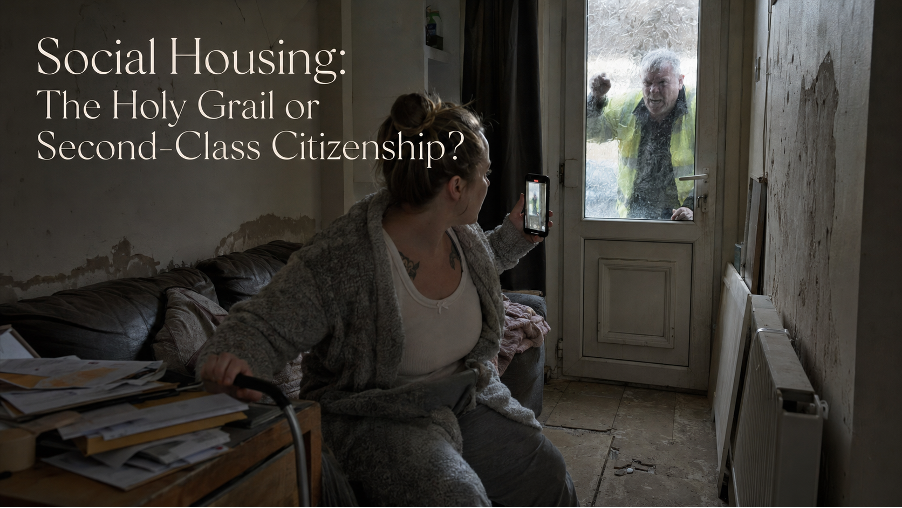
The dog heard the van first. His head lifted; his body stiffened; a door slammed somewhere beyond the window. Then came boots on the path and a man at my front door whom I had not agreed to see.
There had been others. For months, maintenance workers arrived without appointments, often without a call or message to say they were coming. An unexpected visit is difficult in most homes. In mine, it creates an immediate safety problem. My dog is reactive and must be moved or taken out before a stranger enters. I am disabled, with mobility difficulties, and cannot reorganise my body, my care and the room around somebody else’s unannounced arrival. Sometimes opening the door was unsafe; sometimes it was physically impossible.
The man outside expected to be admitted. I refused. He began to shout.
“You fucking old fucking cunt.”
He was about sixty. I was thirty-three.
The inversion might have been comic in another setting. On a doorstep, with a stranger furious at being denied entry, it had no harmlessness. The word old was so inaccurate that its function became clearer. It was there to wither me: to turn the woman saying no into a ridiculous, disposable hag. Then came cunt, the emergency vocabulary of male contempt when ordinary anger is no longer sufficiently degrading. I had neither threatened him nor obstructed an arranged repair. I had declined to let an unexpected man into my home. His answer was to make my age and sex into charges against me.
The recording matters because memory is one of the first things challenged when a tenant complains about a person sent by her landlord. Perhaps there was confusion. Perhaps his tone was misunderstood. Perhaps she was difficult. A camera removes some of those polite escape routes. His words remain his words, delivered on my doorstep because I insisted that the door belonged, for the duration of the tenancy, to me.
One man’s outburst establishes his misogyny. The larger cultural question is answered by what an employer does once it sees the evidence: whether the behaviour is investigated as a serious failure, whether the tenant is protected from further contact, whether the worker’s colleagues regard the incident with alarm or merely with the weariness reserved for inconvenient complaints. A culture is often easiest to see in the conduct it learns to absorb.
Six times homeless
By the time the tenancy finally came through, four and a half years and six separate losses of home had made instability the governing rhythm of my life.
The reasons were sometimes painfully ordinary. Landlords decided to sell. On one particularly sad occasion, my landlord died and his family sold the property. His death was a loss to them, and their decision about an inherited asset was understandable. For me, it meant homelessness again and nobody needed to behave like a pantomime villain. A private tenant’s home could disappear through events in somebody else’s family, changes in their finances or a calculation about the property market.
This is part of what makes housing insecurity so difficult to explain. There may be no single catastrophe, only the recurrent removal of ordinary life. A cupboard is packed before it has become familiar. Medical letters go to an address already passing out of use. Care arrangements, neighbours and the routes through which a disabled person learns to move safely are rebuilt, then abandoned. Hope adjusts itself to the length of the current notice period.
Searching for another private tenancy is unpaid work: listings, enquiries, affordability checks, deposits, inaccessible viewings and the quiet audition of presenting oneself as an uncomplicated applicant. Disability introduces needs that a hurried market can treat as delay. A pet shrinks the available field further. The person doing this work still requires somewhere to sleep, somewhere to keep medication, and enough composure to sound employable and solvent while explaining that she is about to lose her home.
The numbers are enormous and still incomplete. At the end of March 2025, 1.34 million households were on English local-authority housing registers, the highest figure since 2014. By 31 December, 134,210 households were living in temporary accommodation, including more than 176,000 dependent children. The Office for National Statistics acknowledges that there are no UK-wide official figures for sofa surfing. A person sleeping in a friend’s spare room may have escaped the street while remaining homeless in every meaningful sense: possessions in bags, privacy borrowed, departure permanently imaginable.
For people living this way, social housing acquires the reputation of a holy grail. The phrase can sound excessive until one understands what a secure address permits. It allows a person to unpack without privately calculating the labour of packing again. It gives a disabled tenant a chance to establish care, learn the building and make adaptations. It restores time beyond the next landlord’s decision.
Reform after the damage
The private-renting system has begun to change. Since 1 May 2026, England’s Renters’ Rights Act has prevented landlords from issuing new Section 21 “no-fault” notices, converted most assured tenancies into rolling arrangements and limited ordinary rent increases to once a year. Tenants now have a case-by-case right to request a pet, which a landlord cannot refuse unreasonably. The protection stops short of allowing any animal in any property, yet makes the old reflexive no pets rule harder to defend. The government’s 2026 information sheet sets out the current protections.
These are substantial reforms. They also arrived after years in which renters learned that a complaint, a pet, a child or a landlord’s wish to sell could place the home at risk. Law changes on a date; fear and market behaviour are less punctual.
The law had begun to move, but the market had not become humane overnight. From 1 May 2026, private landlords in England could no longer serve new Section 21 “no-fault” notices, while tenants gained the right to request a pet—a request landlords must consider individually and cannot unreasonably refuse. Renters nevertheless entered the new system carrying the consequences of the old one. Notices validly served before the deadline may continue through the transitional process, and landlords can still seek possession on defined legal grounds.
In the final weeks before Section 21 ended, solicitors reported a rush to serve notices while the old route remained available. Citizens Advice helped 2,335 people facing no-fault eviction in March 2026, 16 per cent more than during the same month a year earlier; one law firm received four times its previous volume of Section 21 instructions. The Guardian documented the last-minute surge. The stronger law therefore began with some tenants already carrying its predecessor’s consequences towards court.
The pet reforms reveal the same delay between legislation and ordinary practice. A landlord can no longer fall back on a lazy blanket refusal once a tenant makes a proper request; the circumstances must be considered on their merits. Yet a market accustomed to advertising no pets will not surrender the habit merely because Parliament has changed the rules. Applicants may fear that asking will make another prospective tenant more attractive. For renters with animals—especially disabled people whose animals may be woven into the practical and emotional structure of daily life—a right that must be fought for can still feel remarkably like permission withheld.
Enforcement is now the test. Rights offer limited protection when challenging a refusal requires money, legal knowledge and stamina that a tenant may not possess. Ending Section 21 removes a notorious route to arbitrary eviction; it cannot produce an affordable replacement home for somebody displaced before the deadline, nor ensure that every landlord immediately abandons practices the law was intended to end. Legal reform and lived security are related achievements. They do not necessarily arrive together.
The prize, when it came
The social tenancy offered something the private market had repeatedly failed to provide: rent I could afford and the prospect of remaining. In 2024–25, the average weekly social rent in England for a one bedroom place was £129, compared with £250 in the private sector. After so much forced movement, the belief that I might still occupy the same rooms next year felt almost indecently luxurious. The English Housing Survey figures explain why people wait so long and speak of an offer with such relief.
The house itself was harder to recognise as good fortune. It contained asbestos, had no flooring and bore what appeared to be human faeces on the walls. Almost nothing worked. No functioning heating system was installed until six months after I moved in, leaving me without working heat or hot water for more than half a year. There was no meaningful practical support or compensation. Progress depended upon my continuing to call and ask what was happening.
Cold takes possession gradually – before you know it it’s mid-December I am surviving off hot water bottles and electric blankets. Clothes become necessary and essential indoor equipment. Washing and bathing requires extreme planning. Pain, fatigue and limited mobility meet rooms that draw heat from the body instead of holding it. After years waiting for a permanent address, I had acquired one in which ordinary domestic life remained physically punishing.
NICE guidance identifies disabled people and those with cardiovascular, respiratory or mental-health conditions among the groups particularly vulnerable to cold-related illness. It notes that disability and chronic illness may mean spending longer at home, increasing exposure. The World Health Organization treats indoor temperature, accessibility and domestic injury hazards as matters of public health.
The psychological effects are difficult to detach from the practical ones. A study using UK household data found that entering a home one could not keep adequately warm was associated with almost twice the odds of severe mental distress among people who had previously reported none, and more than three times the odds among those already near the threshold. The research, published in Social Science & Medicine, reflects a fact the body understands without consulting a housing officer: health does not stop where a repairs department’s remit begins.
Stress gathered in the day cleared for an appointment nobody kept, the repeated explanation of an unsafe condition, the pause before checking whether a sound outside belonged to another unexpected worker. The NHS lists headaches or dizziness, muscle tension or pain, stomach problems, chest pain and a faster heartbeat among possible physical symptoms of stress, alongside disrupted sleep and concentration. These symptoms can have many causes and require medical support when persistent or worrying. Their physicality matters. Bureaucratic failure is still experienced by a nervous system.
Before the tenancy, I knew that an address could be taken away. Afterwards, I knew that permanence could coexist with exposure: a fixed home that would not keep me warm, a landlord that could not reliably record reality, strangers who might arrive as though my consent were an optional stage of the repair.
The man at the back door
One worker did not knock at the front. He came around the back of the property and appeared at the glass of my living room. I had recently left the shower and was undressed, waiting for my carer to help me. He peered inside and tried the door.
There is no elegant substitute for the word creepy. A strange man had approached the private side of my home, looked through the glass and attempted to let himself in. I had received no appointment, warning or request for permission. Whatever innocent error might have existed on an office screen, its physical form was his hand on the door and my unclothed body on the other side.
Embedded video: an unannounced worker appears at the rear of the property and attempts to gain entry. Private identifying details should be obscured while the sequence remains intact.
Once somebody has tried the handle, the house is occupied differently. A shower becomes a period of exposure. Movement outside must be identified before it can be dismissed. Almost anyone can be caught vulnerable by an unexpected man at the door: half-dressed, asleep after a night shift, alone with a child, ill, frightened or simply unwilling to receive a stranger. Disability sharpened the danger in my case. The right itself belongs to every tenant.
Social and private tenancies are not identical legal arrangements, although affordable rent does not create a discounted form of privacy. Tenants retain the long-established right to quiet enjoyment: protection from substantial or unreasonable interference by the landlord or people acting for it. The phrase sounds concerned with silence. Its real subject is authority over the home.
Government guidance states that a tenant has the right to live in the property undisturbed. It says landlords should provide at least 24 hours’ notice for inspection or repairs, except in a genuine emergency. Section 11 of the Landlord and Tenant Act 1985 provides for reasonable-time access after at least 24 hours’ written notice to inspect condition and repair. Tenancy agreements can contain provisions governing access for work, and a true emergency may justify immediate action. Ownership alone is not a warrant.
An unexpected knock is not automatically a criminal offence. Actual entry without consent, contractual authority, emergency justification or a court order may amount to trespass or breach of quiet enjoyment. Conduct likely to interfere with an occupier’s peace and comfort, carried out with the intention of making them leave or stop exercising their rights, may cross into criminal harassment under the Protection from Eviction Act 1977. The classification depends upon the evidence. A uniform and a work order do not supply permission by themselves.
The practical point is plainer. Notice allowed me to arrange safe access around my disability, care and dog. Ignoring those needs produced the very closed door the landlord could later describe as tenant failure. I was willing to have repairs completed. I was unwilling to let unexpected men decide when my home became available to them.
The Housing Ombudsman’s 2025 report, Repairing Trust, describes contractors “cold calling,” arriving on incorrect days and overlooking residents’ medical circumstances. Some tenants were then unfairly recorded as denying access. It also records repairs being closed after missed appointments that had never been arranged. The phrase no access is efficient because it begins the story at the locked door and deletes everything that happened before it.
Another disabled resident told me that a maintenance worker pushed her into a separate room, slammed the door and ordered her to stay there because he considered her a nuisance while he worked. Her account requires her consent and any available corroboration before publication. Its internal logic is nevertheless familiar: the person who lives in the property becomes an impediment to the efficient management of it.
The house that existed on screen
When I reported that my back door would not lock and a window would not close, the housing provider said the matter would be treated as an emergency. Nothing happened. Weeks later, after I followed up, I discovered that the repair had been marked complete. Nobody had visited. The door remained incapable of locking; the window still would not shut.
I cannot know why the job was closed. Error, haste, contractor reporting and deliberate misrepresentation carry different implications. The established facts require no speculative motive: the record said the property had been made safe while the physical home remained unsecured. The landlord possessed a system capable of declaring the work complete. I possessed the door.
That discrepancy has consequences. Records decide whether another appointment is offered, whether targets appear to have been met and whether a tenant acquires a reputation for pursuing work officially finished. An inaccurate tick can travel farther through an organisation than the resident’s account of what is under her hand. By the time she reaches somebody with authority, she may be arguing against a history from which the problem has disappeared.
The regulator’s Safety and Quality Standard requires English social landlords to maintain accurate property-level records, provide timely repairs, communicate clearly and shape services around tenants’ needs. Current Awaab’s Law guidance includes broken external doors or windows that leave a home unsafe among possible emergency hazards requiring action within 24 hours. The law took effect in October 2025 and cannot be applied retrospectively to earlier events. Its existence records the failure of vague promises and internal discretion to keep tenants safe.
The population affected is not marginal to social housing. In 2024–25, 61 per cent of social-rented households included someone with a long-term illness or disability. Only 19.5 per cent of disabled respondents to the Ombudsman’s repairs call for evidence felt reasonable adjustments had been made. Across the Ombudsman’s 2024–25 casework, poor practice was found in 72 per cent of the living-conditions cases it investigated. These complaint figures do not describe every landlord or repair. They describe failures too recurrent to be explained by a few unlucky encounters.
Many housing officers and operatives work carefully inside depleted services, ageing buildings and systems they did not design. Their decency cannot correct records they never see or supply accountability their employer does not demand.
Keeping the other record
Recovery has not resembled a return to innocence about home. It has accumulated as a second administrative system: dates written down, screenshots saved, repair references kept beside photographs, verbal promises followed by emails. The videos preserve incidents that might otherwise be reduced to a disagreement over tone or memory. This labour consumes energy a disabled tenant does not have in surplus, but it also prevents the landlord’s version from becoming the only version.
Publishing the footage is part of that correction. Social media may carry a man’s shouted obscenity farther than any account of months without heating, which is precisely why the article must hold the two together. The outburst was spectacular; the neglect was repetitive. One made a better clip. Both belonged to the same relationship of power.
I remain grateful for affordable rent and the security of a social tenancy. Years of waiting taught me their value with unnecessary thoroughness. Gratitude cannot settle the landlord’s obligations or turn intrusion into maintenance. Social housing is worth defending because the private market has failed so many people; that defence includes refusing the degraded standards its tenants are sometimes told to accept.
Attempts to redirect the argument towards competition for housing confuse allocation with conduct. The subject here is what a landlord does to people already in its care.
The heating was eventually installed. Warm rooms could not make the delay reasonable, and a repaired fixture cannot restore the assumption that every person sent by the landlord will respect the threshold. Hope has returned in a less decorative form: plans made beyond the next notice period, knowledge of the law, evidence retained, the confidence to continue after being called difficult—or considerably worse.
Now, when a van stops outside, the dog raises his head. I check the calendar and my messages. If no appointment has been made, the door remains locked. Its closure records an ordinary fact that should never have required this much evidence: this is my home.