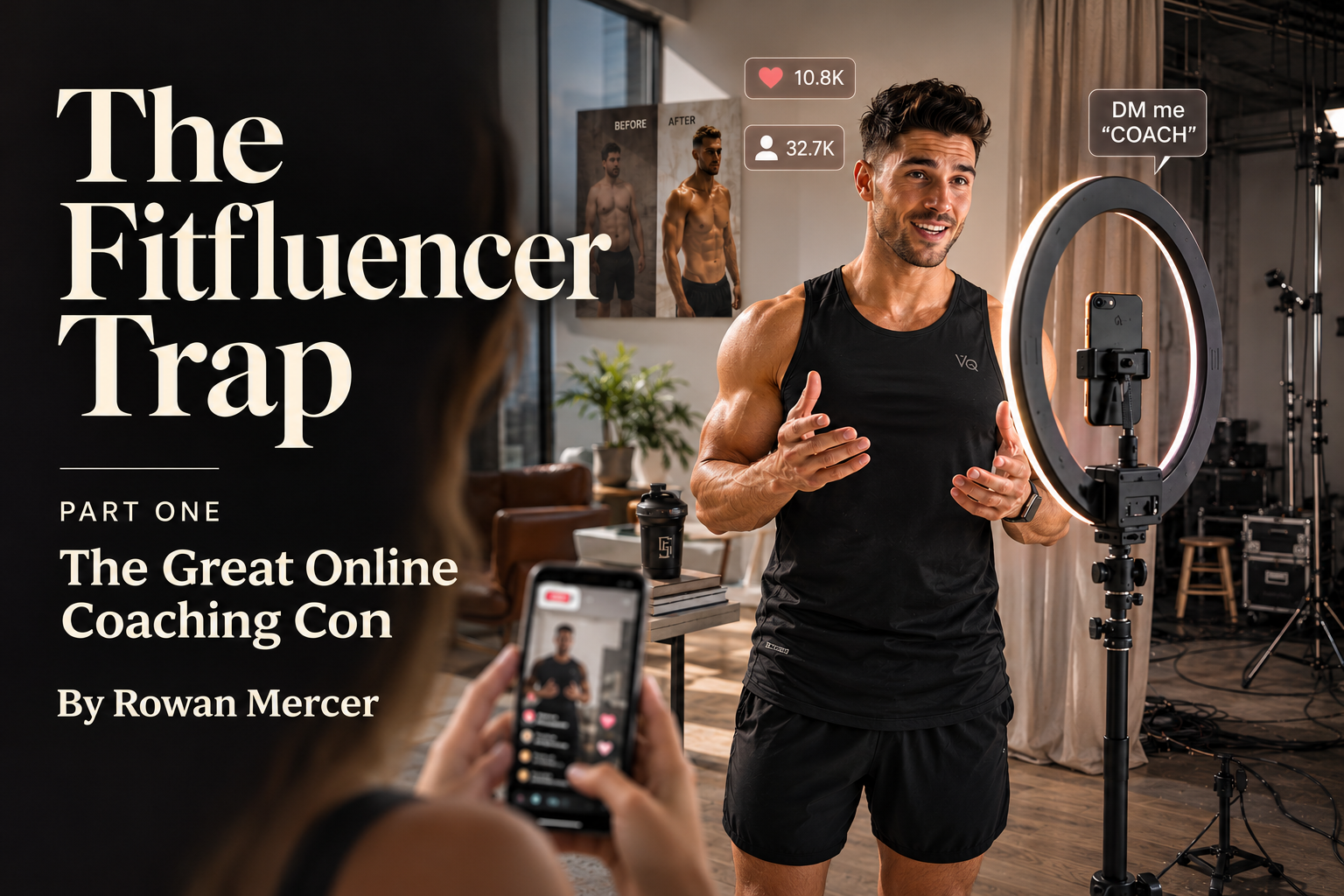
IN DEPTH • Part 1
The Fitfluencer Trap, Part One: The Great Online Coaching Con
By Rowan Mercer
The modern online coaching sale rarely begins with coaching. It begins with a body, a biography and the carefully managed possibility of access. By the time the creator asks for payment, the follower may have mistaken months of exposure to a persona for knowledge of the person, and confidence in that person for evidence that a professional service exists behind them.
The Atlantic Ocean, Briefly Reassuring
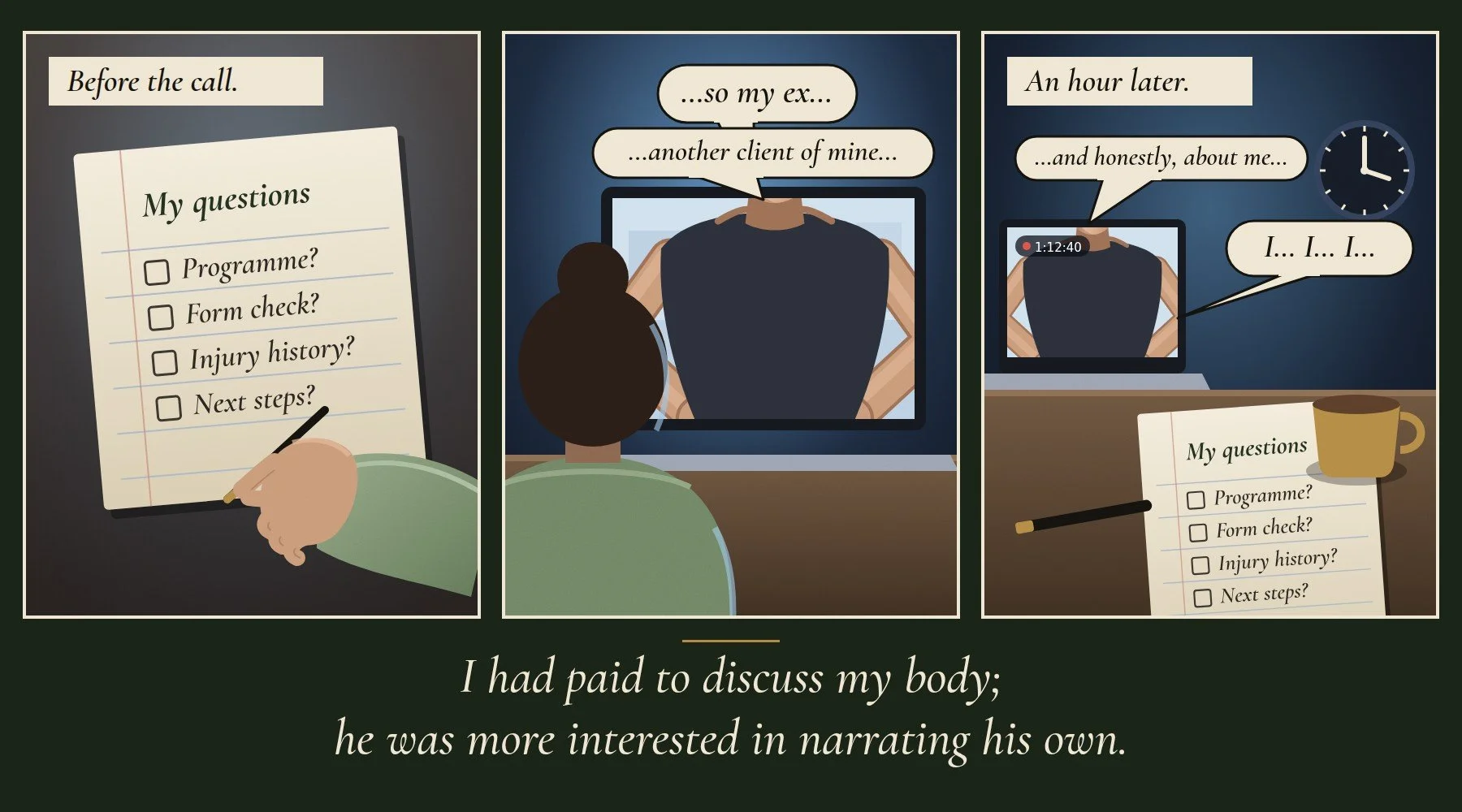
During the coaching call I had paid for, the conversation drifted from exercise to his former girlfriends, to other clients and, eventually, to the unsolicited disclosure that he did not masturbate.
I remember sitting at my adaptable desk in the bedroom, the laptop throwing its hard blue light over a room that had already gone dark, wondering how an appointment concerning my strength, health and training had arrived at a stranger’s sexual habits. I had paid to discuss my body; he appeared considerably more interested in narrating his own.
By the end of the call, I knew that he abstained from masturbation. I still did not know what professional method I had purchased.
The exchange did more than embarrass me. It altered the atmosphere of the encounter. A conversation sold as coaching had become intimate on terms I had neither invited nor controlled, and the easy informality that had seemed attractive online now felt invasive. For the first time, the Atlantic Ocean ceased to look like an inconvenience and began to seem usefully wide. Had the same exchange taken place face to face, alone with him in a gym, I would have walked out and thought twice about returning.
The man on the screen had not suddenly become somebody else. The error was mine in assuming that the public persona—the humour, apparent openness, physical discipline and repeated suggestions of emotional intelligence—was reliable evidence about how he would conduct himself when money and responsibility entered the room.
I had believed I was unusually well placed to detect that error. I had a long history of structured training, held a personal-training qualification and understood more than the average consumer about what a professional service ought to contain. I was not unfamiliar with online persuasion, nor did I consider myself especially credulous. That confidence became part of the trap. I assumed experience would protect me from being mis-sold a service, when it merely supplied more sophisticated reasons for trusting the seller.
What followed was not a minor disappointment. The bespoke exercise plan I had paid for, which was supposedly built around my body and my health, turned out to be the same document he had sent to everybody else, personalised in nothing but its price. For somebody living with chronic illness, a plan written for everyone is not merely lazy but potentially unsafe. The rest of the service unravelled into delays, confusion, missed arrangements and work I had to perform on behalf of the business I was paying, until he stopped turning up to our appointments altogether. A refund was promised and never arrived, forcing me to pursue the money through my bank. For someone already living with chronic illness, none of this was merely inconvenient: it consumed time, energy and emotional reserves I did not have, aggravated the strain already placed on my physical and mental health and left me noticeably worse than before I sought support. A failed service is an irritation to somebody with options; to somebody whose options have already narrowed, it can be genuinely dangerous. What had been sold to me as help became something I needed to recover from.
Those failures, and the long process of escaping them, belong in detail to the next part of this investigation. Part One begins earlier, before the call became uncomfortable, before the appointments stood empty and before the refund became a private administrative war. It begins with the more troubling question of how a man behaving like this had persuaded me that purchasing access to him was a sensible decision.
The answer was not a single lie. It was an environment in which the sale had been taking place long before I recognised myself as a customer.
The Man the Algorithm Thought I Needed
I will call him Robert.
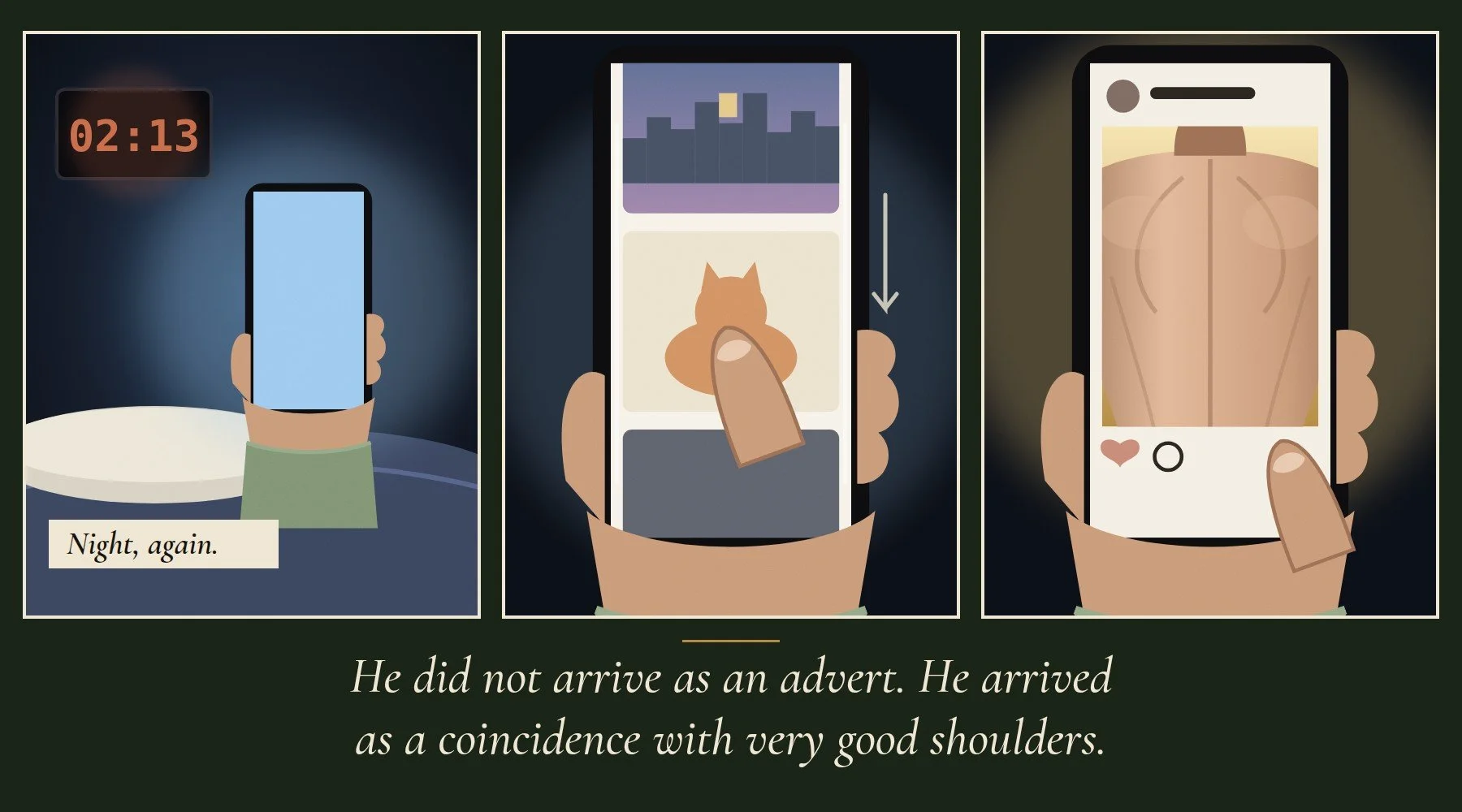
He first appeared late at night, among gaming clips, fitness content and the loose collection of material served to people whose sleep has become an unsuccessful negotiation. He was based in Florida, dark-haired and strikingly attractive, with the sort of physique that appeared to have been built carefully and then photographed by someone determined not to waste it.
His looks were part of the appeal, although beauty alone would have been easier to classify. The account surrounded the body with enough recognisable detail to make him appear unusually compatible. He spoke about ADHD, referred to games and anime I knew, and retained a faint, self-conscious awkwardness that distinguished him from the more industrial products of online fitness culture—the men who appear to have been assembled from pre-workout powder and motivational captions in a facility outside Dubai.
He once admitted that the identity he presented online was partly constructed from the qualities he wanted to embody. I took this as evidence of candour. A person willing to acknowledge the performance seemed less likely to be deceiving anyone.
It was an attractive piece of reasoning and almost perfectly backwards. Revealing the mechanism did not dismantle the persona; it made the persona appear self-aware. He was still conducting the backstage tour, and he alone decided which parts of the machinery the audience was permitted to see.
The platform had delivered a persuasive combination. His body represented the strength I wanted to rebuild, while the shared interests implied that communication might feel easier than it often did. The time difference suited my erratic sleeping hours. His distance made the arrangement seem contained, free from the social exposure of a local gym or the physical demands of travel. Each reason was practical enough to conceal the emotional force of the whole.
He did not arrive as an advert. He arrived as a coincidence with very good shoulders.
That distinction matters because advertising is easiest to resist when it identifies itself. A poster has no interior life. A thirty-second commercial does not discuss concentration problems, post from bed or make a joke about a programme you loved as a teenager. The influencer enters through the ordinary channels of social recognition, allowing affinity to form before commerce declares its interest.
Ofcom’s most recent research found that although UK adults reported high overall confidence online, confidence was lower when they were asked about specific skills such as recognising advertising or judging accuracy. Familiarity with digital environments does not reliably produce immunity to their persuasion.
I knew I was looking at a constructed account. What I failed to see was how much interpretive labour I was performing on its behalf.
Advertising With a Pulse
The old advertisement stood apart from life. Influencer marketing is effective because it resembles life closely enough to borrow its emotional privileges.
The follower sees the workout, then the journey home; the carefully posed image, then the apparent outtake; the motivational speech, then the creator eating cereal in bed and complaining about a neighbour. Confession, instruction, boredom and commerce occupy the same visual space. A coaching offer can therefore emerge without feeling like a change of subject. It appears to be another development in a person’s story.
Repeated exposure produces a particular kind of social confidence. The audience learns how the creator speaks, what makes them angry, which jokes they repeat and how they describe their failures. This information would ordinarily signal growing acquaintance. Online, it may have been distributed identically to several hundred thousand people.
The experience is collective at the point of broadcast and private at the point of reception. A creator looks directly into the camera while the follower watches alone, often in a bedroom or during an unguarded hour. The scale of the audience is intellectually understood; the older cues of intimacy—eye contact, direct address, vulnerability—are felt more immediately.
Research has found that self-disclosure by a media figure can increase perceived authenticity and liking, making viewers more receptive to the message being delivered. The effect was observed even where no established relationship with the performer existed. The disclosure does not need to be fabricated. Its sincerity and its persuasive usefulness can coexist without inconveniencing one another.
This is what makes the modern fitness creator more commercially potent than a conventional model displaying sportswear. The follower does not merely admire a body. They acquire a working impression of the person inside it.
Robert seemed open because he spoke about difficulties. He seemed intelligent because he could describe his own self-construction. He seemed relatable because familiar interests survived beneath an exceptionally curated physique. Each impression may have contained some truth. None amounted to knowledge of how he behaved when a client disagreed with him, requested accountability or expected professional boundaries.
The feed showed character as content. I mistook it for character under pressure.
The Body as a Business Proposal
Fitness influence has a built-in sales advantage: the creator can present their own body as evidence that the product works before the product has been described.
The standard transformation story begins with an earlier photograph, generally taken in worse lighting and before the subject understood that their old body would later become a marketing asset. The posture is uncertain; the surroundings are ordinary. The later photograph is cleaner, harder and more deliberate. Muscle has acquired definition, and definition has acquired a ring light.
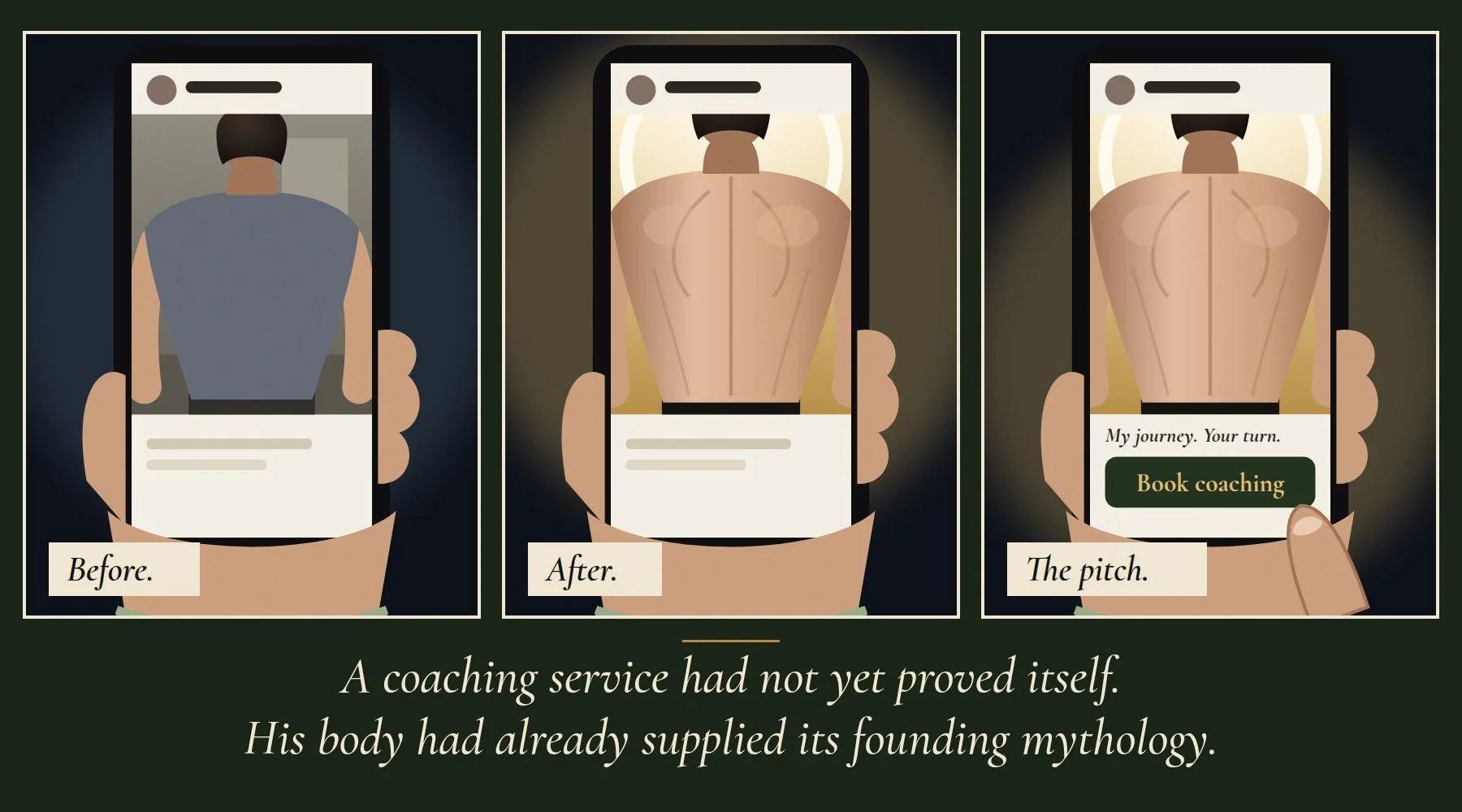
Between the two images, years of life are compressed into a moral narrative. The earlier self was unhappy, undisciplined or lost. The present self has learnt control. Money, genetics, previous training, medication, work, relationships, time and luck disappear from the account because context makes poor advertising. What remains is pleasingly linear: suffering, decision, transformation.
The creator’s body becomes testimonial, shop window and business prospectus at once.
The follower is invited to identify with the abandoned version while aspiring towards the current one. This is more emotionally persuasive than being shown an anonymous success story, because the creator occupies every useful role: former sufferer, discoverer of the solution and living proof of the ending.
Influencer research has repeatedly linked perceived credibility and parasocial interaction with purchase intention. Viewers are affected through both their evaluation of the creator and their felt relationship with them, rather than through product information alone.
Robert’s transformation was sold as more than physical change. He spoke about reinventing himself and building the man he wished to become. His physique appeared to confirm a wider mastery over disorder: appetite controlled, habits organised, uncertainty forced into submission. For somebody living with a body and life that frequently refused neat management, this was compelling.
The appeal was not simply that he had become stronger. He seemed to have solved the humiliating gap between intention and action, the private distance between the life one means to live and the life that repeatedly turns up instead.
A coaching service had not yet proved itself. His body had already supplied its founding mythology.
OnlyFans Would Have Been More Honest
Robert told me that he had considered opening an OnlyFans account but rejected the idea because he did not want the reputation for himself or any future children.
It was, in retrospect, the most illuminating thing he said.
OnlyFans, whatever one thinks of the platform, generally has the courtesy to name the transaction. A creator sells access to their image or body; the customer knows what sort of threshold they are paying to cross. Desire is not disguised as development, and the buyer is not asked to pretend that proximity to an attractive stranger is a form of healthcare.
Robert had chosen a more respectable ambiguity. His body remained the principal attraction, but it was packaged with the vocabulary of discipline, transformation and support. The audience could desire him while understanding that desire as admiration; they could pay to move closer while calling the purchase coaching. He was still monetising himself. He had simply dressed the transaction in activewear and given it a wellbeing objective.
The distinction is ethically important because a sexual-content platform is unlikely to persuade the customer that the creator is assuming responsibility for their health. Online coaching can. It attaches bodily attraction and emotional familiarity to a service that implies competence, care and personal guidance. When the arrangement fails, the loss may extend far beyond buyer’s remorse, landing hardest on those who sought help precisely because they had little margin left to lose.
At least on OnlyFans, both parties broadly understand why the lighting is flattering.
With Robert, the commercial ambiguity protected the seller and burdened the customer. If attraction played a role in the purchase, it could be denied because the official product was fitness. If intimacy seemed to be offered, it could later be dismissed because nobody had technically promised a personal relationship. The persona generated emotional demand while the business retained the right to interpret every expectation in its narrowest possible sense.
Whether he consciously understood this contradiction is impossible to know. People can repeat their own mythology until it feels less like branding than biography. What mattered was the effect: he occupied the profitable space between being admired as a body and trusted as a helper, without appearing to recognise the responsibilities created by either position.
The eventual call exposed the confusion. The boundaries between fitness professional, online personality and sexually charged confidant had never been properly separated because the brand benefited from allowing them to blur.
How a Follower Becomes a Prospect
The word funnel sounds too mechanical for the experience it describes. Nothing in the early stages felt like entering a process. I watched, followed and occasionally responded. He became familiar through accumulation.
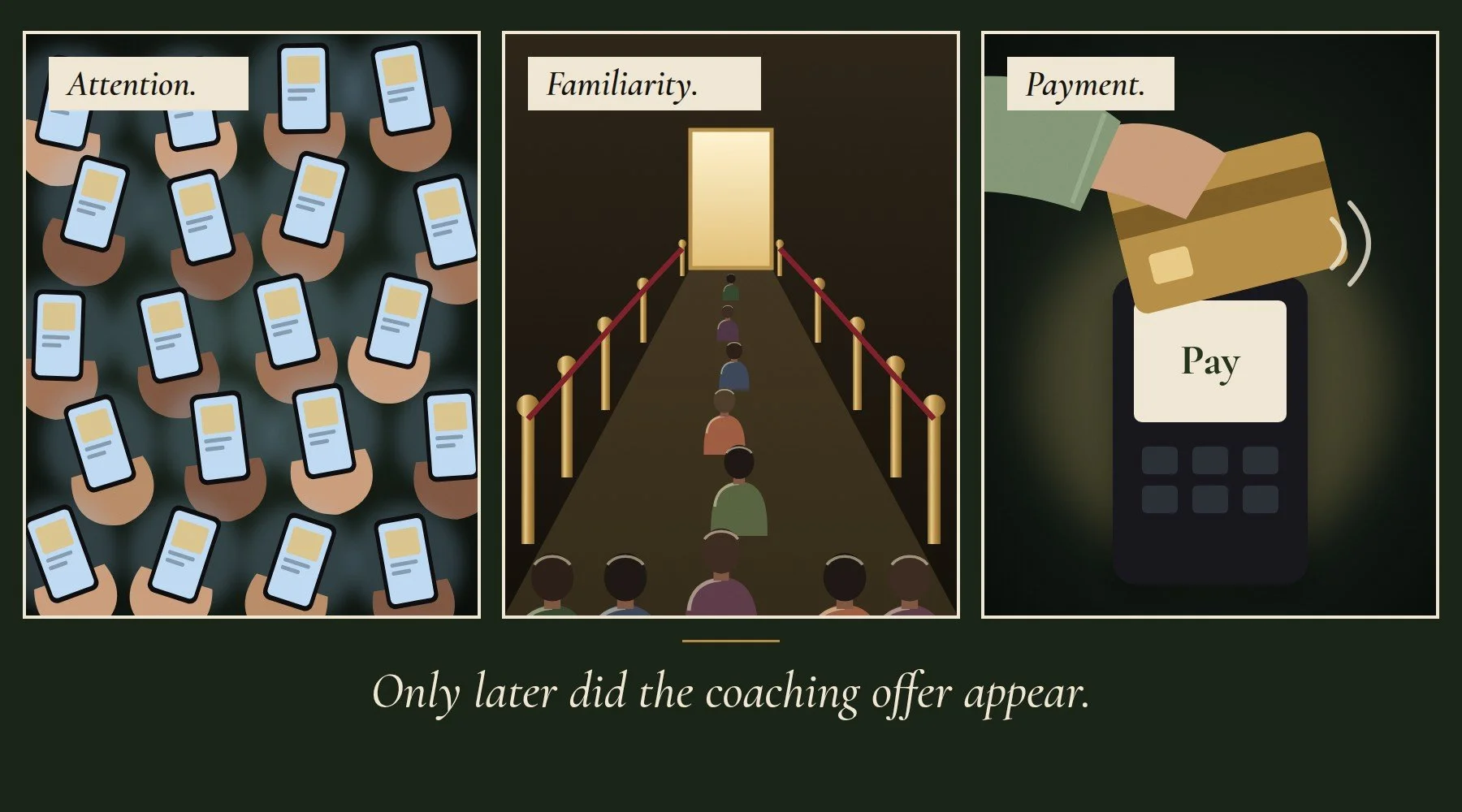
The commercial route was nevertheless taking shape. First came attention: the arresting body and recognisable interests. Then identification: the account of self-reinvention, difficulty and discipline. Personal disclosure created the impression of access to an inner life. Repetition converted novelty into familiarity. The possibility of direct contact gave that familiarity a future.
Only later did the coaching offer appear.
This sequence is common to a creator economy in which audience-building may precede the decision to operate a business. A 2025 NatCen study commissioned by HMRC found that some creators began posting to share interests or seek social connection and monetised only after opportunities emerged, while others pursued income from the outset. The available revenue streams included subscriptions, donations, partnerships and other forms of audience access.
Fitness offers an especially easy commercial transition. Followers already ask questions, praise results and request advice. The creator does not have to locate a market; it is visible in the comments, volunteering its insecurities beneath every post.
Coaching then appears to be the natural extension of influence. The audience assumes the service grew from expertise, although it may equally have grown from demand. The account, customer base and payment channel can exist before the less visible elements of a serious professional operation have been considered.
From outside, the creator looks established because the media business is established. There are followers, livestreams, multiple platforms and a constant flow of content. The coaching offer inherits that scale even though private service operates according to a different arithmetic.
One post can reach a million people. One person cannot attend meaningfully to a million clients, however handsome the dashboard.
This contradiction remained concealed because public presence looked like availability. Robert seemed to be everywhere: Instagram, Facebook, TikTok, Twitch, each platform offering another angle on the same man and another route through which his audience could support him. There was a donation link, branded merchandise, affiliate promotions and even a PO box for gifts, creating an ecosystem in which admiration could be converted into money, purchases, commission or tribute. Taken together, the arrangement felt less like a community than a privately maintained court: a devoted audience invited to subsidise the lifestyle of someone whose visible labour consisted largely of remaining visible. The machinery of attention was extensive; the obligation to provide anything meaningful in return appeared considerably less developed.
Why Knowledge Did Not Protect Me
It would be comforting to frame the people caught by these arrangements as naive. That leaves the more experienced observer safely outside the story, confident that fraud has poor taste and can be recognised by its spelling. My position was less convenient.
I knew that social media involved performance. I understood that attractive people were commercially persuasive and that personal transformation did not prove universal ability. I also knew enough about fitness to believe I could recognise whether an offer sounded plausible. This knowledge did not prevent the sale. If anything, it helped me rationalise the decision. Because I understood some of the practical advantages of remote support, I could explain why the arrangement suited me. Because I had experience of training, I recognised enough of the language to find the proposition credible. Because I did not think of myself as vulnerable to a handsome online personality, I translated attraction into compatibility and familiarity into fit.
Experience can protect against crude deception while leaving a person open to subtler forms of confidence transfer. The customer does not suspend judgement; they use judgement to construct a case for something they already hope will work.
I was also buying under conditions that made hope unusually active. Chronic illness had reduced my options and made reliable support difficult to access. Fatigue narrows the appetite for prolonged research, and isolation changes the emotional value of being approached by somebody who appears interested. None of this erased my critical faculties. Instead, it altered the burden placed upon them.
A person with abundant local options, stable health and spare energy can treat an online offer as one choice among many. Somebody whose life has become logistically smaller may experience accessibility itself as evidence of suitability. The service is available when better-supported alternatives are not, and availability begins to acquire the moral glow of help.
I thought I had enough knowledge to avoid being conned. What I did not understand was that the funnel did not need me to become ignorant. It needed my knowledge to compete with convenience, recognition, attraction and the possibility that this particular person might be useful.
The sale won by coalition.
When the Persona Entered the Appointment
The coaching call should have clarified what I had bought. Instead, it revealed how little separation existed between the public personality and the private service.
Robert spoke about himself at length. Former girlfriends entered the conversation. Other clients’ personal details appeared as stories, their difficulties used as evidence of his importance in their lives. Then came the disclosure about masturbation, delivered during an appointment I had purchased to discuss strength training...
The issue was larger than one inappropriate remark. The call felt like an extension of his content, with me cast as an unusually attentive audience member who happened to have paid for admission. The familiar persona had not transformed into a professional role because no convincing professional boundary had been constructed around it.
What had felt online like openness now appeared as self-absorption. The charming absence of formality became a disregard for the purpose of the appointment. His habit of making himself the centre of the story, effective when building an audience, proved far less appealing when the customer was meant to be the subject.
This was the point at which the sales proposition became visible in reverse. I had believed that payment would purchase his attention and expertise; instead, I appeared to have bought a private opportunity to give him mine.
The discomfort stayed with me because the exchange carried the same ambiguity that had made the account commercially effective. He was personal, but not reciprocal; intimate, but not careful; available, but largely as a subject for his own narration. The call made clear that I had entered his orbit rather than purchased a service built around my needs.
Had the meeting taken place in a gym, the social breach would have been harder to disguise. A client could leave, speak to staff or simply recognise that a professional encounter had become inappropriate. Across an ocean and behind a screen, the behaviour existed in a private space without witnesses, context or any immediate route for accountability.
The distance that had once made the arrangement feel safely contained, and that had briefly seemed protective, now worked almost entirely in his favour.
The Persona’s Last Defence
When I later raised concerns, the self-awareness displayed so fluently online did not produce accountability. Messages were ignored or dismissed, and the responsibility he spoke about with such ease in public proved remarkably shy in private.
Then he stopped turning up. The appointments I had paid for became a series of small, recurring humiliations: the hour set aside, the screen waiting, the time passing in silence while a man who had found so much to say about himself apparently found nothing to say to me. Each absence made the eventual dispute with my bank more inevitable, and the dispute itself demanded that I gather the evidence, reread every exchange and relive, in careful chronological order, the very experience I was trying to leave behind. Stress aggravated my symptoms, uncertainty consumed what concentration I had, and the need to pursue someone who had been paid to support my health became a bitter administrative joke. The service itself barely materialised, yet its consequences occupied weeks.
What remained striking was the contrast between the disciplined public image and the disorder surrounding any demand for responsibility. Online, he continued presenting motivation, personal growth and self-command; his feed, unlike my appointments, was never left unattended. Privately, ordinary accountability seemed to be interpreted as an injury rather than an obligation.
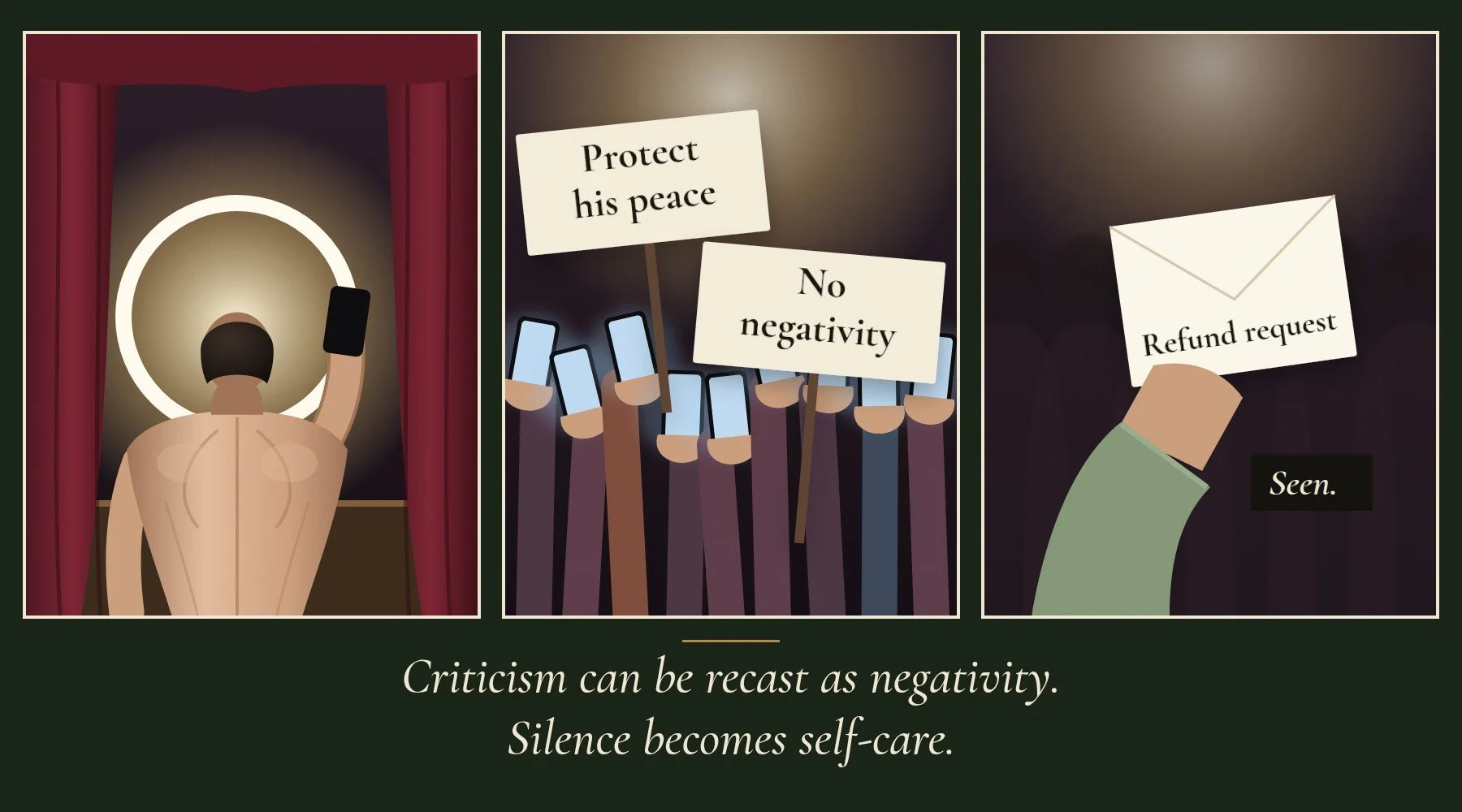
This is one of the protections offered by the creator model. Criticism can be recast as negativity. Avoidance can be presented as maintaining boundaries. Silence becomes self-care. A dissatisfied customer is reduced to an unpleasant message outside the main performance, while the creator returns to an audience that has not seen what happened backstage.
A conventional business cannot always disappear into its own personality. A creator can retreat behind theirs.
The same apparent vulnerability that attracts trust may later become armour. Questioning the service is experienced as questioning the person; holding the person accountable is framed as hostility towards their mental health, identity or “peace”. Wounded ego acquires therapeutic language, and the refund remains outstanding.
Robert had built a brand around becoming the man he wanted to be. The problem arose when other people were expected to finance the construction while absorbing the rubble.
The Moment Before the Payment Link
The practical lesson is not that attractive creators should be distrusted, that online relationships are imaginary or that anybody purchasing coaching has mistaken lust for a business plan.
The useful question is narrower: which part of the offer belongs to the service, and which part belongs to your feelings about the seller?
Remove the body, biography, shared interests and apparent vulnerability. Imagine the same proposition delivered by an unknown person in plain text. Would it remain distinctive? Would the price still make sense? Can the service be described without relying on words such as access, personalised support, community and accountability, all of which sound reassuring while carrying remarkably little freight on their own? In my case, “personalised” had meant a plan copied and pasted to everyone else on his books.
Then examine the private hope attached to the purchase. Would this offer feel as urgent if the creator were less attractive, less familiar or less emotionally significant? Are you purchasing guidance, or also the possibility of being noticed by a person whose attention has become valuable?
There is no shame in the second answer, and research suggests it is far from unusual. Desire, loneliness and admiration are ordinary human forces, not defects exposed during checkout. The shame belongs more properly with business models that cultivate those needs while pretending to sell something emotionally neutral.
Time is useful because the funnel depends upon atmosphere. Close the page. Allow the launch language, limited spaces and personal warmth to cool. Return when the creator looks less like a possible answer and more like a seller whose claims must survive comparison.
The service should be capable of standing without the person posing beside it.
If it cannot, the product may be the person.
Checkout
I paid because the arrangement seemed practical, the creator seemed familiar and my own experience persuaded me that I would recognise a bad service before it could do much damage.
I was wrong on all three counts.
The algorithm had made the introduction appear accidental. His transformation gave the offer a plot. Personal disclosure created the impression that I had seen beneath the surface. Shared interests encouraged me to imagine compatibility, while selective access suggested that payment might turn a one-sided familiarity into something attentive and useful.
The coaching service arrived at the end of this process and inherited every favourable conclusion I had formed about the man.
What happened afterwards showed how dangerous that inheritance could be. A persona designed to attract attention had been mistaken for a person capable of assuming responsibility. The resulting service cost time, physical energy and psychological safety, along with money I was forced to pursue through my bank, while delivering little beyond proof that the public image had no obligation to resemble the private conduct.
The great online coaching con does not always depend on a creator consciously planning every stage. Systems can exploit people through incentives as effectively as individuals can exploit them through intent. Platforms reward visibility, intimacy and constant self-display; audiences reward apparent authenticity; payment tools make monetisation almost frictionless. A personality can become a business before either the creator or the customer has examined what responsibilities that business creates.
Robert may genuinely believe that he helps people. Belief is cheap, particularly when protected from contradiction and accountability. The damage appears in the distance between the story a creator tells about himself and the experience imposed on the person who pays to enter it. Stories like this are seldom heard from both sides, and it is rarely a fair contest: one side has a considerably larger platform than the other, as well as a literal army of followers who may be willing to attack or discredit any accounts that frame that person in a negative light.
His rejection of OnlyFans now seems almost quaint. He feared the reputation attached to selling access to his body, then chose an arrangement in which the same sale could be dressed as care. OnlyFans would at least have told me what I was buying. It would not have pretended that listening to a handsome stranger discuss his masturbation habits was part of a personalised health service.
The sales funnel did not end when I paid. It ended when I stopped believing the man on the screen was evidence for the business behind it.
By then, the payment had been taken, the support had stopped turning up and the personality had returned to his feed, where confidence remained abundant and accountability had apparently been blocked.
Postscript
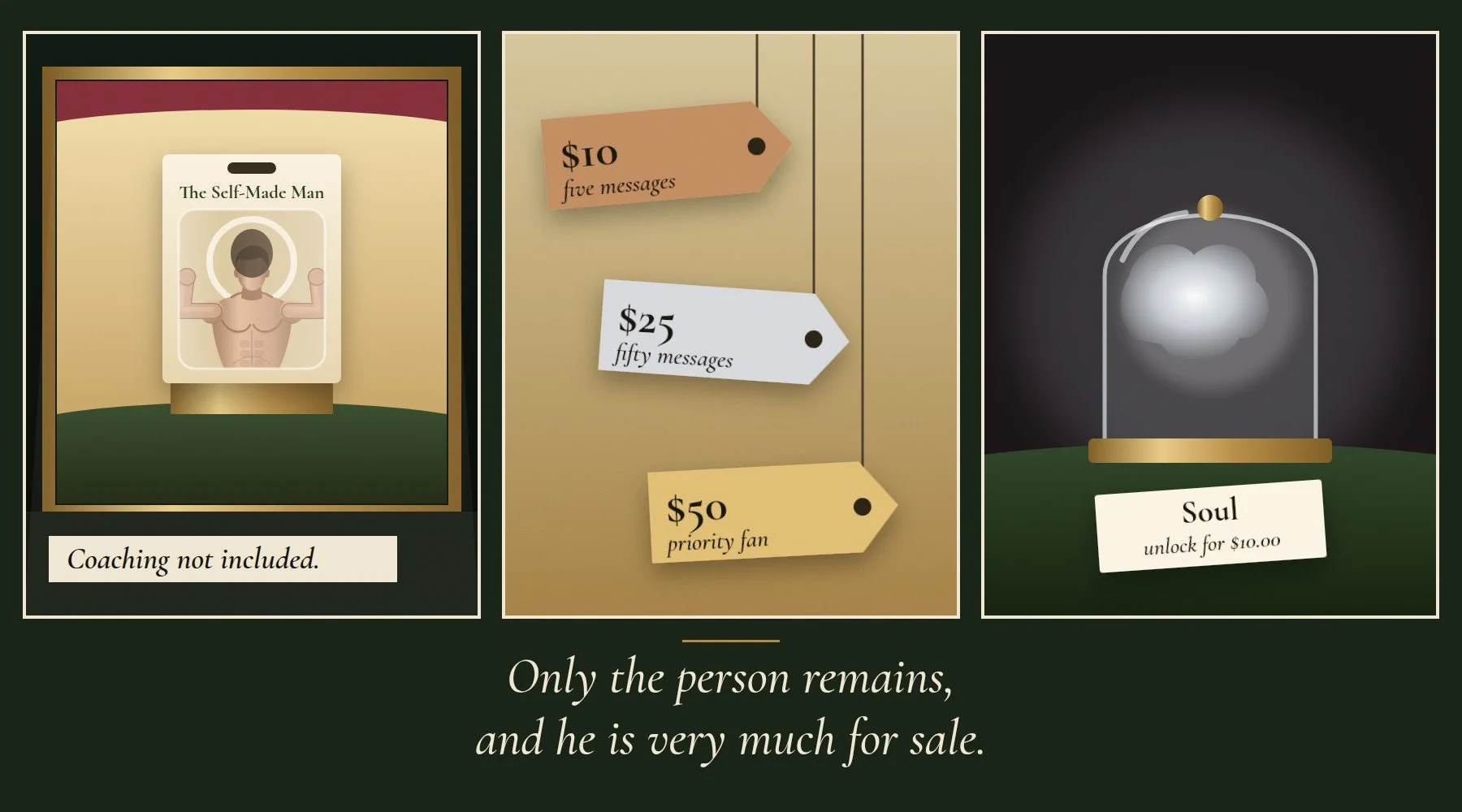
Shortly before publication, while checking my research one final time, I discovered that Robert had found his true calling. He has opened a page on Passes, a subscription platform he now describes as the only place he will answer messages, and conversation with him is now sold by the yard. Ten dollars a month buys five “free” messages; twenty-five buys fifty; fifty buys unlimited messaging and promotion to “priority fan”, a title that once required, at the very least, a laminated card. Individual posts are priced separately, including thirty-three seconds of behind-the-scenes Spider-Man footage for $10, a rate per second that would make a Hollywood studio blush. Fitness content does appear on the menu, wedged between the cosplay sets and “much more”, which feels about right. Presiding over it all is his familiar benediction: he hopes you stay happy and healthy. One suspects he hopes, rather more fervently, that you stay subscribed.
The man who declined OnlyFans to protect his reputation has arrived, with remarkable efficiency, at its partially-clothed cousin: paid access to himself, sold in tiers, the shirt removed only when the occasion demands. His followers’ thirst was always the real market; he has simply fitted a meter to the tap. It is an odd choice for someone who sells self-improvement. Most people, on discovering that their expertise cannot sustain a business, improve the expertise. Robert appears to have cut out the middleman instead, and the middleman was the coaching.
When I was a paying client, my messages were ignored. Replying, it transpires, was never beyond him; it simply had not yet been priced. The service has finally stepped out of the shop window. Only the person remains, and he is very much for sale.
*Names have been changed to protect identities.
Sources
Nah, H.S. (2022) ‘The appeal of “real” in parasocial interaction: The effect of self-disclosure on message acceptance via perceived authenticity and liking’, Computers in Human Behavior, article 107330. https://doi.org/10.1016/j.chb.2022.107330
National Centre for Social Research (NatCen) for HM Revenue & Customs (2025) Research to Understand Social Media Content Creators, HMRC Research Report 852. https://www.gov.uk/government/publications/understanding-social-media-content-creators
Ofcom (2026) Adults’ Media Use and Attitudes Report 2026. https://www.ofcom.org.uk/media-use-and-attitudes/media-habits-adults/adults-media-use-and-attitudes
Sokolova, K. and Kefi, H. (2020) ‘Instagram and YouTube bloggers promote it, why should I buy? How credibility and parasocial interaction influence purchase intentions’, Journal of Retailing and Consumer Services, 53, 101742. https://doi.org/10.1016/j.jretconser.2019.01.011