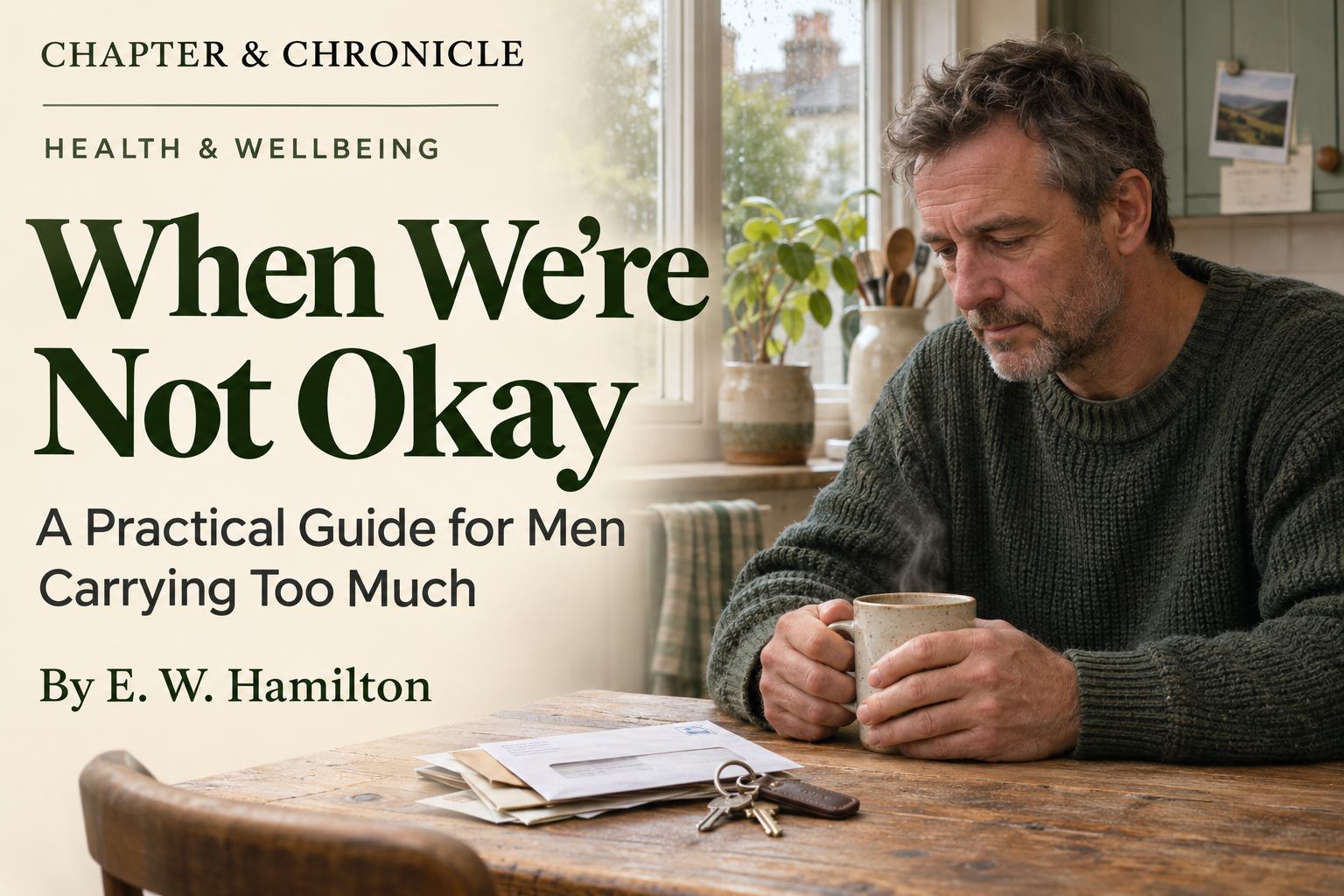
When We're Not Okay: A Practical Guide for Men Carrying Too Much
By E. W. Hamilton
There is a particular kind of man you will recognise, even if you have never met him. He bleeds the radiators, remembers the bins, and carries the shopping in one trip because two would be an admission of something. Asked how he is, he says "not bad"; asked again, he says "fine"; and pressed a third time, he produces a joke so good that everybody forgets the question was ever put. By most visible measures he is coping, and quite often he is also, very quietly, going under.
We have built a culture remarkably skilled at admiring this man and remarkably poor at noticing him. Stoicism is still handed to boys as a kind of birthright, passed down alongside the toolbox and the opinions on football, and the sales pitch is persuasive: endure, provide, say little. What the brochure omits is the cost of carrying all of it without ever setting it down — the debt, the grief, the redundancy, the marriage that ended, the father who never said he was proud, and the long, flat ache of being needed by everyone while being truly known by almost no one.
This article is not a lecture, nor a leaflet in literary clothing. It is a practical companion for men who are carrying too much, and for the people who love them: what the strain looks like, what the body is trying to say, what genuinely helps, and where to turn when the weight becomes more than one person should hold. If you happen to be reading this at two in the morning, you are not the only one awake.
The Arithmetic of Silence
The figures are stark enough to deserve plain telling. In 2025 the Office for National Statistics registered 6,162 suicide deaths in England and Wales, and, as has been the case since the mid-1990s, around three-quarters of them were men. The male rate stood at 17.5 per 100,000, more than three times the female rate, and the highest of all belonged to men aged 50 to 54 — a generation raised, almost to a man, on the very stoicism described above.
Behind those numbers lies a broader pattern of men arriving late to their own care, if they arrive at all. Men in England can expect to live roughly four years fewer than women, and in November 2025 the government published England's first Men's Health Strategy, acknowledging, with the faintly startled air of an institution discovering a draught it has lived with for decades, that men are less likely to seek help and more likely to suffer in silence. Among its commitments are £3.6 million for suicide-prevention projects aimed at middle-aged men in high-risk communities, and closer work with grassroots groups such as Men's Sheds.
None of this is fate. Statistics describe where a road has taken many people; they do not dictate where you must go. The value of knowing them is simply this: if you are struggling, you are neither unusual nor weak, and you are certainly not alone. You are, unhappily, in very large company — and a good deal of help has now been built with you specifically in mind.
How It Shows Itself
Distress in men rarely introduces itself by name. It tends to arrive in disguise, and frequently in costumes that we have been taught to read as character rather than symptom. The man who erupts over a misplaced remote control may not be irritable by nature so much as depressed; the one working sixty-hour weeks may be less ambitious than unable to bear the silence of an evening at home. These are some of the signs worth taking seriously, whether you notice them in yourself or in someone close to you:
Irritability, anger or a fuse that has grown noticeably shorter
Withdrawal from friends, hobbies and conversations that once brought pleasure
Sleeping far too little or far too much, or waking in the small hours with a racing mind
Drinking more, gambling, or reaching for anything that switches thought off
Overworking, or its opposite: a loss of drive that makes ordinary tasks feel immovable
Physical complaints with no clear cause, such as headaches, stomach trouble, a tight chest or a tiredness that sleep does not touch
Recklessness, or a strange new indifference to risk
Feeling like a burden, or talking as though everyone would be better off without you
The last of these deserves particular attention. It is not idle talk to be laughed off over a pint, but one of the clearest signals that someone needs support now rather than later.
The Body Keeps the Ledger
The tidy division between mind and body has always been a convenient fiction, and nowhere does it collapse more completely than in a man under strain. Stress is not merely a mood but a physical state, and the body keeps a meticulous ledger of every unslept night and every swallowed worry. Tending to it is not a distraction from emotional recovery; it is one of the foundations on which recovery is built.
Sleep. Most adults need somewhere between seven and nine hours, and a chronic shortfall makes low mood, anxiety and irritability considerably worse. A consistent waking time, daylight early in the day, a cooler and darker bedroom, and an hour without screens before bed will not solve everything, but they quietly change the conditions in which everything else is fought.
Alcohol. The UK Chief Medical Officers advise that it is safest not to drink more than 14 units a week on a regular basis — roughly six pints of average-strength beer — spread across three or more days, with several drink-free days each week. Alcohol is a depressant that borrows calm from tomorrow at a ruinous rate of interest: it may soften the evening, yet it deepens anxiety and fractures sleep in the early hours. If you find you cannot easily cut down, that is well worth raising with your GP.
Movement. The same guidelines recommend 150 minutes of moderate activity a week, or 75 of vigorous activity, alongside strength work on at least two days. It sounds forbidding until you translate it into a brisk twenty-minute walk on most days. Movement is among the best-evidenced supports for mood, and it carries the added advantage, for many men, of not requiring anyone to discuss their feelings while doing it.
Checks. Men are famously reluctant patients, inclined to regard the GP surgery as a building to be entered only under escort, yet several checks are free, quick and genuinely protective. If you are between 40 and 74 and have no existing heart, kidney or diabetic condition, you are entitled to an NHS Health Check every five years, a twenty-to-thirty-minute "midlife MOT" that looks for early signs of heart disease, stroke, type 2 diabetes and kidney disease, many of which have no symptoms at all. About one in eight men in the UK will be diagnosed with prostate cancer, and the risk rises to around one in four for Black men, as it does for men over 50 and those whose father or brother has had it; Prostate Cancer UK's online risk checker takes thirty seconds. Testicular cancer, meanwhile, is the most common cancer in men aged 15 to 49 and one of the most treatable when caught early, so a monthly self-check, ideally after a warm bath or shower, is two minutes very well spent.
Small Acts of Repair
Recovery is seldom a single dramatic turn. More often it is a series of modest, unglamorous acts, repeated until they become a kind of scaffolding. The NHS sets out five evidence-based steps to mental wellbeing — connect with other people, be physically active, learn new skills, give to others, and pay attention to the present moment — and they work precisely because they are humble enough to fit into an ordinary Tuesday. In practice, they might look something like this:
Name it, even privately. Three lines written at the end of the day about how you actually feel, rather than how you are performing, loosen the grip of thoughts that otherwise circle unexamined.
Shrink the task. When everything feels immovable, choose the smallest possible version of it: not "sort out the finances" but "open one letter". Momentum is built from very small stones.
Keep one appointment with daylight. A walk before ten in the morning helps to set the body clock and lifts mood more reliably than most things sold in bottles.
Make something with your hands. Cooking, woodwork, gardening or fixing a bike steadies the mind and offers that rare, honest satisfaction of a thing visibly done.
Ration the feed. Doomscrolling is an endless buffet of other people's outrage and other men's apparently flawless lives; set limits, and notice how you feel after an hour on particular apps.
Give something away. Volunteering, helping a neighbour or teaching a skill restores a sense of purpose, which is one of the most potent antidotes to the feeling of being a burden.
Write a plan for bad nights. A short note on your phone listing what helps, who you can call and the numbers at the end of this article means you need not think clearly at the very moment you are least able to.
Saying It Out Loud
For many men, the hardest sentence in the English language is not a declaration of love but the plain admission that they are not okay. It helps to know that it need not be delivered across a kitchen table beneath a bare bulb. Men often talk best side by side rather than face to face — on a walk, in the car, on a riverbank, or with their hands busy on some shared task — and there is no shame whatever in choosing whichever setting makes the words possible.
When you are ready to speak to a professional, your GP is a sensible first port of call, and you can be entirely direct: "I've been feeling low for a while and I'd like some help." You do not have to wait until things are unbearable. In England you can also refer yourself to NHS Talking Therapies without seeing a GP first. These free, confidential services offer evidence-based treatments such as cognitive behavioural therapy and counselling for depression, anxiety, stress, panic and post-traumatic stress, delivered in person, by phone, online or through guided self-help.
Peer support offers something different, and for some men it is the door that finally opens. Andy's Man Club runs free, confidential talking groups for men over 18 every Monday at 7pm, except on bank holidays, in hundreds of locations across the UK and online, and you can simply turn up. Men's Sheds offer a gentler route still: community workshops where men gather to make, mend and drink a heroic quantity of tea, and where conversation tends to arrive sideways, at precisely the moment nobody was looking for it.
When It Cannot Wait
If you are thinking about ending your life, or are worried that you might act on thoughts of harming yourself, please reach out now. A mental health emergency is as serious as any other, and you will not be wasting anyone's time.
If you are in immediate danger or have already harmed yourself, call 999 or go to A&E.
In England and Wales, call NHS 111 and choose option 2 to speak to a trained mental health professional, 24 hours a day; in Scotland, call NHS 24 on 111.
Call Samaritans free on 116 123, at any hour of the day or night, or email jo@samaritans.org.
Call CALM on 0800 58 58 58, or use its webchat, from 5pm to midnight every day of the year.
Text SHOUT to 85258 for free, confidential support by text, 24 hours a day.
If you cannot make the call yourself, someone else can make it for you; a partner, friend, carer or even your GP can ring 111 on your behalf.
For Those Who Love Him
If you are worried about a partner, son, brother, father or friend, you do not need perfect words, only the willingness to ask and then to listen. Ask twice, because "How are you, really?" carries far more weight on the second asking, once the reflexive "fine" has been spent. Choose a moment without an audience, and resist the very natural urge to fix things, since most people need to be heard before they can be helped.
It is safe to ask someone directly whether they are thinking about suicide. Asking does not put the idea into anyone's head; more often it brings relief, because a secret that has been carried alone no longer has to be. If the answer is yes, stay with them, help them contact one of the services above, and, where it is safe to do so, remove anything they might use to hurt themselves. Samaritans also offer guidance for anyone supporting someone they are worried about, and you are welcome to call them on your own account. Carrying another person's weight is heavy work, and you deserve support while you do it.
A Different Kind of Strength
We have spent a very long time telling men that strength means carrying everything and saying nothing. It is a story with a certain rugged poetry, and it has buried a great many good men. Perhaps it is time for a better one, in which strength belongs to the man who notices the weight, names it and lets someone help him lift it; who books the check-up, takes the walk, sits in the circle on a Monday night, and finally makes the phone call he has been putting off for months.
None of us were built to carry the world alone. Set some of it down, because the people who love you would far rather share the load than lose the man beneath it.
Resources and References
Urgent support
NHS 111, option 2 (England): 24-hour urgent mental health support from trained professionals. Call 111 and press 2.
Samaritans: free, confidential listening, 24 hours a day, 365 days a year. Call 116 123 or email jo@samaritans.org. samaritans.org
CALM (Campaign Against Living Miserably): helpline and webchat, 5pm to midnight daily. Call 0800 58 58 58. thecalmzone.net
Shout: 24-hour crisis text line. Text SHOUT to 85258. giveusashout.org
NHS: Help for suicidal thoughts: what to do and who to contact. nhs.uk/suicidal-thoughts
Talking, therapy and peer support
NHS Talking Therapies: free therapy for anxiety, depression and stress, with self-referral in England. nhs.uk/talking-therapies
Andy's Man Club: free peer-support groups for men over 18, every Monday at 7pm. andysmanclub.co.uk
UK Men's Sheds Association: find a local Shed or start one. menssheds.org.uk
Mind: information and support on mental health, including how to help someone else. mind.org.uk
Hub of Hope: a directory of local and national mental health support, searchable by postcode. hubofhope.co.uk
Men's Health Forum: plain-speaking health information written for men. menshealthforum.org.uk
NHS: 5 steps to mental wellbeing. nhs.uk/five-steps
Physical health
NHS Health Check: free check for adults aged 40 to 74 in England. nhs.uk/nhs-health-check
Prostate Cancer UK risk checker: thirty seconds, three questions. prostatecanceruk.org/risk-checker
NHS: Testicular cancer: symptoms and how to check. nhs.uk/testicular-cancer
UK Chief Medical Officers' low risk drinking guidelines. gov.wales (PDF)
UK Chief Medical Officers' physical activity guidelines. gov.uk
References
Office for National Statistics, Suicides in England and Wales: 2025 registrations. ons.gov.uk
Department of Health and Social Care, Men's Health Strategy for England (19 November 2025). gov.uk
Department of Health and Social Care, Men's health: a strategic vision for England, equality impact assessment (life expectancy figures). gov.uk
Prostate Cancer UK, Barriers to Action (lifetime risk figures). prostatecanceruk.org
If this article has stirred something difficult, please be gentle with yourself, and reach out to one of the services above. You do not have to be in crisis to deserve a conversation.