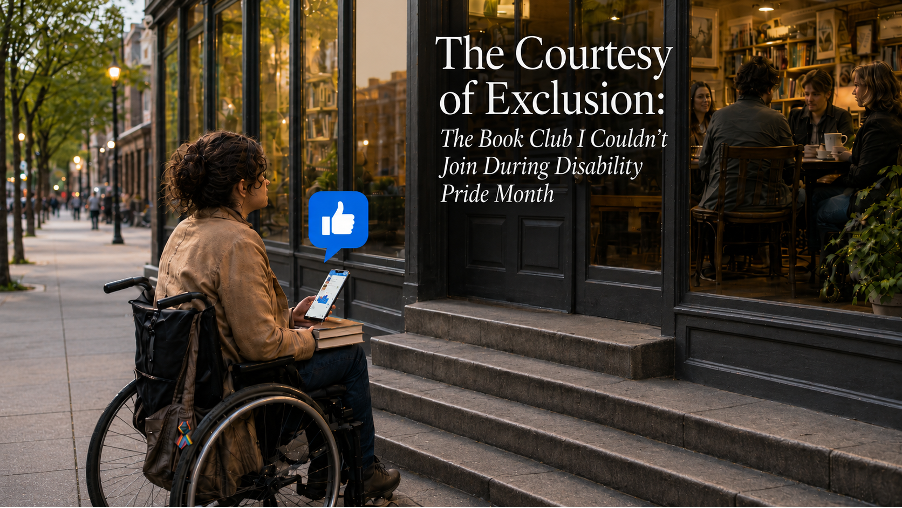
The Courtesy of Exclusion
What a Local Book Club Taught Me About Access
By Iris Bell
A local book club should be one of the least complicated forms of belonging: a room, a book, a few people willing to talk. Yet for many disabled people, even this modest invitation depends on whether access is treated as part of the welcome or as an optional favour.
The Like Beneath the Door
The first thing I felt was ordinary hope, which is always more embarrassing afterwards. A local book club had appeared in my feed with the soft promise these things carry: a room of people, probably a little awkward at first, united by the private habit of reading in public. There would be books, conversation, perhaps bad coffee in a chipped cup, the strange relief of sitting among people who also notice sentences. It sounded small enough to be possible.
For many disabled people, opportunities like this do not arrive often, and when they do, they carry a disproportionate weight. Community spaces are so frequently inaccessible—physically, socially, structurally—that the idea of something as simple as a book club can begin to feel like a rare opening rather than an ordinary part of life. You learn to scan for possibility in places others take for granted. You learn to hope carefully, because hope itself can be costly.
When something appears that might work, even tentatively, it becomes something to hold onto. Not just the event itself, but what it represents: a chance to belong without explanation, to participate without negotiation, to exist in a space that does not immediately place your body or your needs at odds with its design. That hope is not naïve. It is built from experience, from knowing how often the answer is no, or silence, or something softer that amounts to the same thing.
So you reach out. You explain. You ask the questions you have learned to ask, even when asking them feels like exposing yourself to dismissal. You try to make it easy for people to understand, to respond, to adjust. You offer solutions. You make yourself legible.
And then, sometimes, you are told that your concerns will be considered. That alternative venues might be explored. That accessibility matters. The language is reassuring enough to keep hope alive a little longer.
Until the next event is announced, and it is in the same place. The same inaccessible venue. The same barriers, unchanged. The same quiet message, now unmistakable: you were heard, but not enough to matter.
It is difficult to convey the particular kind of disappointment that follows. Not just because the space remains inaccessible, but because the exclusion has been confirmed as a choice. Whether through indifference, inconvenience, or a simple unwillingness to adapt, the result is the same. You are not included. Not really. Not in any way that requires effort from others.
Moments like this shrink the world. They take something that briefly felt possible and fold it back into the familiar limits. It is not only the loss of one evening, one group, one conversation. It is the accumulation of these moments that begins to shape how you move through the world, how often you try, how much you expect.
There is a particular sadness in being excluded not by distant systems or faceless institutions, but by people who might otherwise be your community. People who share your interests, your neighbourhood, your language. People who could have made space, and chose not to.
Inclusion, when it happens, can feel quietly transformative. It can restore a sense of proportion to the world, make it feel wider, more navigable, more human. Exclusion does the opposite. It narrows everything. It leaves you standing outside something that was never quite meant for you, even when it said it was.
And the hardest part is knowing how little it would have taken to change that.
Small hopes are not small when your life has trained you to measure every invitation against the body. Before excitement can become a plan, it has to pass through logistics. Where is it? How do you get in? Is there step-free access? Are the toilets usable? Is the route manageable? Is there somewhere to sit that will not punish you for staying? What will the lighting, noise, distance, timing, transport, weather, and aftermath cost? A non-disabled person may read “book club” and imagine whether they have time to finish the novel. A disabled person may read the same words and begin, quietly, to calculate whether attendance will require pain, humiliation, risk, or pleading.
The Venue for the local book club’s monthly meeting was not suitable. I had checked, assessed, phoned, and communicated all of this. That was the blunt fact underneath the softer disappointment. I looked at the details, checked what I could, and realised that the space would exclude me before anyone had even taken a chair. I did what disabled people are so often told to do: I messaged the organiser. I explained carefully, more carefully than should be required, why the venue was a problem. I tried to be constructive rather than accusatory. I addressed the group directly and in good faith, naming the access barriers and suggesting that other venues might make it possible for disabled people to attend.
There is a particular kind of self-editing that happens when you ask for access. The message must not sound angry, though anger would be proportionate. It must not sound demanding, though access is not indulgence. It must be precise, grateful, patient, readable, and emotionally house-trained. You learn to make the case for your own presence in a tone that will not frighten the room.
The Messages Before the Silence
Before I said anything publicly, I reached out privately. That is worth mentioning. Disabled people are often accused of making things difficult, of embarrassing people, of calling out what could have been handled quietly. So I did try quietly first. I wrote with care, trying to make the issue legible without making it feel like an attack.
“Hi! I hope you’re doing well.
I just wanted to ask a quick question about the venue for the book club. I was wondering if the meeting location is likely to change in the future, or if it’s planned to stay at the current venue long term?
Unfortunately, because of my health conditions, the current venue isn’t accessible enough for me, so I wouldn’t be able to attend safely. It would be wonderful if future meet-ups were sometimes held somewhere more accessible as it would make it possible for people with physical disabilities like me to join in.
If the venue isn’t likely to change, I was also wondering whether there might be any possibility of making an exception to allow me to attend with my carer? My carer is male, and I completely understand that the group is intended to be women-only, so I appreciate this may not be possible. I just wanted to ask, as I wouldn’t be able to attend without his support and sadly the current venue isn’t particularly suitable for those who are disabled.
I’d absolutely love to be part of the group if there’s any way to make it work, but I also understand if plans have already been decided or if exceptions can’t be made.
I’d really appreciate any update or advice you can offer. Thank you so much for your time, and I hope to hear from you 🙏”
It was not a hostile message. It was almost painfully careful. I had already softened the facts before handing them over. I had explained that the venue was not accessible enough for my health conditions, that I could not attend safely, that a more accessible venue would allow disabled people like me to take part. I had also raised the possibility of attending with my carer, while acknowledging the group’s women-only structure and the possible difficulty that might create. Even here, asking for access meant anticipating someone else’s discomfort before my own exclusion had been addressed.
The organiser replied warmly.
“Hi
Thank you so much for your message
It will likely change yes, because I have a connection with the forge this is the only reason we chose this. Absolutely we would never consciously exclude anyone, but absolutely your carer can come along to any of the meets ups, this is the first meet up so didn’t know how popular it would be, but would love for you to come along to the next one so will definitely think about this in the future. I can only apologise that you miss out on today x”
At the time, I took this in good faith. The venue would likely change. They would never consciously exclude anyone. My carer could come. They would think about it in the future. It was the kind of reply that allows hope to continue. Not certainty, perhaps, but enough to make you feel that the conversation has been heard rather than merely received.
So I replied with gratitude.
“Thank you so much for such a lovely reply. ❤️ I really appreciate you taking the time to respond and for being so understanding.
That all makes complete sense, especially for a first meet-up. It’s lovely to hear that the venue will likely change in the future, and thank you so much for being happy for my carer to come along as well. That really means a lot to me.
I won’t be able to access today’s meet up but I absolutely look forward to the next 😊
Please don’t apologise—I completely understand why you chose the venue, and I know accessibility isn’t always something that’s obvious until someone raises it. I really appreciate how open you’ve been to the feedback and your willingness to consider it for future meet-ups. It’s really a breath of fresh air compared to some previous experiences 😅
I’m really looking forward to hopefully joining everyone at a future book club. I hope today’s meet-up goes brilliantly and that it’s the first of many successful ones! 🥰📚
Thank you again for creating this group x”
Looking back, what strikes me is not only what I asked for, but how hard I worked to make the ask comfortable. I reassured them that I understood. I praised their openness. I thanked them for creating the group. I made myself smaller around the inconvenience, as disabled people are so often trained to do. The message contains genuine gratitude, but also the familiar choreography of self-protection: be kind enough, reasonable enough, appreciative enough, and perhaps the door will stay ajar.
There was no further private reply.
I then raised the issue publicly, partly because access is rarely only personal. If I was struggling to work out whether I could attend, someone else might be too. Public access information helps people who do not have the energy, confidence, privacy, or safety to ask. It also prevents accessibility from becoming a private negotiation between one disabled person and one organiser, conducted quietly enough that nothing structural has to change.
My public message said:
“This looks like such a lovely group, and I’d really love to join. I just wanted to ask whether the venue is likely to change for future meet-ups, or if it’s expected to stay the same?
Unfortunately, I can’t attend at the current venue because it’s not accessible enough for my disability and health conditions. As it’s Disability Pride Month, it felt like a good opportunity to highlight how much a more accessible venue could help make the group welcoming to everyone who wants to be involved.
If the venue is staying the same, would it be possible to make an exception to allow me to attend with my carer? My carer is male, and I completely understand that this is a women-only group, so I appreciate that may not be possible. But I simply wouldn’t be able to attend this venue without his support.
I’d really love to be part of the book club so if there’s a way to make it work so it’s accessible to everyone, I’d be very grateful for any information or advice.
Thank you so much.”
Again, the language was careful. I did not accuse. I did not demand. I linked the issue to Disability Pride Month, not as decoration, but because awareness without access is a strange kind of public performance. I asked whether the venue would change. I explained that I could not attend. I asked whether my carer could come if the venue stayed the same. Beneath the softness of the wording was the actual problem: the group existed, the invitation was public, but the space selected for it made attendance impossible.
The group responded:
“Hi Rita* We are looking at running these meetings monthly and some of these will be at The Forge. We have spoken with the venue and they have advised they are accessible friendly and next time, we can even host downstairs - if that may help? The manager is also more than happy if you wish to call him with any accessible queries. We look forward to meeting you in the future 😊”
There is a sentence in that reply that reveals a common failure in how access is handled: “the venue advised they are accessible friendly.” It sounds reassuring until you have lived inside the gap between a venue’s description of itself and the reality of arriving in a disabled body. “Accessible friendly” is not the same as accessible. It is not a measurement, an audit, a route description, a guarantee, or a commitment. It is a mood wearing a lanyard.
The offer to host downstairs might have solved one narrow part of the problem, but access is not a single switch. A downstairs room does not answer questions about parking, drop-off points, pavements, entrance thresholds, temporary ramps, gradients, safe independent entry and exit, toilets, seating, distance, fatigue, dignity, or whether a person can arrive without having to negotiate their body through a sequence of improvisations. Nor does suggesting that a disabled person call the manager shift the burden in the right direction. Disabled people already do that labour constantly. We phone ahead. We ask the awkward questions. We compare photographs. We read reviews for clues. We translate vague assurances into risk assessments. We decide whether the outing is worth the possible consequence.
So, I replied publicly with more detail:
“@DD&ML Book Club* Thank you so much for your reply, I really appreciate that you’ve taken the time to look into it and that you’re thinking about accessibility. It genuinely means a lot.
One thing I’d like to mention, though, is that ‘accessible’ can mean very different things in practice. As disabled people, we’re often told a venue is accessible, but unfortunately that doesn’t always reflect the reality when we arrive.
I actually contacted the venue beforehand (something many of us routinely do), and after discussing the layout it became clear that it wouldn’t be suitable for my access needs. It’s not just about whether there’s an accessible toilet or whether an event can be moved downstairs. Things like suitable parking and availability of drop-off points, the route into the building, quality and angles of pavement, steps at the entrance, whether temporary ramps are needed, and whether someone can enter and leave independently all make a huge difference.
For many disabled people, accessibility isn’t simply about being able to get inside with assistance—it’s about being able to access the space safely, with dignity and independence. Having to ask for a ramp or rely on someone else every time we enter or leave can itself be a barrier.
I completely understand this is your event but I really appreciate your willingness to consider accessibility for future meet-ups. I just wanted to share my perspective because venues are often described as ‘accessible’ when, in reality, they only meet some access needs rather than being genuinely inclusive.
I’d still love to come along in the future if there’s a venue that’s a better fit, as the group sounds wonderful. 💜
#DisabilityPrideMonth”
This was the point at which the issue could no longer be misunderstood as a simple question about a downstairs room. I had explained that I had contacted the venue myself. I had named the practical barriers. I had distinguished between partial access and genuine inclusion. I had explained that being helped into a building is not the same as being able to access it safely, independently, and with dignity.
That last distinction matters. Disabled people are often expected to accept access on humiliating terms: someone will fetch a ramp, someone will open a side door, someone will move a chair, someone will help you over the awkward bit, someone will escort you through the staff entrance past the bins. These arrangements are sometimes necessary, and many disabled people use assistance without shame. But assistance becomes a problem when it is used to disguise a building’s failure. Independence is not vanity. Dignity is not fussiness. Safety is not a preference.
After that message, there was no substantive public reply. There was no further private reply either. There was only a like. Less than two days later, the next meeting was announced at the same venue I had explained I could not access.
This is why the decision felt exclusionary. Not because I imagined malice. Not because every organiser is expected to know every access need in advance. The exclusion lay in the sequence. A disabled person raised a barrier privately and was reassured that the venue would likely change. She responded with gratitude and hope. She then raised the issue publicly in case others needed the information too. She explained in detail why the venue’s version of accessibility did not match the reality of her needs. The group acknowledged the comment, offered no meaningful response, and then continued with the same venue.
At that point, the barrier was no longer accidental in any meaningful sense. Once a group has been told that its chosen venue excludes someone, continuing without engagement is a choice with consequences, even if nobody involved thinks of themselves as unkind. Intent matters morally, but impact determines whether a door opens. A person can be pleasant, apologetic, even well-meaning, and still participate in exclusion by leaving the structure exactly as it is.
That is the quiet violence of access being treated as optional. The disabled person does the labour of explanation, offers the emotional cushioning, absorbs the disappointment, and watches the event proceed as if the conversation never happened. The group remains able to say it would never consciously exclude anyone. The inaccessible venue remains booked. The disabled person remains outside.
At first, there was a response, though it felt more like a deflection than a genuine attempt to engage. They said the venue had assured them it was accessible, and suggested that the meeting might be moved downstairs if needed. It carried the implication that the issue had already been considered and resolved. I replied with a more detailed explanation, outlining why those assurances did not match the reality of the space and why those adjustments would still leave it inaccessible. I tried again to describe what genuine inclusion might require, grounding it in the practical barriers I would face.
After that, the conversation stalled. The final response came as a like. There was no reply to my follow-up message, no further questions, no indication that what I had said had been taken seriously. Instead, there was only a like beneath my comment, a small gesture that acknowledged receipt without offering any response. The following day, another event was announced at the same inaccessible venue, without explanation, apology, or any recognition of the concerns raised.
The like sat beneath the comment like a paperweight on a letter nobody intended to answer.
When Exclusion Has Good Manners
It would be easier, in one sense, if exclusion always announced itself plainly. A slammed door has the virtue of honesty. Much of the exclusion disabled people encounter is more polished than that. It comes with friendly branding, community language, smiling photographs, and the vague assurance that everyone is welcome. It does not always say “you cannot come.” Sometimes it says nothing at all, having noticed the problem and decided that silence will be administratively simpler.
This is where the harm becomes difficult to explain to people who have never had to ask whether a room will accept their body. The injury is not only that one event remains inaccessible. It is the sequence: the hope, the checking, the asking, the careful disclosure, the public vulnerability, the acknowledgement without action, the repetition of the same barrier. By the end, the disabled person is left holding both the practical exclusion and the emotional labour of having tried to prevent it.
In the UK, this is not a marginal issue affecting a tiny handful of people outside ordinary community life. The Family Resources Survey for 2024 to 2025 classified one in four people in the UK as disabled, around 16.7 million people. The same survey uses the Equality Act 2010 definition of disability: a physical or mental impairment with substantial and long-term negative effects on normal daily activities.
The scale matters because it exposes the absurdity of treating accessibility as a special request made by an unexpected visitor. Disabled people are not rare exceptions to public life. We are readers, neighbours, parents, workers, artists, friends, volunteers, commuters, insomniacs, unpaid carers, and people trying to join a book club on an evening when the weather is tolerable and the body has not already spent the day’s allowance. When a community group does not think about access, it is not forgetting a theoretical minority. It is designing ordinary life around a fiction.
The Equality and Human Rights Commission describes the duty to make reasonable adjustments for service providers as “anticipatory,” meaning providers should think ahead about disabled customers with different access needs, rather than waiting for a known disabled person to struggle. It also states that where a disabled person is placed at substantial disadvantage, reasonable steps may include changing practices, removing or avoiding physical features, or providing auxiliary aids. Government guidance for service providers puts the point in plainer terms: organisations should not wait until a disabled person experiences difficulty, because by then it may be too late to make the necessary adjustment.
A local book club may not think of itself as part of this larger architecture of access. It may see itself as informal, friendly, under-resourced, volunteer-led. Those things may be true. They do not make exclusion evaporate. The disabled person left outside does not experience the inaccessible venue as informal. They experience it as another locked door with a pleasant poster.
The Room as a Test
The social model of disability helps explain why these moments cut so deeply. The Office for National Statistics has described this model as understanding disability through the disadvantage or restriction of activity caused by aspects of society that take little or no account of people with impairments. In other words, the problem is not simply the disabled body. It is the meeting between that body and a world built as if it will never arrive.
This does not mean impairment is imaginary or that pain, fatigue, sensory distress, mobility limitations, cognitive load, illness, anxiety, or fluctuating capacity can be wished away by better architecture. Disabled people know the reality of our bodies too intimately for slogans. The point is sharper than that. A body may have limits; society decides how often those limits become exile.
A book club is an unusually revealing setting because it looks so harmless. It is not a hospital appointment, a benefits assessment, a tribunal, or a workplace negotiation. It is leisure, culture, companionship: the kind of life people are meant to have beyond survival. That is exactly why access matters there. Disabled people are often granted concern in medical contexts while being quietly denied participation in pleasure. We are allowed to be patients, cases, claimants, service users. We are less reliably imagined as people who might want to talk about a novel with strangers and go home feeling slightly more human.
This is one reason inaccessible social spaces can feel so bleak. They do not merely block an activity; they narrow the imagination of a life. After the book club carried on without changing venue, I did not simply think, “That group is inaccessible.” I felt the old arithmetic return. Perhaps this is what happens when you try. Perhaps other groups will be the same. Perhaps the cost of asking will exceed the possible reward. Perhaps it is safer to stay with books that do not require a doorway.
Many disabled people recognise that withdrawal. It is not always dramatic. It can happen quietly, event by event, after one too many messages ignored, ramps absent, toilets unusable, lifts broken, chairs unsuitable, websites vague, emails unanswered, assumptions made. Eventually, the body learns not only where it cannot go, but where it is tired of asking to go.
The evidence bears out what disabled people often know long before statistics arrive. ONS analysis found that disabled people in England were more than four times as likely as non-disabled people to report feeling lonely “often or always” in the year ending March 2021: 15.1% compared with 3.6%. Disabled people who were limited a lot in day-to-day activities were especially likely to report loneliness. A peer-reviewed UK study using Understanding Society data found persistent loneliness among 46.4% of respondents with disabilities, compared with 22.2% of respondents without disabilities.
These numbers should not be used to turn disabled people into objects of pity. They should make indifference harder to defend. Loneliness is not an unfortunate mist that happens to descend on disabled lives. It is often produced by systems, habits, buildings, transport failures, poverty, stigma, inaccessible communication, and the cumulative discouragement of being told, politely or otherwise, that participation is conditional.
Acknowledged Without Being Accommodated
There is a phrase that should exist for the experience of being noticed just enough to be dismissed. The like on my comment did not deny the access issue. In some ways, that made it worse. It confirmed that the message had reached the room. Someone had seen it, understood at least that a response was expected, and chosen the gesture that required least change.
This is one of the more sophisticated forms of contemporary exclusion. It borrows the appearance of care while refusing the inconvenience of care. It allows the non-disabled organisation, group, venue, or individual to feel responsive without becoming responsible. The disabled person is acknowledged, and the structure remains intact.
The Cabinet Office’s 2025 thematic report on disability, loneliness, and relationships found that disabled people face barriers that can make it hard to establish and maintain relationships, leading to isolation and loneliness. It also noted that disabled people are regularly made to feel like “an other” by social perceptions, and that their preference for socialising can matter less than whether they can access social opportunities in the first place. That last point is devastating in its simplicity. Choice becomes ornamental when the available options are built elsewhere.
The same report suggests that legislative protections and conventions promote rights, while lived realities often diverge sharply. This gap between principle and practice is where many disabled people live. On paper, access is a right. In daily life, it is frequently treated as a favour, a complication, a budget problem, a shame-faced afterthought, or a task for the disabled person to manage with enough politeness.
The World Health Organization estimates that about 1.3 billion people, or 16% of the global population, experience significant disability, and its health equity work calls for disabled people to be empowered and included, with outcomes monitored rather than assumed. That global framing matters even in a small local story, because exclusion is rarely only local. The same pattern repeats across cafés, classrooms, theatres, workplaces, faith spaces, gyms, galleries, festivals, libraries, transport networks, and community groups: disabled people are invited in theory, then left to discover the conditions in practice.
Access Is Cultural Before It Is Technical
Accessibility is often treated as a technical problem: ramps, doors, toilets, captions, seating, lighting, parking, websites, microphones, quiet space, transport links. These details are necessary. They are also only part of the matter. Access begins earlier, in the imagination of the organiser. Has anyone asked who might want to come? Has anyone considered that “everyone welcome” is meaningless if the venue says otherwise? Has anyone made access information visible before a disabled person has to disclose themselves? Has anyone budgeted for inclusion as part of the event rather than as an emergency repair?
There are practical steps that would change the texture of these encounters. A group can choose accessible venues by default, publish clear access details, ask venues specific questions rather than relying on vague assurances, offer hybrid or online participation where possible, rotate locations if one place excludes some people, and respond seriously when someone names a barrier. It can treat an access request as useful information rather than personal inconvenience. It can remember that disabled people should not have to audition for empathy.
NICE guidance on community engagement stresses that approaches to health and wellbeing should reduce inequalities, involve communities, and make participation as easy as possible. NICE also recognises that group and one-to-one activities can help prevent loneliness and social isolation, particularly where people are offered a range of activities likely to meet different needs and interests. NHS England Digital notes that persistent and prolonged loneliness is associated with adverse effects on wellbeing and health, including poorer mental health.
None of this means a book club must become a clinic, or that every awkward social disappointment should be medicalised. It means belonging has health, civic, and human consequences. A reading group is not just a reading group when it is one of the few available routes into community. A venue choice is not just a venue choice when it decides whose loneliness will be interrupted and whose will be confirmed.
For disabled people, the question is rarely only “Can I attend?” It is also “What will it cost me to try?” The cost may be physical pain, days of recovery, financial strain, sensory overload, transport anxiety, exposure to infection, loss of dignity, or the familiar embarrassment of becoming the problem in a room that was already the problem. Sometimes the cost is smaller and more poisonous: the knowledge that people were willing to let you disappear rather than move chairs, change rooms, answer properly, or plan ahead.
After the Unanswered Invitation
I did not join the book club. The meetings continued, presumably with their familiar rituals: coats on chair backs, someone arriving late, someone apologising for not finishing the book, someone sharing a new story or series they had discovered, someone making a perceptive comment and then ruining it slightly with the word “relatable.” Life went on in the inaccessible room. That is the part people underestimate. Exclusion does not require a dramatic scene. It often leaves no mess for those inside. The event happens. The group survives its own failure without visible injury.
Then I saw the photograph.
It was an ordinary photograph, which made it worse. A table, a cluster of women, drinks gathered between them, faces turned towards one another in the small brightness of a successful evening. There was nothing cruel in the image. No one was pointing at the absence just outside the frame. No one looked triumphant. They simply looked happy and comfortable, which is sometimes the part that hurts most: the ease of people for whom access has never interrupted the shape of an event and how easy they forget about those who have.
By then I had already seen that the next meeting had been booked at the same venue. The photograph arrived with that knowledge attached to it. I looked at a group of like-minded women enjoying the kind of social life I had been trying, very carefully, to reach. Books on the table, conversation moving without me, the room warm and available to those whose bodies could meet its terms. I do not know whether anyone thought about the person who had asked to be included. Perhaps they did for a moment. Perhaps the thought passed quickly, as inconvenient thoughts often do, and then everything carried on.
What settled in me was not only sadness, but a particular loneliness that feels almost physical. It was the sense of being outside more than one room. Outside the venue, yes, but also outside the casual world in which people can make plans without translating their needs into public evidence. Outside the ease of arriving. Outside the assumption that community will make room.
I kept thinking about how simple the choice must have seemed from inside the group. Keep the venue that worked for the people already able to come. Avoid the complication. Let accessibility remain a future intention, soft enough to mention and distant enough not to disturb anything. It is easier, perhaps, to build a social life around the bodies that require no adjustment. Easier to call that normal. Easier to let the person outside become theoretical again.
That is what hurt. Not only that I missed a book club, but that I could see the life I had hoped to join continuing perfectly well without me. The conversation had happened. The chairs had been filled. The next date had been set. The world had not paused to notice the person it had left at the threshold.
Outside the room, something else happens. Hope becomes more cautious. The next invitation is examined with less innocence. The next group is approached, if at all, with a smaller expectation of being met. This is how public life contracts around disabled people: not always through open cruelty, but through the repeated discovery that other people’s convenience has more institutional power than our presence.
Still, I do not want to end by making withdrawal sound inevitable. Disabled people have always made culture, community, language, humour, politics, art, kinship, and care in the gaps left by inaccessible systems. We build side doors when front doors fail; we organise online when rooms refuse us; we share access information like contraband; we warn each other about venues; we make jokes so dry they could be stored in a museum drawer. There is ingenuity here, but it should not be romanticised. Resilience is not a substitute for a ramp.
The more useful hope belongs with responsibility. If you run a community group, access is part of the work, even when the group is small. If you host events, your venue is part of your message. If someone tells you they cannot enter, the minimum response is not sympathy, and it is certainly not a like. It is a conversation followed by action. Ask what would help. Say what you can change. Be honest about what you cannot change yet. Look for alternatives. Put the burden where it belongs: on the structure, not on the person already kept outside it.
Disability awareness cannot remain a calendar date, a caption, a lanyard, or a paragraph on a website. Awareness that does not alter behaviour becomes another form of decoration. Accessibility is where awareness either becomes real or quietly admits that it was mostly aesthetic.
I still love the idea of a book club. I like the stubborn intimacy of people gathering around pages, bringing their private weather into a shared room. I like the possibility that a sentence can make strangers briefly less strange. That is what I wanted: not special treatment, not applause for turning up, not a miniature ceremony of inclusion. Just a place at the table, a route through the door, and the ordinary dignity of being expected.
Somewhere, perhaps, there is a room where that is already understood. The chairs are movable. The access information is clear. The organiser answers properly. The book is lying open, face down, beside a cup gone cold. Nobody has had to beg to be imagined or included.