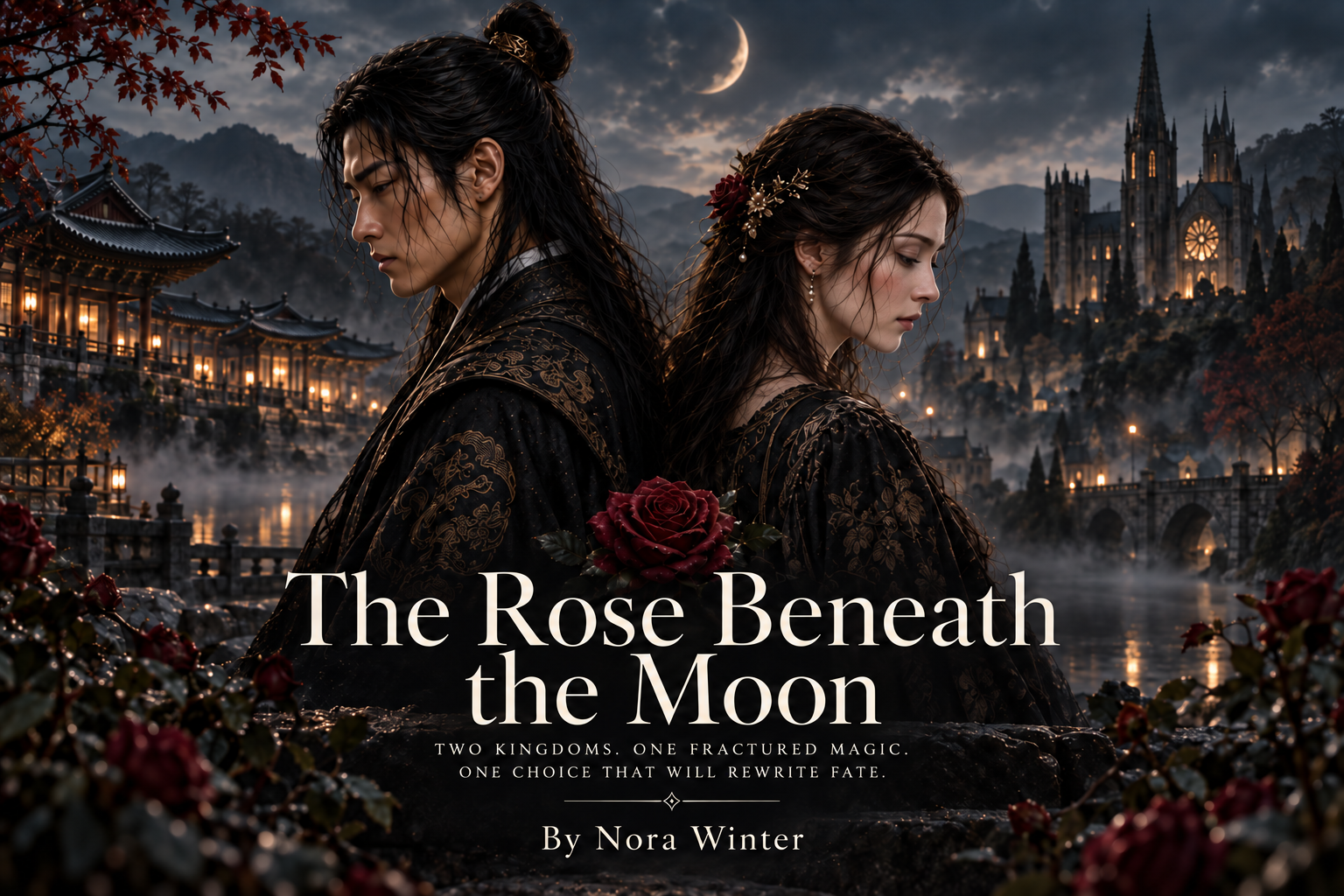
THE ROSE BENEATH THE MOON
Episode 1 · By Nora Winter
The Black Water
I. The Children Who Stopped Dreaming
By the third night of the waning moon, the children of Hanseong had stopped dreaming.
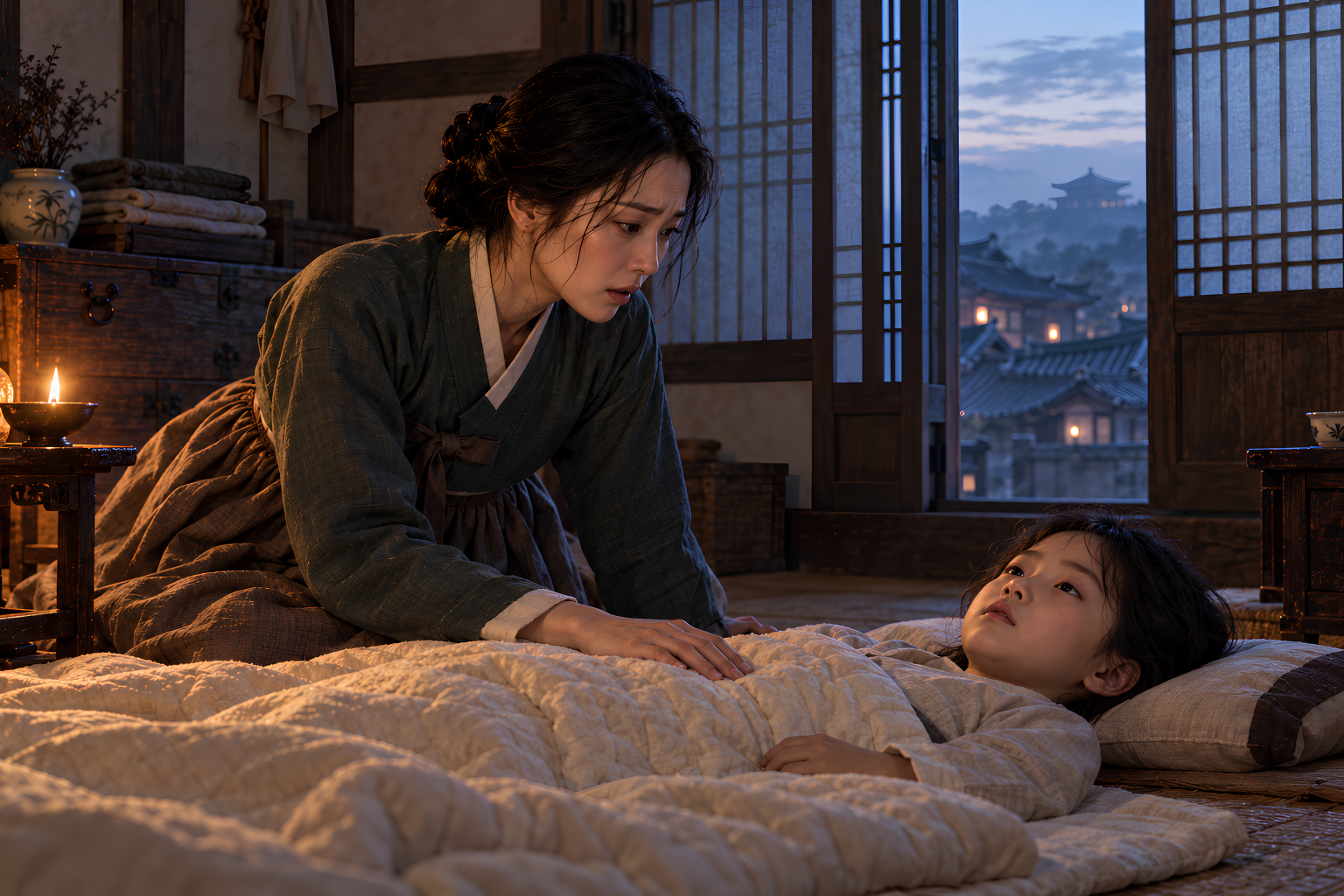
That was how the old women first knew something was wrong. Not because the palace astrologers announced an imbalance, nor because the royal physicians admitted the truth, nor because the Moon Court—hidden beneath ministry seals and ancestral rites—confessed that its oldest protections were beginning to fail. The truth arrived first in smaller, poorer rooms, where mothers woke in the blue hour before dawn to find their children lying too still beneath thin quilts, eyes open in the dark, breathing softly and staring at nothing.
No nightmares. No fever. No crying.
Only absence.
In the northern quarter, a girl of seven forgot her mother’s face before dawn, and asked, with terrible politeness, who the woman weeping at her bedside might be. In Mapo, a boy born with silver in one iris began speaking in the voice of his dead grandfather, calmly reciting the names of people buried before he was born. Near the eastern market, a newborn’s shadow appeared on the wrong side of the room and remained there until sunrise, shivering against the wall while the child slept warm in his basket.
By morning, none of these stories were officially true.
Hanseong had survived too long on ceremony to let terror walk openly through its streets. Scholars still crossed the palace courtyards with their tablets tucked beneath their arms. Merchants still opened their stalls beneath awnings stained with last month’s rain. Servants still scrubbed blood from butcher-stones and ink from sleeves, and the smoke of breakfast fires, thick with pine resin and scorched millet, lifted between the tiled roofs as though the city had not spent the night listening to the old magic cough beneath the foundations of the world.
Han Seo-jun heard three of the rumours before noon and believed none of them entirely.
He believed the pattern instead.
Stories changed in the mouth. Fear embroidered itself. But patterns were harder to corrupt, and this one had been gathering for weeks: failed charms, cracked altar bowls, shrine bells ringing without wind, infants marked and then unmarked, as if some ancient hand had reached for them in sleep and withdrawn unsatisfied.
A little before noon, in a lane behind the paper-makers’ street, the pattern acquired a face.
He had taken the lower way to the palace, as he often did, because the lower way was honest about its smells: lye and wet pulp from the paper vats, charcoal, the sour breath of a blocked drain. Halfway along, a woman sat on the step of a narrow house with a child across her lap. A shrine bowl lay at the threshold, split cleanly in two, the rice inside gone grey with rain. Someone had hung a paper charm from the lintel. Someone else had torn it down; half of it still clung to the nail and stirred when the wind remembered it.
The child was a girl of perhaps five, in a quilted jacket patched at both elbows. She was not ill. Her cheeks had colour; her small hands lay clean and warm-looking in her lap. Yet she sat as still as something carved, and her eyes, open and dark, rested on the lane without travelling along it.
Children did not look at the world like that. Children looked at everything as though it might be about to do something.
The mother saw his soldier’s dress and bowed too quickly, drawing the girl closer, the way people in the lower quarters gathered in what was theirs whenever the palace walked past.
Seo-jun should have walked on. Instead he stopped, and crouched, until his face was level with the child’s.
She looked at him. It took her a moment, as though his face had to travel a long way to reach her.
“Do soldiers dream?” she asked.
Her voice was perfectly ordinary. That was the worst of it.
“Sometimes,” he said.
“What is it like?”
He thought of his own dreams, few and mostly made of mud. He considered lying, and found he could not.
“Like going somewhere else for a while,” he said, “and coming home.”
The girl weighed this with grave courtesy. “I go to sleep and nothing comes,” she said. “It is very dark there. It is not frightening. It is only nothing.”
Her mother made a small sound and pressed her mouth against the child’s hair.
Seo-jun rose. There was nothing in his training for this: no stance to correct, no order to give, no enemy to face. He took the few coins from his sleeve and set them beside the broken bowl, knowing as he did so that coins were what the palace offered when it had nothing else to give, and disliking the gesture a little for that.
At the end of the lane he looked back. The girl had not moved from her mother’s lap, but her eyes had followed him the whole way, and they held him now with a small, unguarded hope, as though the stranger who had crouched in the mud to answer her honestly might yet turn round and come back to sit beside her in the dark.
II. The Training Yard
By late afternoon, even the training yard felt altered.
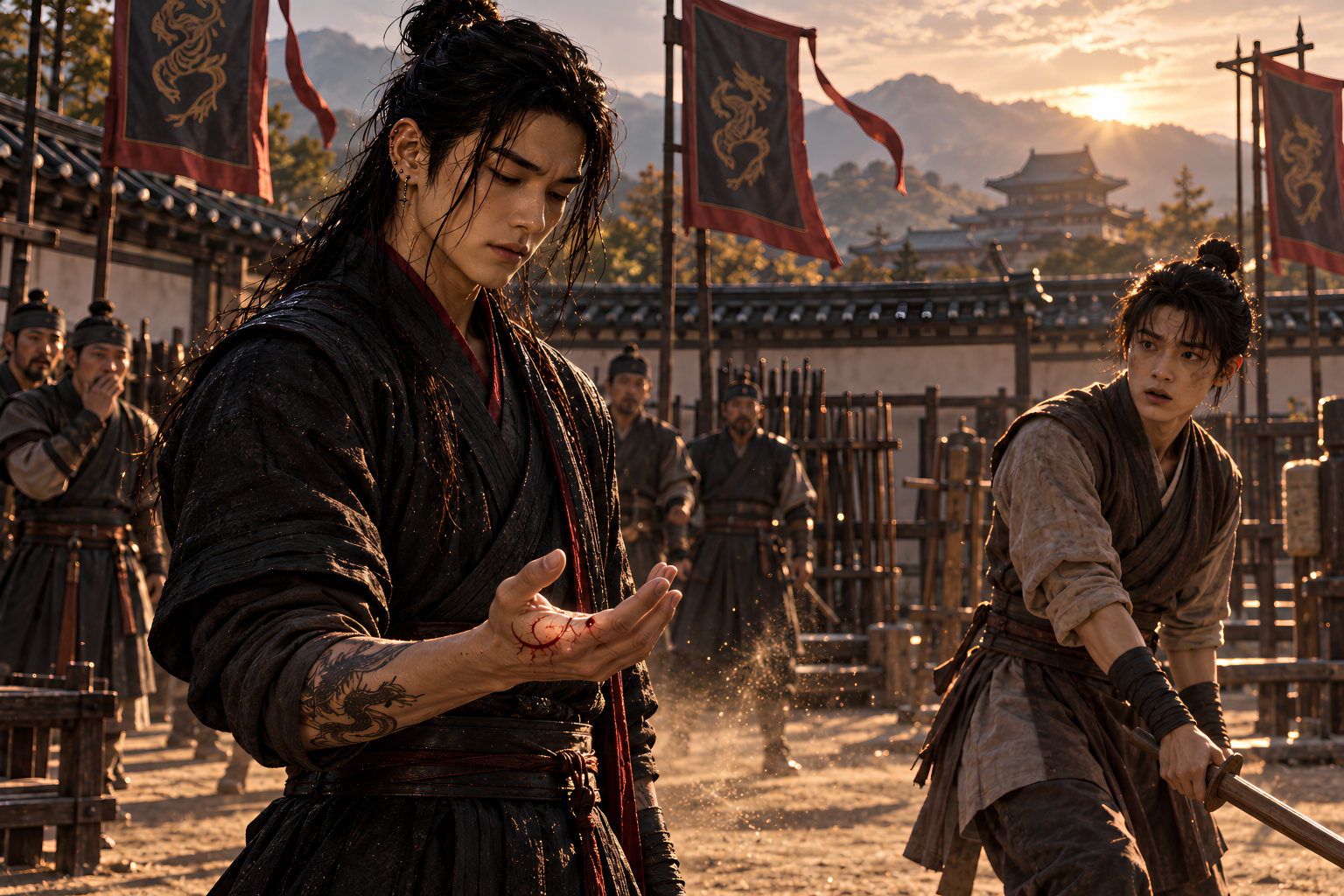
It lay in the lower quarter of the palace compound, far from the ceremonial halls where power preferred to look polished. Here the earth had been packed hard by decades of footwork, and the air held the honest smells of sweat, leather, oiled wood and bruised grass. The sun, sinking toward the western ridges, laid a long amber light across the yard and gilded the dust. Seo-jun preferred this place to the court’s perfumed chambers. Men lied everywhere, but they lied less convincingly when exhausted.
The young soldier opposite him was lying with his whole body.
He wanted to appear fearless, so he moved too quickly. He wanted to appear strong, so he struck too hard. He wanted Seo-jun’s approval, which made him more dangerous to himself than to anyone else.
Seo-jun turned the boy’s blade aside with a movement so economical that several of the watchers missed it. The boy overcommitted, stumbled, recovered badly, and would have taken a killing cut beneath the ribs had the weapons been steel.
Seo-jun let the wooden blade rest, lightly, against the place where the wound would have opened.
“Again,” he said.
The boy swallowed. “Captain, I—”
“Again.”
The boy reset himself. His ears were scarlet with humiliation, but he raised his weapon.
Seo-jun waited.
He had learned long ago that patience unsettled men more thoroughly than anger. Anger gave them something to resist; patience left them alone with the shape of their own inadequacy.
Around the yard, the other soldiers watched without pretending not to. They had all heard some version of his history. A son of the Han blade-line, though that lineage had become something no one praised too loudly. A man whose father had died under sealed circumstances. A captain trusted with difficult tasks and excluded from honourable ones. Useful enough to summon; unsuitable enough to celebrate.
That suited the court.
It suited Seo-jun, too—or so he had told himself for years.
The boy attacked again.
This time he corrected the angle of his wrist. Not enough, but enough to show he had listened. Seo-jun shifted to meet him, and that was when the wind left the yard.
It did not fade.
It ceased.
The training banners along the wall stiffened mid-ripple, rigid as lacquer. Dust kicked up by the boy’s heel hung suspended in the amber light, each mote as distinct as a flake of gold leaf. A crow crossing the roofline gave one harsh cry and then fell silent so abruptly that the absence of its voice seemed to strike the tiles harder than sound would have.
Seo-jun felt the change through his skin before his mind could name it. The hair along his forearms lifted. His ears filled with a pressure like deep water.
The young soldier’s strike faltered.
“Do not stop,” Seo-jun said, though his own hand had already begun to burn.
The pain was not on the surface. It opened deep in the palm, beneath callus and scar, precise as a needle pushed through old leather. Seo-jun tightened his grip on the practice blade, but the heat spread regardless—not outward like fire but inward, as if something beneath the bone had turned its face toward the world.
The boy saw his expression alter by a fraction and made the mistake of looking down.
Seo-jun followed his gaze.
A mark was surfacing in the centre of his right palm.
Not appearing. Surfacing.
The skin lifted around it without breaking. Lines rose in dark red threads, a crescent split through its curve by smaller branching strokes, each one fine as a vein and too deliberate to be injury. It was not a symbol he had been taught, yet some deep inner recognition moved through the yard faster than understanding.
One of the older soldiers stepped back.
Another whispered a prayer under his breath—and not to any court-approved ancestor.
Seo-jun closed his fist.
The mark burned hotter in the dark of his hand, and for one brief, intolerable instant he heard a child crying somewhere beneath the earth, thin and far away, as though through a floor of stone. Not the girl in the lane; she had not cried. Someone younger. Someone who had not yet learned that crying might not bring anyone.
Then the wind returned all at once.
Dust fell. Banners snapped. The crow launched from the roof and vanished toward the palace kitchens, screaming as though pursued.
The yard remained still.
Seo-jun opened his hand.
The mark had darkened. A thin line of blood was gathering along one of its branches, though the skin was unbroken.
No one spoke until a servant appeared at the edge of the yard, pale from running and trying not to look afraid. He bowed so low that his forehead nearly touched the dirt.
“Captain Han,” he said. “You are summoned to the Cheonggye Pavilion before moonrise.”
There it was: not surprise, but confirmation.
The court had been waiting for someone to be marked.
It had simply not expected it to be him.
Seo-jun looked once at the boy still standing before him, practice blade lowered.
“Your stance narrows when you are afraid,” he said.
The boy stared.
Seo-jun handed him the wooden sword. “Correct it before someone less patient teaches you the hard way.”
Then he turned and left the yard, blood closing slowly in his palm.
III. The Cheonggye Pavilion
He crossed the compound as the palace changed its skin for the night.
Lamplighters moved along the galleries with long tapers, waking the paper lanterns one by one. Kitchen smoke drifted from the service courts, heavy with sesame oil and bone broth. A procession of court ladies passed beneath a covered walkway, silk whispering at their ankles, their faces arranged into careful incuriosity. At the inner gate, the day guard surrendered the watch to the night guard with the same muttered words they had used for a hundred years.
Seo-jun kept his marked hand closed at his side. Twice he saw someone notice the blood on his fingers and decide, quite visibly, not to have seen it. The palace was very good at that. It was perhaps the thing it did best.
The Cheonggye Pavilion was older than the dynasty that denied its purpose.
Officially, it served no function. Unofficially, it was maintained with a care bordering on devotion. Its roof tiles were replaced before they cracked. Its beams were oiled in silence. No lamp was left burning inside after dark, and no servant assigned to clean it ever remained past sunset unless ordered by someone powerful enough to make refusal impossible.
Seo-jun had passed it many times without entering.
Everyone in the palace learned to do that.
It stood behind a screen of black pines at the western edge of the inner grounds, beside a sealed well whose bronze lid was engraved with the phases of the moon and bound shut by nine rings of iron. Snow never settled properly on its roof. Birds would not nest beneath its eaves. In summer, cicadas shrieked everywhere except around its foundations, where the heat felt strangely muted and sound thinned as though passing through cloth.
Tonight, the path leading to it had been swept clean.
That disturbed him more than neglect would have.
Cleanliness, in the palace, was often the first mask placed over violence.
Two guards stood outside. Both were senior men, neither easily unsettled, yet one kept his eyes fixed on the ground while the other held his spear too tightly. They opened the doors before Seo-jun reached them, releasing a breath of air that smelled of burned mugwort, wet stone and old metal—the stale copper of coins held too long in a closed hand.
Inside, the pavilion had been stripped bare.
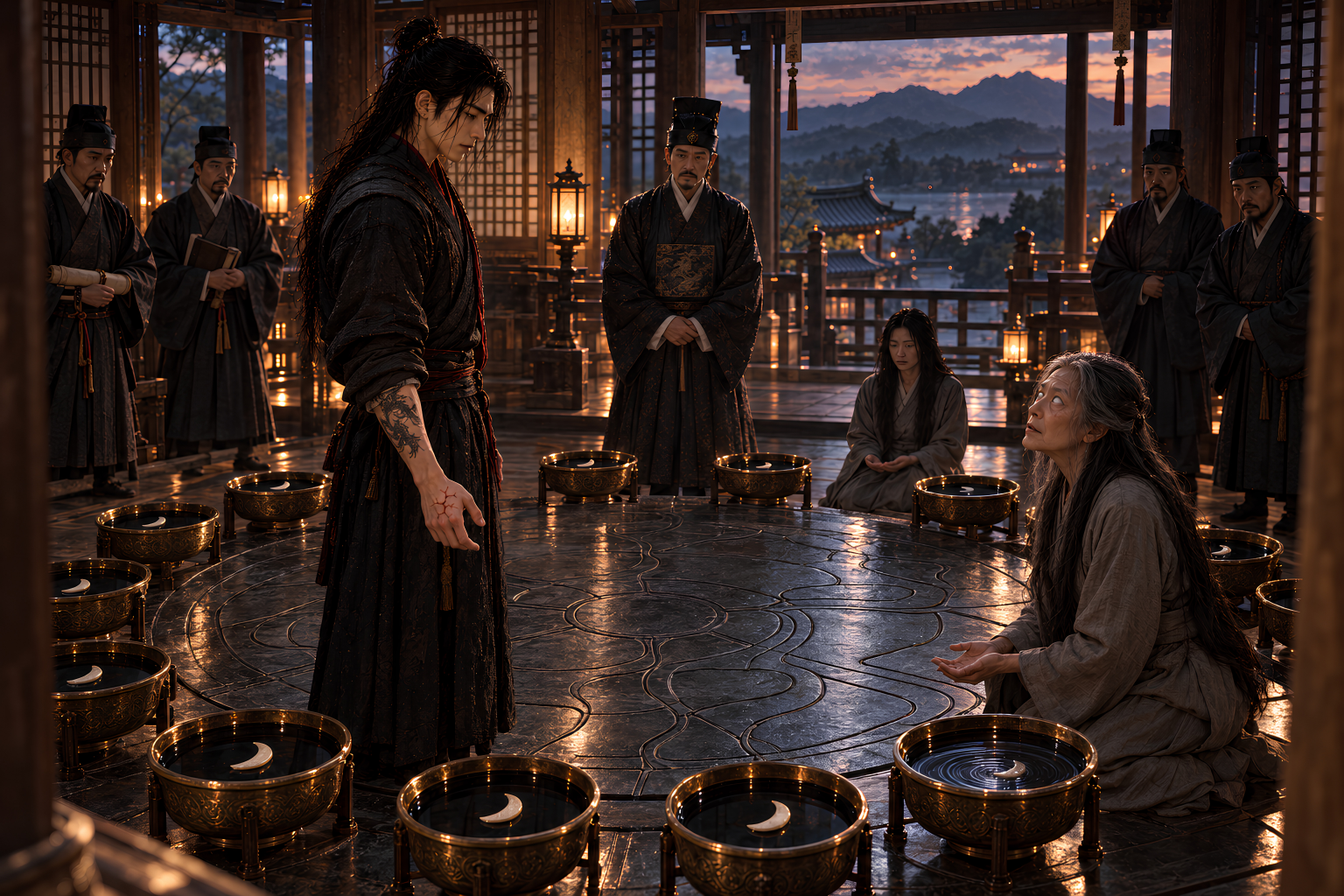
The wooden floor he remembered from passing glimpses had been lifted away, exposing the stone beneath: a single circular slab wider than any quarry could have yielded, black-grey and faintly reflective, as though water slept just beneath its surface. Across it ran engravings that seemed at first like calligraphy and then like scars. They curved, broke, crossed and returned to themselves with an intelligence that made the eye uneasy.
This was not decoration.
This was containment.
He had encountered the shape of it once before, though only in fragments—ink scratched across silk and burned before questions could follow. The lesson had never been named, which in the palace was often a more meaningful warning than prohibition. What remained with him was not the image but the instruction given alongside it: that certain rites did not call power down from heaven, nor bargain with it as scholars preferred to believe, but forced it upward—from blood, from memory, from whatever had been buried too deeply to remain still.
The stone beneath his feet bore that same intention. These were not symbols meant to be read but channels built to endure strain. Whatever entered this circle would not be granted anything. It would be opened—and whatever answered would do so without regard for whether the body that received it could survive the exchange.
Around the stone stood twelve bronze basins filled with dark water. Moon pools. In each floated a crescent of bone, polished so thin that lamplight passed through it like breath through paper. Between the basins knelt three women in ash-coloured robes, their hair unbound, their palms turned upward upon their knees. Vessel Keepers. Seo-jun had only ever seen one before, and then from a distance, at a funeral no one admitted was magical.
Behind them waited the men who preferred to survive by naming things.
Blood Archivists with genealogy cords looped at their waists. Ritual scholars with ink-blackened fingers. Veil Ministers in the plain robes of administrators who had long ago learned that secrecy looked most convincing when dressed as boredom.
At their centre stood Minister Yi Mu-ryeong.
He was not the highest-ranking man in the kingdom—not publicly—but power often hid from official titles the way poison hid from silver. Yi had the spare, controlled face of a man who had disciplined all visible grief into usefulness. His hair was white at the temples, his hands elegant, his gaze steady enough to be mistaken for calm.
Seo-jun stepped fully inside.
The lamplight caught him only in passing—the line of a shoulder, the edge of his jaw—before slipping away again. It did not linger. It rarely did.
He moved with the quiet certainty of a man accustomed to being relied upon without being acknowledged. Up close, the scale of him became apparent: not in the blunt way of size alone, but in the way space adjusted around him without seeming to resist. He stood taller than most men in the room, yet it was proportion rather than height that unsettled—the breadth carried through his shoulders, a density that suggested force held in reserve rather than displayed. He did not impose himself. Each step was placed with an economy that bordered on absence. In another room it would have been possible not to notice him at all, until he chose otherwise.
His clothing bore the soft wear of repetition, shaped by the same movements performed ten thousand times. Beneath it, his body was not ornamental but functional: built for endurance, for control, for force applied without hesitation.
Ink marked him where armour could not. Along his right arm, hidden beneath the sleeve, a coiled dragon followed the movement of muscle and tendon in restrained lines. Across his chest, unseen but constant, lay the sigil of the Han blade-line, placed where it would be felt with every breath, every strike, every hour the body was asked to endure.
These were not marks of rank.
They were commitments. Given once. Carried without removal.
When Yi saw the newest mark, the one in Seo-jun’s palm, something in his expression tightened.
Not fear.
Recognition against preference.
“So it was you,” Yi said.
“You sound disappointed.”
“A ritual does not consult our preferences.”
“No. Only our blood, apparently.”
Several of the scholars looked away; whether from discomfort or disapproval, it was difficult to tell.
Yi descended the single step from the raised threshold. “Your bloodline was not expected to answer.”
“My bloodline has spent years being described as compromised.”
“It is.”
“Then your ritual has poor taste.”
A Vessel Keeper inhaled softly. Yi’s eyes did not leave Seo-jun’s face.
“The Cheonggye Rite chooses for endurance, not purity,” the minister said. “That distinction may be the only reason you are standing here.”
Seo-jun looked toward the stone. “How many stood here before me?”
The question moved through the chamber like a blade drawn slowly enough for everyone to hear.
Yi did not answer at once.
One of the bronze basins trembled. A ring spread across its surface, though nothing had touched it.
“Seven,” he said at last.
Seo-jun glanced at the Vessel Keepers, then at the scholars, who had arranged themselves with great care just beyond the circle’s edge.
“And how many walked out?”
The oldest of the kneeling women opened her eyes.
They were clouded white.
“Two,” she said. Her voice was cracked but firm. “One without speech. One without his own memories.”
The room did not welcome her honesty.
Seo-jun did. “What happened to the others?”
The woman lowered her gaze to his marked hand.
“The rite asked what they could not pay.”
For the first time since entering, Seo-jun felt something colder than caution move beneath his ribs.
Not fear, exactly. Fear had heat in it. This was a narrowing of possibility: the body recognising a door that did not open both ways.
Yi’s voice settled over the room before the silence could deepen. “The cost is known.”
“Known by whom?” Seo-jun asked. “The dead?”
“The dying magic does not bargain gently, Captain Han. It cannot afford to.”
There was the court’s true language at last, stripped of courtesy: not justice, not reverence, not even restoration, but expenditure. Some lives cost less than others. Some blood could be poured out and entered in the ledger as necessary.
Seo-jun thought of a girl on a doorstep, watching a lane without seeing it. He wondered which column of the ledger she had been entered in.
He looked down at the mark. Another bead of blood gathered from unbroken skin and slid along the crease of his palm.
“What does it take?”
The old Vessel Keeper answered before Yi could.
“What it can reach.”
That, Seo-jun thought, was the first honest thing anyone had said in the room.
IV. The Three Needles
A ritual scholar stepped forward carrying a narrow bowl of black lacquer. Inside lay a cord of braided silk, three iron needles and a strip of pale paper covered in names so small they looked at first like a column of insects.
Seo-jun recognised none of them, but his body did.
The mark in his palm pulsed.
“Your paternal line,” Yi said. “As far as the Archivists could recover it.”
“Recover,” Seo-jun repeated. “Not record.”
“Some names had to be persuaded from sealed places.”
The scholar knotted the silk cord around Seo-jun’s wrist, drew it tight, and laid the paper of names across his open palm, so that the mark showed through it like a bruise through thin skin. Then he lifted the first needle. In the lamplight its point held a single bead of brightness, like a star caught on a thorn.
Seo-jun did not move away.
The needle went in cold.
It did not stay cold. Heat bloomed outward from the centre of the mark, and then came something stranger: his hand was suddenly crowded. He felt other fingers inside his own—broader ones, older ones, a scholar’s soft knuckles, a woman’s skin cracked raw by lye—all of them closing around a hilt that was not there. His own grip was among them somewhere. For a terrible moment he could not find it.
The rite was not testing his strength. It was taking down the wall between what he had inherited and what he was, stone by stone, with no interest in whether the house still stood afterward.
Not gently. Not partially.
Entirely.
A man who relied on the illusion that his past ended at his own skin would not endure this. The rite was not asking whether he could fight, or bleed, or obey. It was asking whether he could remain himself when everything that had made him began pressing inward at once.
Pain opened upward through his arm, clean and bright, and beneath it came something worse: memories that did not belong to him.
A woman running through snow with a child strapped to her back, her breath tearing white from her mouth, the child’s weight dragging at her shoulders with every stride.
A man kneeling in mud, pressing both hands over a wound that glowed faintly blue, the light leaking between his fingers like water he could not hold.
A boy hiding beneath temple boards, splinters in his cheek, dust in his throat, while voices overhead debated whether blade-blood could be bred without mercy.
Seo-jun’s breath caught before he could stop it.
Yi noticed.
Of course Yi noticed.
“The rite requires ancestral access,” he said. “You may experience some residue.”
Some residue.
The scholar pushed the second needle through the mark.
This time Seo-jun tasted seawater.
Not imagined. Not symbolic. Salt flooded his mouth so sharply that he nearly gagged; his eyes stung and ran. Somewhere far away, gulls cried over a black coast beneath a moon too large and too low to be natural, and he felt the sting of spray on skin that was nowhere near the sea.
The salt had direction. He felt it pulling west—a tug beneath the breastbone, like a fishing line drawn suddenly taut—and at the far end of that line, impossibly, something pulled back.
Whatever had been taken had not been lost entirely.
It had endured—elsewhere—and the rite was testing whether what still survived here could bear the strain of finding it again.
Then the vision turned.
A woman stood in a chapel of foreign stone.
She was not a girl, though the vision tried at first to soften her into one, perhaps because kingdoms preferred women easier to arrange when imagined young. She was near thirty, composed with the practised stillness of someone who had been watched too long and had learned to make surveillance useless. Candlelight struck the line of her cheek, the dark red of her gown, the pale severity of her hands resting one over the other. The air around her smelled of beeswax and cold stone and, beneath both, of something green and living that had no business inside a church: wet earth, crushed stems, roses after rain.
Men surrounded her.
Not physically. Politically.
Their intentions pressed closer than bodies could have done: marriage, alliance, containment, interpretation. She listened to them without yielding the smallest piece of herself. Behind her, in stained glass, a rose bloomed around a crescent moon that belonged in no English chapel.
Then her eyes lifted.
Not toward the men.
Toward him.
He felt the rite change its grip. Until then it had been groping, like a hand moving blind through dark water. On her, it closed—and not the way a hand closes on a stone. It closed the way a hand finds another hand in the dark, and is held in return.
Seo-jun understood then, with a certainty that left no room for comfort, that she was not simply containing what had been taken.
It had learned her.
To remove it would not be an act of recovery. It would be a separation forced upon something that no longer knew itself as divided.
He heard the old Vessel Keeper begin to chant, but the words were distant now, swallowed by the pressure building inside his skull.
The third needle entered.
The pavilion vanished.
For a moment he stood in a place that existed in neither time nor space.
Darkness, but not emptiness. It had texture, breath, depth. It smelled of cold iron, rain on stone and milk turned sour in a child’s cup. Voices layered through it, none speaking fully, all of them worn thin by centuries of repetition until meaning had nearly rubbed away.
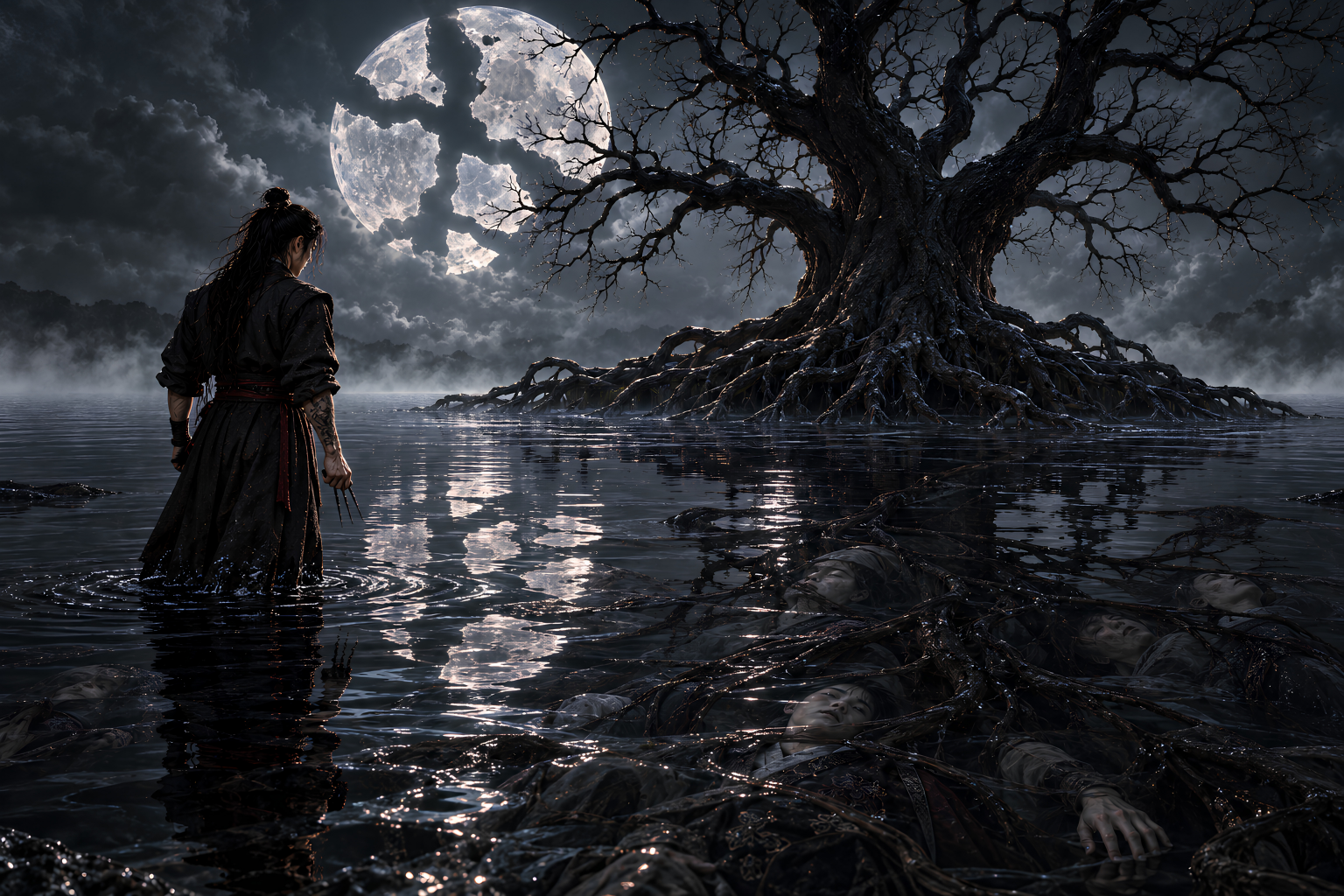
The moon above him was broken.
Not eclipsed. Broken.
Its reflection lay in pieces across water stretching farther than sight, and each piece held a face: infants, soldiers, women in ritual robes, old men with ink on their teeth, children who had stopped dreaming. One of them was very small, in a jacket patched at both elbows.
At the centre of the water rose a tree without leaves.
Its roots were not in earth.
They were in bodies.
He did not reason it out. He felt it, the way one feels cold through a wall. What remained of the source beneath his own land was no longer fed by what had once nourished it. It had turned inward—not in malice, but in failure—and was drinking from the nearest living blood because nothing else answered. Marked children. Weak vessels. Bloodlines too young to defend themselves.
This was not decline.
It was hunger misdirected.
Every failed rite, every marked child who did not survive it, was not an accident the court could bury beneath careful language. It was evidence of something older trying to persist without the wholeness it had once required.
A voice moved through the dark.
It was not clean enough to be divine, nor cruel enough to be demonic. It had too many edges, as though it had once been many voices braided together and left for centuries in a sealed chamber.
Han blood came late.
Seo-jun forced himself to remain upright. “Then call the first blood.”
The first blood answered beautifully.
The water darkened around his feet.
It died.
Faces shifted beneath the broken moon. Men in finer robes. Women of purer lineage. Bodies arranged inside circles, mouths open, eyes emptied of selves that had gone elsewhere and not returned.
The willing opened too widely. The devout mistook surrender for strength. The pure broke cleanly.
The voice pressed closer.
You are not clean.
Pain spread from Seo-jun’s arm into his chest, where it began to search among old injuries with intimate patience: the rib that had knitted crooked, the shoulder that ached before rain, the long scar beneath his collarbone. It touched each one as though reading a record.
You have survived obedience without mistaking it for faith. You have carried shame without letting it become prayer. You have killed without asking death to name you righteous.
The darkness tightened.
That makes you difficult to enter.
Seo-jun’s right knee struck stone.
The pavilion returned in fragments: lamplight, chanting, the bitter smoke of mugwort, Yi’s expression sharpened into hunger. Blood was running freely from Seo-jun’s palm now, soaking the paper of names until they blurred, running down his wrist and beneath his sleeve, warm and then quickly cold. Not enough to kill him. Enough to mark the beginning of a debt.
The old Vessel Keeper’s chant changed.
The bronze basins stirred though no hand touched them. In each dark surface the reflected ceiling dissolved, replaced by glimpses Seo-jun saw from too many angles at once: a ship’s hull cutting through black water; a white cliff; a Tudor hall bright with lies; the woman in the chapel closing her hand around a thorn until blood appeared; a silver object no larger than a child’s heart, beating inside a reliquary of foreign gold.
Then the image corrected itself.
Not an object.
Not only an object.
The fragment was in the relic, yes, but the relic was no longer enough to sustain it. It had rooted elsewhere, woven through living blood, learned the rhythm of a foreign heart.
The woman breathed, and somewhere beneath Joseon the broken root listened.
V. So You Have Finally Come
Seo-jun understood, then, why Yi had not spoken plainly.
The mission was not recovery.
It was removal.
The court would give it gentler language—restoration, balance, necessity—words that could be carried, repeated, obeyed. But the rite had shown him something less forgiving. What remained in this land could not endure as it was, and what had been taken no longer existed in a form that could be returned without consequence.
Yi stepped closer to the circle. His voice was careful, almost reverent, and Seo-jun hated him more for that than he would have hated open greed.
“You have seen her.”
Seo-jun remained on one knee, breathing through the pain in measured counts. “You knew it was a person.”
“A vessel.”
“No. A woman.”
“A vessel,” Yi repeated, and now the word showed its teeth. “One carrying what was stolen from this land before either of us drew breath. One whose existence may be the only reason our children are not yet being born hollow.”
The old Vessel Keeper bowed her head, but not before Seo-jun saw grief pass across her face like a shadow through water.
Seo-jun rose slowly.
The needles remained in his palm. Blood trembled along them.
“What happens to her when it is taken?”
No one answered quickly enough.
There are silences born of ignorance and silences born of calculation. This was the second kind.
“The rites will be prepared,” Yi said.
“What happens to her?”
“The transition will be dangerous.”
“For whom?”
Yi’s gaze held his.
“For everyone.”
Seo-jun let the answer rot in the space between them.
The broken voice returned—not as loudly now, but nearer, down in the blood.
Bring back what breathes.
The command carried less certainty than before. Or perhaps Seo-jun, altered by pain and ancestral residue, could now hear what lay beneath it: not mercy, not morality, but limitation. Magic could demand, but it could not tell justice from repetition unless a living mind bore that burden for it.
That was the true trap.
Not the journey.
Not the foreign court.
The decision.
The rite had not chosen a warrior because a woman needed stealing. It had chosen a man capable of violence, and then placed him before the question of whether violence would ruin the very thing he had been sent to save.
Seo-jun looked at Yi.
“You expected the rite to choose someone more obedient.”
A faint muscle moved in the minister’s jaw.
“We expected it to choose someone less compromised.”
“Those men died.”
“Yes.”
“And still you are disappointed.”
Yi’s face hardened. For the first time, something personal entered his restraint—a grief buried so deep it had mineralised into doctrine.
“My daughter died in a room like this,” he said softly. “She was eleven. The rite took her sight first, then her speech, then her name from her own mouth. Do not speak to me as though I have not paid for what I ask.”
The room altered around the confession.
Even the scholars seemed not to breathe.
Seo-jun looked at him for a long moment.
There were answers that would have been easy and therefore useless. Cruelty could be true and still fail to matter. Sympathy could be offered and become another form of surrender.
At last he said, “Then you know exactly what it means to spend someone else’s child.”
Yi’s eyes went cold.
The old Vessel Keeper made a sound that might have been warning or approval.
Before the minister could reply, the basins darkened again.
This time the woman appeared in all twelve moon pools at once—twelve small, perfect images of the same chapel, as though the pavilion had been ringed with windows onto a single distant room.
Elyria, Princess of the Wild Court, though Seo-jun did not yet know her name.
She stood alone now, the chapel emptied of courtiers. Light fell through the strange rose-and-crescent glass and broke across the floor in fractured colour: garnet, gold, a green like deep forest. She had removed one glove. Her palm bore a mark shaped like his, but not identical; where his crescent was split like a blade wound, hers curved around a thorned stem.
She was looking down at it with no surprise at all.
Then, slowly, she lifted her head.
Her gaze did not find him so much as the place where he stood—as though she could feel the shape of whatever was reaching for her, and had decided to face it.
Across distance, across saltwater, across whatever old theft had braided their fates without consent, she spoke.
Not aloud.
Not in Korean.
Yet he understood her.
So you have finally come.
The words were not plea, nor fear, nor welcome.
They were indictment.
The basins cracked—all twelve at once, with a report like thunder breaking indoors.
Dark water spilled across the pavilion floor and rushed into the carved channels of the circle, where Seo-jun’s blood had already begun to gather. The stone drank both without distinction.
The three needles in his palm blackened.
The old Vessel Keeper seized his wrist before the scholars could move and pulled them free in one brutal motion. Pain flashed white. Blood followed, too dark to be fresh, carrying with it a thin silver thread that twisted in the air before vanishing.
Seo-jun swayed, but remained standing.
The Keeper bound his hand in linen marked with ash. Her fingers were dry and cold, and very strong.
“Do not uncover this before the next moonrise,” she said quietly.
“What did it take?”
Her blind eyes lifted toward him.
“You will know when you reach for what is missing.”
That answer was worse than any wound.
Yi had already recovered himself. Men like him did not allow awe to linger; they turned it into policy before it could trouble them.
“You will depart within three days,” he said. “A diplomatic vessel is being prepared under trade authority. Publicly, you accompany envoys to observe foreign military practice. Privately, you will locate the relic, identify the vessel’s condition, and secure the return of both.”
Seo-jun looked toward the cracked basins, the spilled water, the circle that had swallowed blood and given back consequence.
“Secure,” he said.
Yi did not soften the word.
“Yes.”

VI. Beneath the Black Pines
The rain began before Seo-jun reached the door, sudden and heavy, striking the roof with such force that the pavilion seemed besieged by a thousand small hands demanding entry. Beyond the threshold, the palace had blurred into water and lantern-smear. Hanseong crouched under the downpour, beautiful and diseased, its hidden magic feeding on children while ministers rehearsed the language of necessity.
The rite had not granted him purpose. It had altered his position. Whatever lay beneath his land now recognised him as a point through which something might be restored—or forced—and the woman in the foreign chapel stood at the other end of that line. Whether anything could pass between them without destroying what she had become, the rite had not said.
It had only ensured that he would have to find out.
Seo-jun stepped outside.
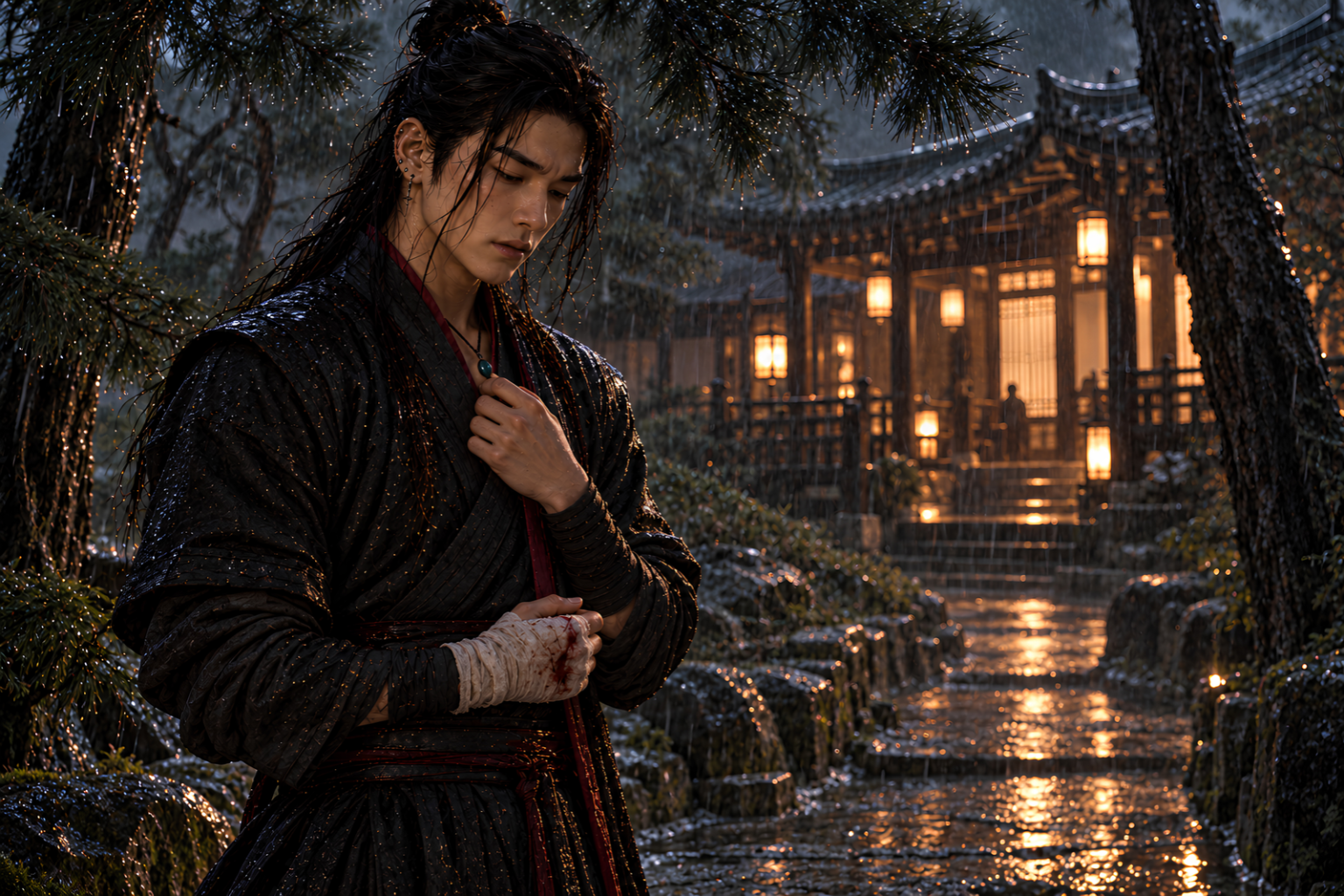
The cold struck his face. Blood warmed the bandage around his palm.
As he moved, something beneath his collar shifted against his skin: a familiar weight, slight but insistent, hung on a blackened cord worn smooth by years. It lay against his chest as it always had, settled into place as though it had long ago learned the rhythm of his breath.
The stone was small, no larger than the first joint of his thumb, cut without ornament. In the low light it held a muted blue-green, like deep water seen through shadow—a colour that seemed to withdraw when looked at directly and return at the edge of vision, as if it belonged more to depth than to surface.
It had been his mother’s. That much he knew. The rest had thinned with time, worn away as slowly as the faint markings along its edge: traces of something once deliberate, now softened to suggestion. He had never taken it off. Not through fire, not through loss, not through the long years that had taken everything else with them. It did not warm, or glow, or answer when touched.
And yet it had remained, unchanged where other things had not endured, as though whatever it carried had not weakened with time but simply chosen not to reveal itself.
Halfway down the path, he reached, without thinking, for something his father had once said to him. It was a habit so old he rarely noticed it: a remnant of boyhood, from the years when grief still went looking for a shape.
Nothing answered.
He stopped beneath the black pines.
Rain threaded through the needles overhead and ran beneath his collar, cold as a blade laid flat along the spine. The air smelled of resin and wet bark. Behind him, within the pavilion, men had already begun speaking in lower tones—converting terror into plans, plans into orders, orders into a story clean enough for others to obey.
Seo-jun stood very still.
He tried again.
His father had told him something after his first battle, something about the difference between surviving and returning. Seo-jun could see the moment with perfect clarity: the smell of smoke, the coarse weight of a blanket over his shoulders, his father’s hand stained with someone else’s blood. He could even hear the shape of the sentence—the low, unhurried rise and fall of it, the pause in the middle where his father had looked away.
He remembered everything except the words.
The rite had taken them.
Not much, perhaps. Not compared with sight, or speech, or a name, or a life.
Only a sentence.
Only a dead man’s counsel.
Only the proof that the past had once reached him gently.
Seo-jun closed his marked hand.
There had been others once. A father whose voice he could still summon in fragments, though never in full. A mother whose face returned to him less often with each passing year. A younger brother who had not lived long enough to become anything the court could name. Fire had taken them—officially. An accident: contained, explained, dismissed. The kind of loss that left no questions the court was willing to answer, and no family left to ask them.
What remained of the Han blade-line had stood alone in a training yard that afternoon, and been marked by something older than the kingdom that had failed to preserve it.
The line had never produced scholars or courtiers. It had produced bodies that endured, and he had been raised to the creed long before he understood its price. A man could see the fractures in the structures he was ordered to defend and still know the shape of his place within them. Judgement belonged to others.
What belonged to him was simpler.
To stand where he was placed.
To endure what was required.
And, when called, to act without hesitation in defence of something larger than himself—even if that something had never learned how to defend him in return.
The mark in his palm burned again, deeper this time, as though acknowledging the terms without agreeing to them.
Beyond the palace wall, through the rain, a few lamps still burned in the lower city. Houses, he thought, where mothers sat up beside children who would not dream. Somewhere among them a girl in a patched jacket was lying in the dark, waiting for nothing to come.
Then the wind shifted. For a single breath, beneath the resin and the rain, he caught a scent that had no place in a Joseon garden at night: roses, crushed and wet, and cold stone, and candle smoke.
It was gone before he could be certain of it.
He did not move for a long time afterward.
Far to the west, under foreign stone, a woman who had been bargained over by kingdoms looked down at her own bleeding palm and smiled without happiness.
By dawn, the court would call him chosen.
By moonrise, the wound would begin to scar.
And before the season turned, he would cross the black water toward a kingdom of salt and thorns, where the fragment they believed lost was no longer waiting to be found—
but already living,
already chosen,
within a woman no court had ever learned how to command.