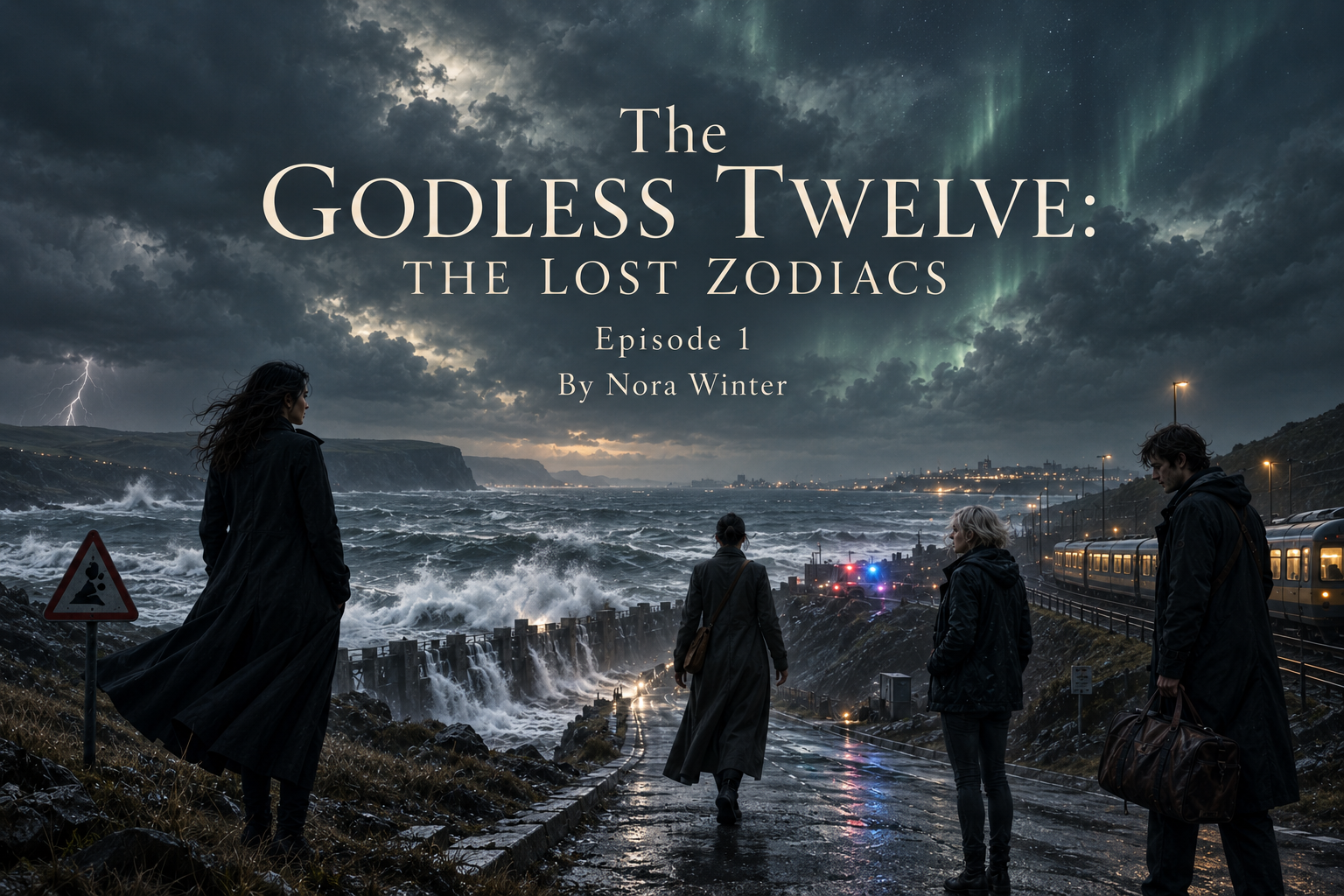
THE GODLESS TWELVE
Episode 1 · By Nell Voss
The Sky Forgets
The world rarely looked neglected. That was one of its better tricks.
It dressed itself each morning in ordinary damage: traffic building in wet streets, hospital lights burning through dawn, office towers waking floor by floor, newsreaders speaking calmly over maps of drought, flood, strike, election, shortage, war. Satellites crossed the upper dark with the bored precision of machines mistaken for stars. Ships waited beyond harbours. Trains dragged themselves into cities full of people who had slept badly and blamed themselves for it. In kitchens and service stations and glass lifts, phones chimed with weather warnings, meeting reminders, bank alerts, apologies delayed until they had become grievances.
Earth had always been loud. It had been loud before language, before roads, before the first hand lifted fire from one place to another and called that theft progress. It groaned in stone and root, in reef and storm, in the private weather of animals. Humanity had added its own noise to the old choir: engines, prayers, sirens, laughter sharpened by drink, the last message left unread. By the twenty-first century, the planet had become skilled at hiding omens inside notifications.
The Twelve had learned to do much the same with themselves.
Most of them lived under names that were not their first names, in countries that had risen after they had already known exile, among people who mistook age for weariness and power for charisma. Some worked. Some stole. Some married, vanished, returned, kept accounts, drank too much, kept too many passports, voted in local elections with private contempt for the word permanent. They had been worshipped in fragments, hunted in mistakes, photographed once or twice in the background of disasters. None of them agreed on what had happened to them. Punishment, error, failed trial, cosmic negligence: they had made a theology out of ignorance and revised it whenever the centuries made fools of them. They called it exile, chiefly because exile implied that someone, somewhere, had once wanted them home.
What they remembered clearly was falling. Memory gave them that much. It gave them speed, brightness, impact, the taste of burned metal and winter air. It gave them the sickening certainty of separation. What it withheld, with exquisite care, was the cause.
That morning, in a town where the sea had eaten three streets in thirty years and was considering a fourth, Luna, whom the sky had once called Cancer, woke before the gulls and lay still while the tide moved the wrong way.
Her rented room stood above a closed amusement arcade on the Briarhaven front, with a carpet that smelled faintly of damp wool and old coins. The landlady had painted the walls a determined shade of yellow, the sort bought by people who wished to defeat gloom through retail, and the single overhead bulb flickered with a violence Luna found personally insulting. She had unscrewed it two nights after moving in and had been using a blue-shaded lamp instead. The landlady had noticed and said nothing, perhaps because Luna paid in advance and had once fixed a leak in the ceiling by staring at it until the water retreated into the pipe with the offended dignity of a guest asked to leave.
Luna disliked overhead light, landlocked cities, microwaved fish, and people who described themselves as empaths. She kept little in the room except what she could pack inside two bags: dark clothes, a cracked enamel bowl, a coat good enough for rain, and a cigar box full of objects she would have denied were sentimental. Inside lay a theatre ticket from 1878, a Roman coin greened by seawater, a child’s tooth wrapped in muslin from a village whose name no longer existed, and a gold cufflink she had not touched in ninety-one years because it had belonged to a man whose name began with L.
She did not look at the box that morning. She did not look toward the part of her mind where sunlight had once lived like a wound pretending to be a crown.
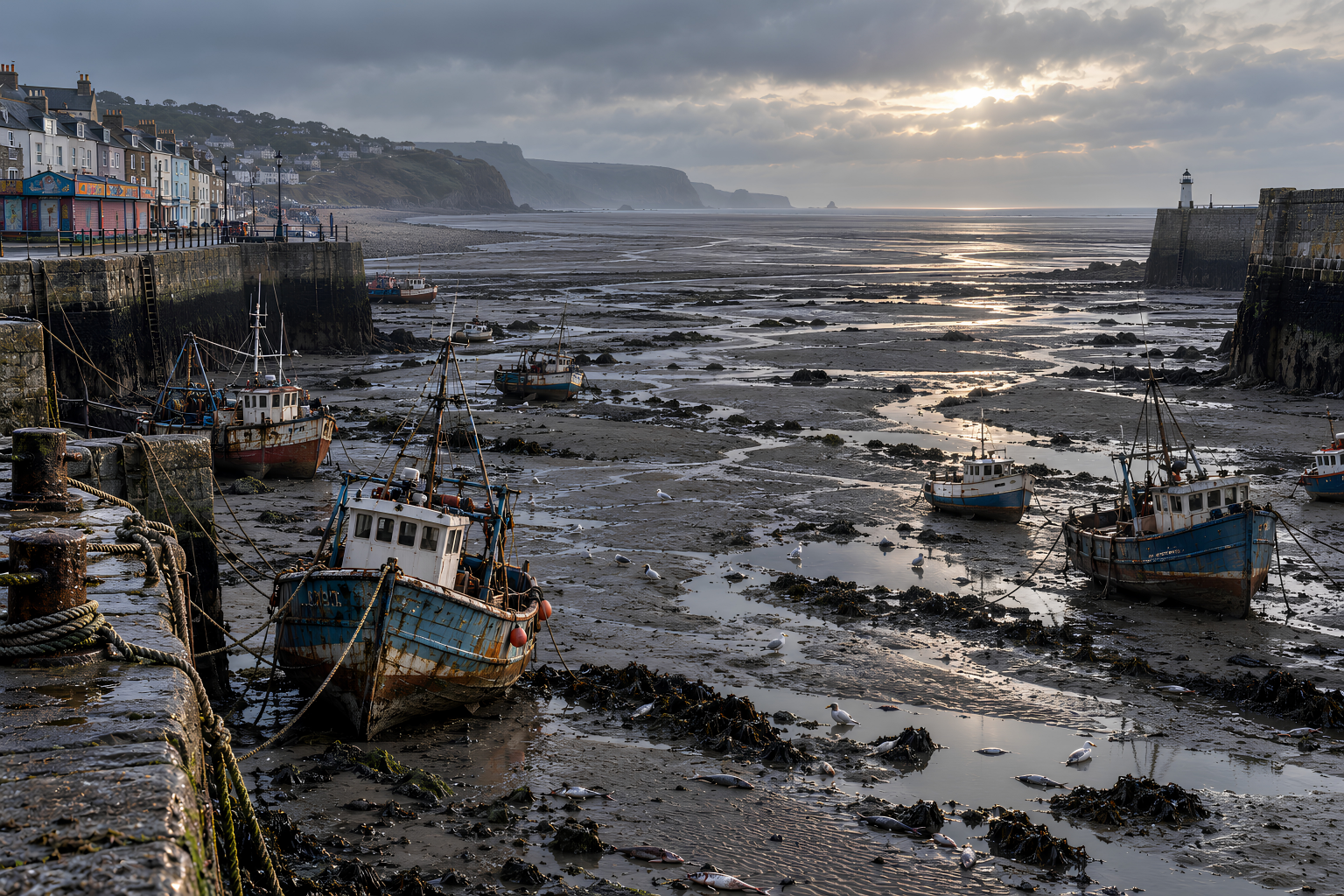
Outside, the sea withdrew from the shore. Not with the hunger that comes before a storm surge, nor the solemn breath before a wave. It pulled back in silence, folding itself away from the shingle as though remembering an appointment elsewhere. Boats settled in the marina mud and tugged against their moorings. A line of stranded kelp shone black in the early grey. Fish moved in shallow pools and opened their mouths uselessly at the sky.
For the first time in thirty years, Briarhaven woke without the sound of the sea. No drag of shingle, no slap against the harbour wall; only the gulls, unsure of themselves, and the tick of rigging against stranded masts. The smell arrived a minute later through the gap in the window frame: iodine and rot and something mineral beneath, like the inside of a stone split open.
Luna sat up, one hand already extended. The water in the glass beside her bed had risen half an inch above the rim without spilling. It trembled there, holding itself in a shape no water had any business keeping, a small clear dome reflecting her face upside down.
“No,” she said, not sharply, not loudly. The word carried the weary intimacy of a woman addressing a dog that had brought in something dead.
The water settled. A single drop slid down the outside of the glass and darkened the cheap bedside table. Luna watched it with the kind of calm that had frightened kings more than her anger ever had.
Two hundred and fifty miles to the north-east, about as far from the sea as England allows, Nessa, Capricorn in a former life and a ratepayer in this one, had been awake for four hours and had already found seven impossible things before breakfast.
This did not please her. Nessa did not dislike impossibility on moral grounds; she considered it rude rather than wicked. It arrived without proper documentation, caused inconvenience, and almost never apologised. She preferred disasters that announced themselves in advance through measurable strain, corrupt procurement, neglected maintenance, or human vanity. Those were honest failures. They wore fingerprints.
Her flat occupied the top floor of a converted insurance building in Birmingham, chosen for its thick walls, reinforced stairwell, and view of three major roads. The estate agent had called the interior “full of character,” by which he meant the windows stuck in winter and the pipes resented hot water. Nessa had bought it anyway, then replaced the locks, the wiring, the shelves, the hinges, the boiler, and eventually the estate agent’s recommendation in every conversation where his name appeared.
The flat was immaculate in a way that suggested not wealth but readiness. Emergency supplies were arranged in labelled crates beneath the bed: water purification, batteries, medical, documents, cash, blades, tinned food, weather gear, spare phones. Her coffee was black, bitter, and served in a chipped mug printed with the words WORLD’S OKAYEST MANAGER, a joke Amara had sent years ago after a disagreement involving a collapsed bridge, three hacked traffic networks, and a stolen goat. Nessa used it because it held the correct volume and because refusing to use it would have given Amara satisfaction.
On her kitchen table lay a stack of printed reports. She distrusted screens for final analysis. Screens lied too attractively. Paper, at least, had the decency to become clutter.
At 04:12, the first anomaly had appeared in the National Seismic Monitoring feed: a tremor under the Celtic Sea, shallow, brief, and shaped incorrectly. Tremors did not have intentions, but this one had approached the coast and withdrawn. At 04:19, three railway signalling systems in unrelated counties logged the same maintenance error code, one retired from use in 1998. At 04:27, a hospital in Cardiff lost precisely one minute from all medication dispensing records, then regained it in duplicate. At 04:31, a suspension bridge registered stress in a crosswind that did not exist.
By 05:03, Nessa had drawn a line from each failure to a point on the south-west coast. Briarhaven. She disliked the name at once. It sounded like the sort of place where people sold overpriced candles in converted chapels and drowned through negligence.
Amara received the first signal through a toaster.
This would have embarrassed most people. Amara, the Water Bearer once, though she had never carried anything she could not rewire, was not most people, and the toaster was not most toasters. She had rebuilt it during an especially bleak winter in Prague, when the heating failed, her landlord attempted to raise rent in a building with mushrooms growing in the lift shaft, and she had decided that if civilisation insisted on declining, breakfast should at least be efficient. The toaster could brown bread, scramble local police frequencies, and, once, during an argument with Nessa, intercept a baby monitor from two streets away in which a toddler was earnestly threatening a stuffed rabbit with legal action.
A little after six that morning, it began whispering in static.
Amara lay under her desk in a Hackney workshop between a box of stripped circuit boards and a dead synthesiser, holding a soldering iron in her teeth and trying to reattach a wire inside a device she had stolen from a private aerospace contractor because they had called it “unhackable” in a press release. She hated that word. It had the same smug emptiness as “destiny” and “user-friendly.” Her hair, black and thick and currently containing two small screws she had misplaced, spread over the concrete floor like an argument. The workshop smelled of ozone, machine oil, old takeaway, and the basil plant she kept forgetting to water but which survived out of spite.
The toaster crackled.
“Not now,” she said around the soldering iron.
The toaster crackled again, louder, and produced a thread of sound that ran beneath the ordinary static like a vein under skin. Amara froze. The soldering iron rolled from her mouth and hit the floor with a hiss, burning a small crescent into a takeaway menu. She swore, not because of the burn but because she had liked that menu. It belonged to a Thai place that still answered the phone like human beings.
Drew, who had been Pisces when the sky still answered to such names, slept through the first six alarms and woke only when the seventh began speaking in his brother’s voice.
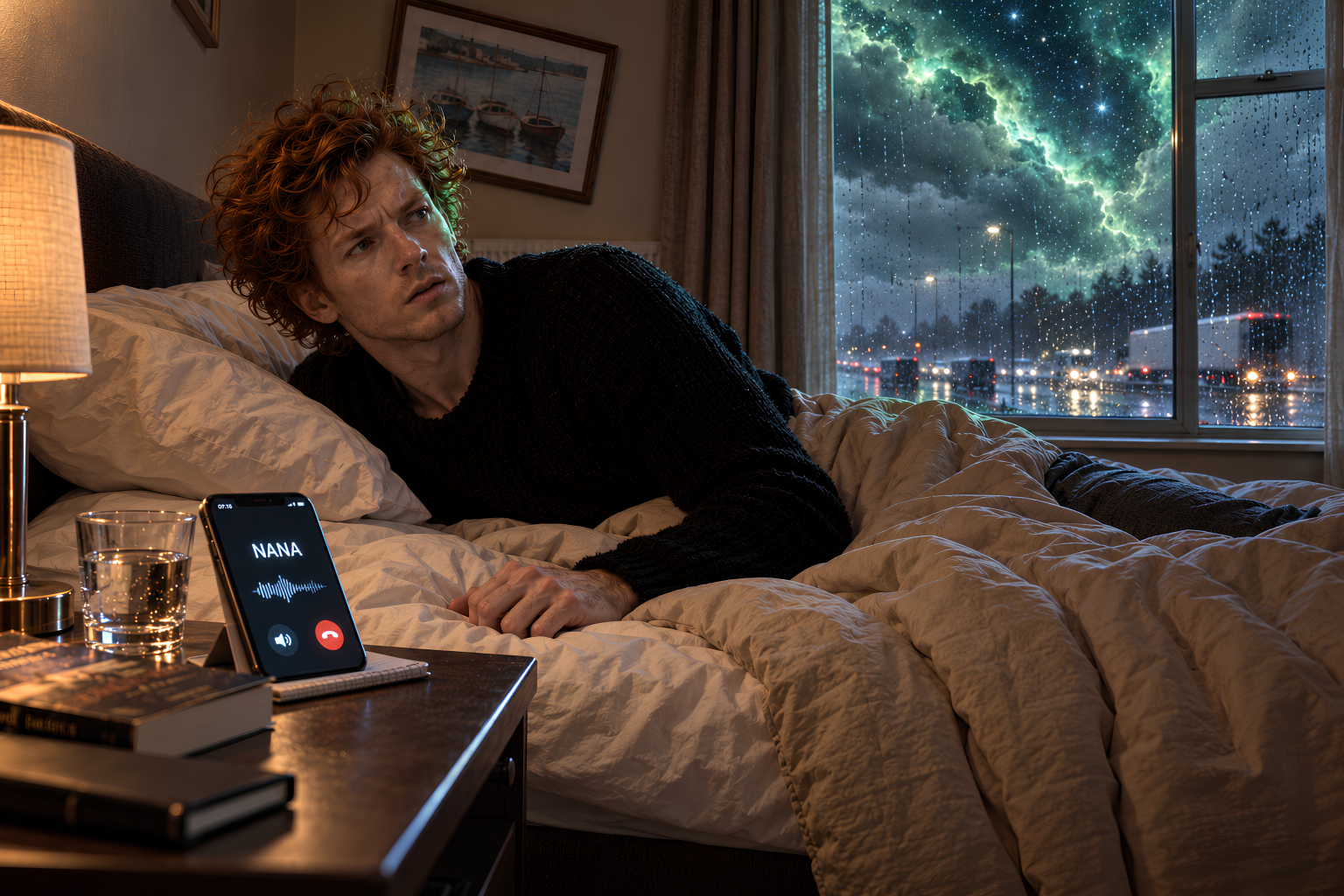
“Get up,” said Nana from the phone on the bedside table. “You’re late.”
Nana was the least grandmotherly creature ever to answer to the name. The joke behind it had outlived everyone who had first laughed at it.
Drew opened one eye. The room was dim and unfamiliar, which meant he had either astral travelled again without remembering the journey or slept in a hotel that had invested heavily in beige. Rain tapped at the window. A print of three boats in a harbour hung crookedly above a radiator. The air smelled of bleach, dust, and the particular sadness of budget accommodation near a motorway.
He reached for the phone and knocked over a glass of water. It did not fall. The water rose from the glass in a wavering column, held itself upright for a moment like a creature considering evolution, then collapsed across the bedside table and into his open notebook.
Drew looked at the wreckage of his notebook. “I was going to drink you,” he told the water.
The alarm continued in Nana’s voice, though Nana had never recorded such a thing and would have added something obscene if he had. Drew found the phone under a paperback he had no memory of buying. The alarm screen showed no time, only a dark line coiled into a loop. He turned the phone off. The voice continued from somewhere inside the wall.
“You’re late.”
“I’m often late,” Drew said. “It’s part of my charm.”
No answer came. The radiator clicked. From the bathroom, where the light was off, mud began to spread under the door.
Drew sat up properly.
Luna’s phone began to buzz. Weather alert. Coastal flood alert. Tidal advisory. Emergency services advisory. Then, absurdly, a message from the landlady reminding all tenants that the bins went out on Thursday, not Wednesday, because “the council won’t take them if people keep being creative.”
Luna read it twice. The second time, she smiled despite herself, thinly and without pleasure. Humanity’s talent for administration at the lip of catastrophe had always struck her as both touching and deranged.
On the wall opposite the bed, where damp had bloomed beneath the paint, a dark patch spread in the shape of a long curve. Not a serpent. Not yet anything so simple. Just a bend, a suggestion of pressure behind plaster. Luna rose and crossed the room barefoot. The carpet was cold, and faintly gritty with sand that no amount of hoovering had ever quite defeated. Beyond the window the sea had stopped withdrawing and now stood too still, a vast sheet of pewter holding its breath.
She placed her palm against the wall. The plaster was cold, and faintly tacky, like skin after a fever breaks. For an instant she felt not moisture, not rot, but grief.
It came up through her hand and into the bones of her wrist: hunger, mud, engines under snow, a child crying without sound, horses screaming in a field of smoke, the small hard terror of a woman counting tins in a cupboard. Luna snatched her hand back. Her breath remained steady, because her body had learned obedience long ago, but the room seemed to tilt around her.
Below, the arcade machines began to play by themselves. Their dead screens flashed colour through the floorboards, cheerful little songs chiming up into the room. A coin tray rattled out a payout no one had won. Somewhere in the dark, the penny falls shuddered awake and began, with terrible patience, to push.
Luna closed her eyes. In the distance, not from the sea but beneath it, something shifted in its sleep.
In Birmingham, Nessa’s laptop chimed. A traffic algorithm she had been monitoring corrected itself, then uncorrected, then displayed a row of symbols she did not recognise and refused to screenshot. Nessa leaned closer. Her reflection hovered over the black glass: silver hair scraped back, eyes that had watched empires die and still found poorly designed junctions offensive, mouth set in the expression of someone prepared to cross-examine God over a planning application.
The symbols vanished. The screen filled with her spreadsheet again. Every column had rearranged itself by date.
Not by modern date.
Nessa went still.
There are several kinds of fear. The common kind runs toward noise. Nessa’s ran toward order. She took a pen from the cup beside her elbow and began writing times in the margin with neat, vicious strokes. When the pen ran dry, she opened a drawer, removed another from a compartment labelled BLACK INK — DAILY USE, and continued. She did not notice the temperature dropping until her breath showed white above the reports and the pen began to drag, its ink thickening like cold honey. By then frost had crept across the inside of the kitchen window in the branching pattern of a clock face.

The second hand on the wall clock stopped at thirteen minutes past six.
Nessa looked at it for some time. Then she stood, crossed the kitchen, removed the clock from the wall, opened the back, checked the battery, checked the mechanism, and placed it face down on the table.
“Unhelpful,” she said.
The mug cracked beside her with a small, dry sound, like a knuckle. Coffee spread across the table, not outward but inward, drawing itself into a dark circular pool over the map of Briarhaven. Nessa did not step back. Her eyes narrowed.
Somewhere below the building, in the foundations, old concrete gave a faint answering groan. It was not the sound of collapse. It was recognition.
At the moment Nessa’s clock stopped, the signal in Amara’s toaster found its voice.
It climbed. It moved through the toaster into the bench lamp, from the lamp into the cracked radio, from the radio into the stripped aerospace device beneath her hands. Screens woke all around the workshop. Dead phones lit in drawers. A child’s toy robot, purchased for parts in 2016, turned its plastic head and said in a cheerful pre-recorded voice, “Let’s learn numbers!”
“Let’s absolutely not,” Amara said.
On every screen appeared the same interference pattern: a pulse, then a pause, then a long descending curve. It was not code. Code had grammar, however ugly. This was older than code, more like pressure translated badly into electricity. The workshop lights dimmed and brightened. Outside, car alarms began going off one by one down the street, not all at once, but in sequence, a dreadful little parade of complaint.
Amara slid out from under the desk. Her left hand twitched, fingers sparking faintly blue-white at the tips. She clenched them until the charge withdrew beneath her skin. Neural Conduction did not always ask permission when the world became interesting. She had once blacked out three city blocks because someone kissed her unexpectedly in Lisbon. The kiss had been mediocre. The outage had been magnificent.
The aerospace device displayed a map. Not the one she had loaded. This map showed the south-western coast in thin green lines, with Briarhaven marked by a pulsing dot. Around it, data bloomed and decayed: tide readings, seismic noise, animal migration, satellite drift, emergency calls, hospital admissions, electrical surges. Too many systems speaking at once, and beneath them all a deeper signal that pressed against the back of her teeth and set up a faint, sour fizz along her fillings, the taste of a battery licked on a dare.
Amara stared. Her amusement thinned, not vanishing but sharpening into something less sociable.
A message appeared on the workshop’s main monitor.
YOU’RE LATE.
She had not typed it.
The workshop became very quiet except for the car alarms and the toaster, which chose that moment to eject two pieces of bread she had not put into it. Both were burned black except for a clean white circle in the centre of each slice.
Amara picked one up with insulated pliers. “Show-off.”
The bread crumbled in her grip. Inside the blackened surface, for the span of a breath, something moved like a shadow passing under ice.
Across London, traffic lights failed in patterns that made no sense. Red held too long at one junction, green stuttered on and off at another, pedestrian crossings chirped in empty streets. A fox stood in the middle of Mare Street and screamed at the sky until a cyclist swerved into a bin and called it a bastard. The fox did not move. Amara heard it through the open window and felt, with a clarity she resented, that the animal was not afraid of anything above them.
It was warning them about below.
In room 214 of the Westway Lodge, Stevenage, Drew touched the corner of his mouth and found a smear of dried salt. When he touched it, the taste came back full and cold. Deep water. Stone. Something breathing without lungs.
He had slept in his clothes again: black jumper, grey trousers, socks mismatched because he insisted that matching socks tempted fate into noticing him. His hair stuck up on one side. The dream returned in fragments, unwillingly.
He had stood beneath the Earth in a place where roots hung like drowned hair and the dark pressed with the weight of oceans. Above him, cities burned and grew and burned again. Fields yellowed. Trenches filled. Bells rang over plague pits. Ships split in black water. Children sang in languages that vanished as they sang them. Beneath it all lay a coil too vast to be seen in full, not sleeping exactly, not waking, accumulating itself through centuries of hurt. Its scales were not scales but faces pressed into shadow, animal eyes, broken tools, dry soil, wedding rings, bullets, empty bowls.
In the dream, Drew had tried to step closer. The mud had held him. A voice, not Nana’s then, not anyone’s, had said something he could not remember, and his body had understood so violently that he woke with his hands clenched.
Now the mud seeped across the carpet. It smelled of rain, iron, and old fields. It moved with a soft, wet patience, making the sound a boot makes when it is drawn slowly out of a ploughed field. Drew leaned over the edge of the bed and watched it approach his shoes.
“I did pay a deposit,” he told it.
The mud stopped.
Drew had never trusted mirrors after dreams. They were too willing. The one above the little desk reflected him with an expression he was not making. He turned it to face the wall and saw, on the underside of the frame, a date carved with the tip of something sharp: 1303. He had carved it himself, perhaps. Or would. Time behaved badly around certain kinds of warning.
His phone, now off, vibrated once. A text appeared from no sender.
BRIARHAVEN.
Drew stared at it. Then he laughed softly, because there are moments when the mind steps aside and lets absurdity take the first blow. His laughter did not last. It left him with a tenderness in his throat he disliked.
On the floor, the mud formed a shallow groove pointing south-west.
He thought of Nana, who would have said it was probably nothing and then driven toward it at illegal speed. He thought of the others in the vague, painful way one thinks of family after a funeral: not all at once, never safely. He thought of a fall through cold brightness, of hands torn from his, of waking centuries later under a sky that had no right to be so beautiful after what it had done.
Drew packed badly. He always did. Into his bag went two shirts, a notebook ruined by impossible water, three hotel pens, a book of poems he had stolen from a woman in 1694 and still meant to return, and a pair of shoes he did not like but trusted. He left the room key on the desk beside a twenty-pound note and a written apology for the mud. The apology was unnecessary. The mud had already withdrawn, leaving the carpet cleaner than before.
By seven-thirty, the world had begun to notice itself malfunctioning.
At Heathrow, the departure boards showed flights arriving before they had taken off. In Mumbai, a financial server duplicated a morning’s trades, briefly making several men rich enough to consider virtue. In Oslo, reindeer came down from high ground and stood in a tunnel until traffic stopped. Off the coast of Chile, a fishing crew watched the sea flatten into glass while every compass on board pointed straight down.
News sites began cautiously: technical issues, a rare atmospheric event. Governments disliked panic unless they were using it. Social media, that great democratic altar of alarm, filled with videos: auroras over Nairobi, pigeons spiralling above Paris, a microwave in Toronto counting backward in Latin. Half the videos were fake within the hour. The true ones looked faker.
Luna walked the Briarhaven front beneath a sky the colour of unpolished steel. She wore boots now, and a long dark coat, and had twisted her hair up with a pin older than the church at the end of the promenade. The arcade below her room had fallen silent after playing three different winning jingles at once. Along the sea wall, residents gathered with phones raised, their faces pale in the light. The tide had returned but not correctly. It came in long narrow bands, one after another, like muscle under skin.
A boy in a school blazer stood too close to the edge, filming. Luna took him by the back of the collar and moved him three feet inland without looking at him.
“Oi,” he said, more startled than angry.
“Die after breakfast,” she said. “It’s vulgar otherwise.”
He stared at her. She continued walking.
At the old flood barrier, the water was climbing the metal gates in thin streams against gravity. Not pouring over, not splashing, but climbing, testing each bolt, each seam. Luna set her hand against the gate. The streams flattened immediately and fell back into the harbour. A gull dropped from the air and landed beside her, trembling. Its black eye fixed on hers.
“I know,” Luna said.
The gull opened its beak. No sound came. Around its feet, seawater fizzed as though something beneath had exhaled through it.
Luna felt the pull then, clear as a hand beneath her ribs. Not from the harbour. Farther west, beyond the town, where the cliffs broke around Saint Oran’s Head and the old fault ran under the sea. A place of landslips, drowned caves, wartime concrete, and warning signs ignored by teenagers. She had been there once in the 1960s with a man who made her laugh until she hated him for it. Not the one whose name began with L. She allowed herself that correction. The mind could be cruel, but it need not be lazy.
Her phone buzzed again. Unknown number.
COME TO THE FAULT.
Luna deleted it. Then she opened the message, undeleted because the phone apparently had opinions, and read it again.
“Fine,” she said. “But I’m not being dramatic about it.”
She did not leave. Not yet. The sea had not finished with the harbour, and she knew it.
Nessa had already chosen Briarhaven before the summons became vulgar enough to send messages.
She stood in her flat in a charcoal coat and boots polished to a dull shine, checking items off a list she had written in 2003 and updated quarterly. Documents, cash, knife, two phones, medication, torch, water, protein bars, spare gloves, folding map, train routes, false identification, lock picks, thermal blanket, peppermints. The peppermints were not essential, but she disliked the taste of fear in her mouth and had found over the centuries that mint bullied it into submission.
The lift had stopped between floors. Nessa took the stairs. On the fourth-floor landing, Mrs Adeyemi from 4B stood with her door open and a dressing gown belted over work trousers, staring at her phone.
“Do you know what’s happening?” Mrs Adeyemi asked.
Nessa considered the possible answers: yes, no, nothing useful, several things impossible to explain without sounding like an underfunded cult leader. She settled for: “Systems failure.”
“Oh, God.”
“Unlikely to be involved.” Nessa adjusted the strap of her bag. “Go back inside, Mrs Adeyemi.”
Mrs Adeyemi looked down the stairwell, where the emergency lights stuttered. “Should I leave?”
Nessa paused. She had no obligation to this woman except proximity and the minor respect due to anyone who sorted recycling correctly. Obligation, however, had never been a small thing to her, however much she resented it.
“Pack your medication, documents, warm clothes and water. Avoid the lift. Keep the radio on. If the council sends instructions, ignore the first version and wait for the correction.”
Mrs Adeyemi blinked. “You work for the council, then, love?”
“No.”
“Government?”
“Worse.”
“What’s worse than government?”
Nessa allowed herself half a second of satisfaction. “Consulting.”
Mrs Adeyemi laughed, which was useful. Fear moved differently after laughter; less efficiently. Nessa continued down the stairs and out of the door before her neighbour could say another word.
Outside, the city had entered the first stage of public disorder: not panic, but irritation with panic’s scheduling. Buses were late. Contactless payments failed. Traffic lights along the ring road flashed amber in unison. People stood outside offices complaining into phones that had no signal. Above them, faint green light wavered in the morning sky, an aurora where no aurora belonged.
Nessa’s hired car would not unlock. She tried once. The screen on the dashboard lit behind the glass and displayed a route to Briarhaven.
She had not entered one.
For several seconds she stood on the pavement in the rain, looking at the car with an expression of profound personal betrayal. Then she smashed the driver’s-side window with the emergency hammer from her bag, reached in, unlocked the door manually, and sat behind the wheel while the alarm screamed.
“Do not start with me today,” she told the car.
The alarm stopped.
Amara, meanwhile, had decided not to go to Briarhaven, which lasted until every device in her workshop began arranging itself into a map of the route.
The stolen aerospace unit projected coordinates across the ceiling. Her phones displayed train times. The ancient radio spat fragments of shipping forecasts. The toy robot marched in circles on the bench chanting, “South-west! South-west! South-west!” in its bright educational voice. Amara watched this for nearly a minute while eating the unburned centre out of the second piece of impossible toast.
“I preferred it when appliances respected boundaries,” she said.
A spark snapped from her wrist to the bench. The projected map shivered and narrowed, showing Saint Oran’s Head. Beneath the coordinates ran a line of data that was not data: pulse, pause, curve. Pulse, pause, curve. A signal shaped like something dragging itself through stone.
She could have ignored it. She had ignored summonses before. Immortality, or whatever bargain passed for it in their damaged condition, made rebellion petty by necessity; if one wished to remain sane, one needed hobbies, and Amara’s favourite was refusing the obvious. Yet the signal did not command. It suffered. That was harder to dismiss.
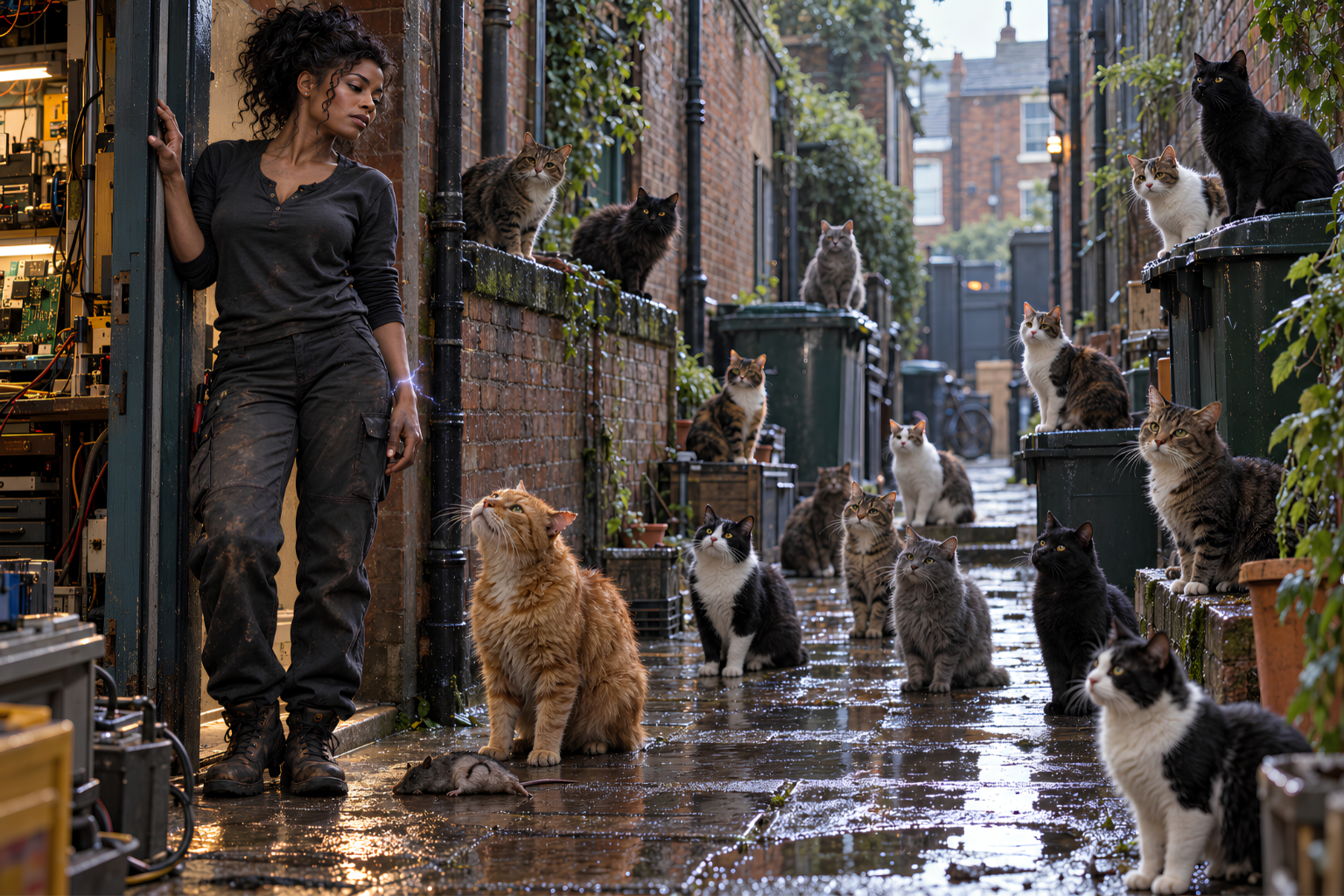
In the alley behind the workshop, every cat in the neighbourhood had gathered on the bins and walls. Fifteen of them, perhaps more, sitting in ranks beneath the wet brick like a jury. When Amara opened the back door, they turned their heads toward her in perfect unison.
“Oh, absolutely not,” she said. “I don’t take instructions from cats.”
The largest, a torn-eared ginger with the moral confidence of a landlord, stepped forward and dropped something at her feet. A dead rat. Its body was stiff, its fur wet. Around its belly, in mud, was marked the same curve she had seen in the signal.
Amara stared at it. The cats stared at Amara.
“Fine,” she said. “But if this is a cult, I’m invoicing someone.”
She packed less than Nessa and more than Drew: tools, chargers, three modified phones, insulated gloves, a coil of wire, a collapsible baton, a packet of biscuits, and the small photograph she kept inside a broken voltmeter because she disliked frames. It showed a bridge in winter and, in one corner, Nessa looking younger only because the coat was worse. Amara shut the voltmeter before memory could become sentimental.
By the time she pulled down the shutter on the workshop, the streetlights were on at eight in the morning and buzzing like trapped insects. She touched one as she passed. The buzz quieted briefly, almost gratefully. Amara pulled her hand away and told herself not to be ridiculous.
Drew reached King’s Cross after nine, though he could not remember boarding the train from Stevenage. This happened occasionally and was one reason he disliked public transport: too many doors, too much reflected glass, too many strangers dreaming with their eyes open. He emerged into the station beneath a departure board that flickered between destinations and, for one heartbeat, showed names no railway had used: Carthage, Ys, Nineveh, Doggerland, Home.
He stopped so abruptly that a man with a suitcase hit him from behind.
“Watch it,” the man snapped.
“I try not to,” Drew said.
“What?”
“Nothing. Sorry.”
He moved on before the man could decide whether to be angrier. Around him, the station churned with disrupted travel. The concourse smelled of brake dust, burnt coffee and wet coats, and the cold off the platforms came in under the barriers like a draught under a door. Announcements overlapped, apologising for delays in tones that suggested the railway had misplaced time through no fault of its own. A little girl in a red coat stood near the ticket machines, staring up at the glass roof. Drew followed her gaze.
For a moment, the sky beyond the roof was not London’s sky. It was too deep, too crowded, full of hard white points and a wound of moving green. Then a train announcement crackled overhead and the ordinary grey returned.
The girl looked at Drew. “Did you see the snake?”
Drew’s mouth went dry. “No.”
She considered him with pity. Children had very little patience for adult cowardice. “You’re lying.”
“Yes.”
“Why?”
“Practice.”
Her mother pulled her away before the conversation could become useful. Drew watched them vanish into the crowd. He found himself touching the inside of his left wrist, where the skin had gone cold. Beneath it, faint as a bruise under moonlight, dark lines formed and faded: the shared wound none of them liked to discuss unless drunk, cornered, or dying.
He bought a ticket to Briarhaven from a machine that charged him twice and printed thirteen receipts. He kept all of them. It seemed unwise to offend omens in bulk.
He crossed London to Paddington by a route he would never afterwards be able to explain. There, under a sign for delayed coastal services, a busker played the violin. The tune was old enough that Drew had heard it first on bone flute. He dropped all his coins into the case. The busker nodded without looking up.
“Bad weather coming,” the man said.
Drew looked down the dark throat of the platform. Air moved out of it, damp and mineral-cold, smelling briefly of mud.
“Yes,” he said. “Though I think the weather is being blamed unfairly.”
At 10:02 Greenwich Mean Time, the Dead Sky Incident entered its official thirteen minutes.
Later reports would disagree about the beginning. That was the nature of events that disturbed clocks. Some placed it at 10:01:47, when the first satellite lost orientation over the Atlantic. Some chose 10:02 exactly, because the human mind prefers neatness even when reality refuses it. Some blamed a solar flare. Others argued it had begun hours earlier in tides, dreams, animals, data. A few, much later and much less publicly, would wonder if it had begun before history and only now found a shape human instruments could panic over.
For most people, it began when their phones went black.
Not dead. Black. Every screen, every television, every tablet, every watch face and airport display and dashboard panel dimmed at once, as if the world had closed its eyes. For the length of a held breath, the electric murmur beneath every city faltered: the whine of chargers, the hum of fridges, the long exhalation of air-conditioning in sealed offices. Into that silence came birdsong, the tick of cooling engines, a baby somewhere, and millions of people discovered, briefly and with horror, how loud their own hearts were.
Then, one by one, the screens returned showing the wrong time: ahead in some places, behind in others, never by the same amount twice. In cities with old clocks, bells rang without hands moving. In hospitals, machines hiccupped and resumed. In prisons, locks opened and closed but did not release. In churches, microphones shrieked. In data centres, engineers watched systems lose no information but rearrange it with an order that felt, to the more honest among them, like contempt.
Auroras unfurled across daylight skies. Not everywhere, not equally. Green in London, violet over Johannesburg, red above Seoul.
In Briarhaven, the sky silvered from horizon to horizon, and the sea climbed the flood barrier again, not in panic now but procession. Water rose in ropes, glistening and muscular, with the slow creak of wet hemp taking a strain. Along the harbour, people screamed and filmed and ran. Luna stood among them with her hands at her sides, coat whipping around her knees, face lifted toward the wrong light.
She still remembered falling.
It came without mercy and without detail: brightness, rupture, the terrible absence of weight before impact. Beside the memory lay another, sealed and shining, and her mind turned from it as it always did. Heat. Hands. A laugh swallowed by fire. She would not look. She had survived centuries by not looking.
The water reached the top of the barrier and paused. Luna raised one hand, and the whole grey weight of the bay leaned against her palm.
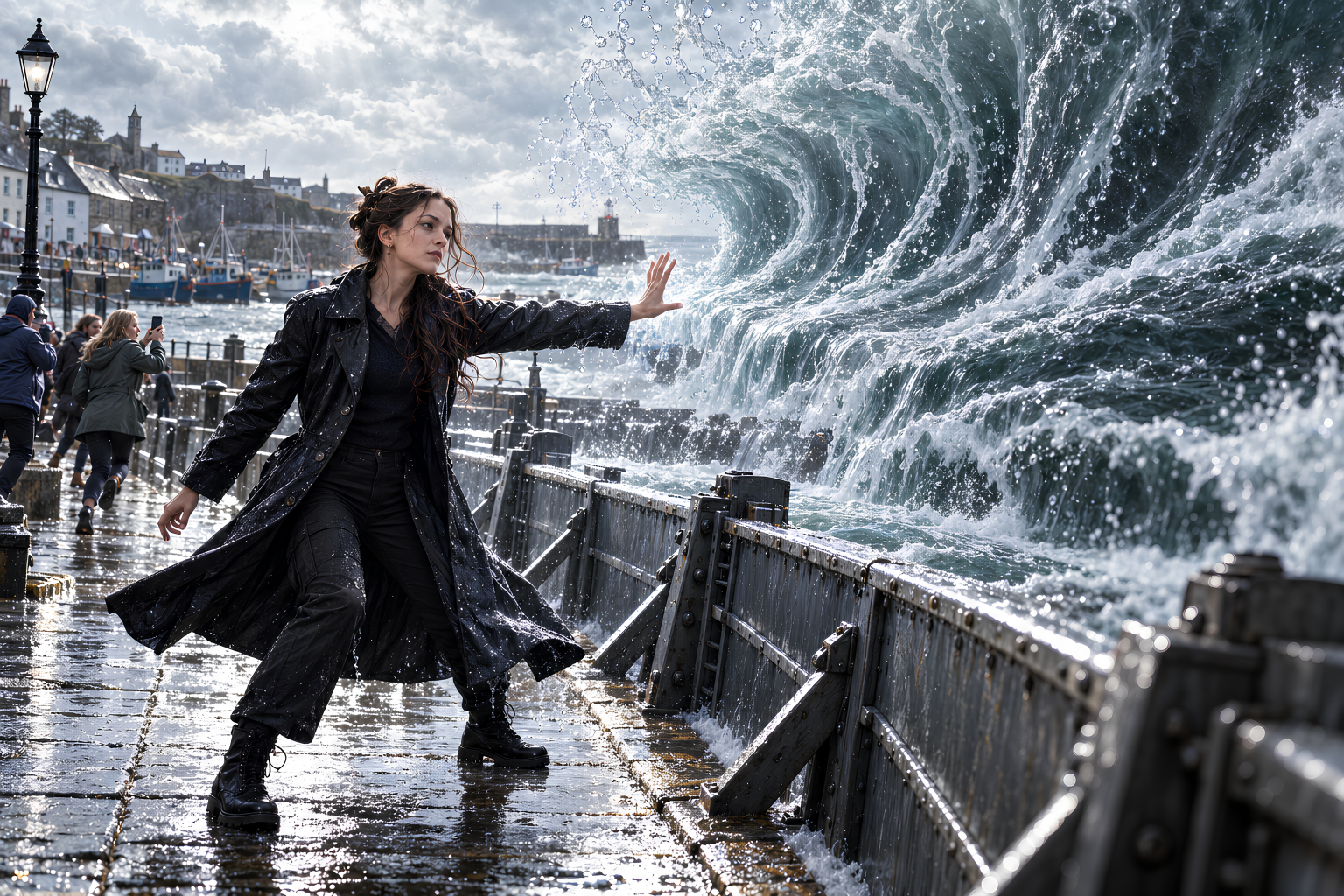
She held it. For a long moment she held all of it: the barrier, the marina, the drowned streets beneath the promenade, the town’s thin crust of brick and habit. Her arm shook. Salt stung her eyes. Somewhere behind her a child was crying, and she could not turn to see whose.
Then, at the far end of the harbour, one rope of water slipped her grip.
It went over the old lifeboat slipway, where a dozen people stood filming, and it did not crash so much as gather. It lifted the end of the slipway with a long groan of iron and folded the railings like paper. Phones flew. Someone screamed a name. A boy in a school blazer went over the edge with the concrete.
Luna let go of the sea.
She did not remember crossing the harbour. She remembered the cold, which struck like a blow to the sternum, and the dark beneath the surface, thick with grit and churning weed and the shapes of things that had been the town’s floor for a century. She remembered her hand closing on the back of a collar, as it had that morning, and the absurd, living weight of a boy who did not want to drown. She remembered dragging him up the weed-slick steps, his forehead opened on the rocks, his blood warm on her sleeve and then cold.
And she remembered the moment, behind her, when the sea understood it was free.
It did not take the town. It took the end of the harbour: the harbourmaster’s hut, three fishing boats torn from their moorings, a length of railing, and a man in a yellow oilskin who had been trying to tie down his boat. Luna saw the yellow for an instant in the grey. Then she did not.
The water fell back. The barrier held. The boy coughed seawater onto the steps and began, hoarsely, to cry. People were running toward them now. No one was watching the sky any more.
Luna knelt on the wet stone with her fist still knotted in the boy’s blazer and looked at the place where the yellow had been. She had chosen. It had taken less than a second, and it had been the right choice, and that did not help in the slightest.
In Birmingham, Nessa’s hired car stopped in the middle of a junction. Every vehicle around her did the same. Engines cut. Horns failed. Rain hung briefly in the air as though reconsidering gravity. Nessa looked at the dashboard, where the route to Briarhaven remained glowing.
The car clock read 10:15. Her watch read 09:49. Her phone read 13:13. The small travel clock in her bag, wound by hand and trusted more than most people, had stopped entirely.
Nessa inhaled through her nose, held the breath for four counts, released it for six. She did this three times. Then she got out of the car, walked to the vehicle behind her, and knocked on the driver’s window. A young man lowered it halfway, wild-eyed.
“Stay in your vehicle,” she said. “Do not attempt to restart until systems return.”
He stared. “Who are you?”
“Busy.”
She returned to the car. The rain fell. Engines restarted in a wave. Nessa drove through the junction under a sky lit like a wound.
In London, Amara stood on the roof of her workshop with a length of copper wire wrapped around one forearm and her modified phone in the other hand. She had gone up to improve reception and because, despite herself, she wanted to see what the sky was doing. The aurora moved above the city in pale green sheets, sliding between tower blocks and crane arms, reflected in puddles and bus windows. Every antenna in a mile radius leaned imperceptibly toward the south-west.
The signal hit her through the bones.
She gasped and gripped the parapet. For a moment the city’s electrical life opened under her: trains, routers, lifts, servers, pacemakers, stolen chargers, traffic cameras, kettles, a thousand bedrooms where phones lay face-down beside sleeping grief. Beneath all of it came the other pulse, too slow for machine, too deliberate for weather. It travelled through wires because wires were available. It would have travelled through blood if blood had been more efficient.
Amara’s teeth clicked together. Sparks crawled over her skin and snapped along the copper. The roof door slammed open behind her. Her neighbour, Mr Patel, emerged with an umbrella and a cricket bat.
“Are you doing this?” he demanded.
Amara turned her head slowly. Her hair had lifted around her face in the charged air. “That is a hurtful level of confidence.”
“You blew up my router. Twice. Last month.”
“I improved its character.”
He looked past her at the sky. The bat came down by inches, and when he spoke again the anger had gone out of his voice and left something smaller behind. “Should we be worried?”
Amara listened to the pulse. For the first time that morning, she did not enjoy being the cleverest person within shouting distance.
“Nah,” she said, and smiled at him the way one smiles at a child on a turbulent flight. “Probably not.”
The copper wire on her forearm had begun to burn.
The thirteen minutes ended. Screens returned. Clocks stabilised by pretending nothing had happened. Across the world, authorities issued statements with the exhausted speed of institutions trained to deny mystery before naming it. The Dead Sky Incident became a phrase before it became an understanding. That, too, was human: give a thing a title and hope it behaves.
Luna did not wait for the lifeboat to come back. She told herself it was because the pull beneath her ribs had grown too strong to refuse. It was nearly true.
She took the cliff road toward Saint Oran’s Head in an old blue car with a heater that worked when praised. The road rose beyond Briarhaven through gorse and wet grass, past warning signs for landslips and unexploded ordnance left from a war everyone agreed was history because the alternative was unbearable. The gorse was in flower, absurdly yellow against the slate of the sky, and through the vents its scent came in warm and wrong: coconut, as if someone on that freezing headland had opened a bottle of sun cream. The sea moved beside her, too close and too attentive.
Nessa took the motorway south-west, breaking several traffic laws with precision rather than enthusiasm. Road signs began showing distances that changed as she approached. On the passenger seat, her notes rearranged themselves whenever she looked away.
Amara stole a van, because the trains were down and the van belonged to a man who had once tried to pay her in exposure. Its radio played only shipping forecasts. Every cat in the alley watched her go.
Drew took the delayed coastal train from Paddington, in a seat facing away from the direction of travel. He preferred not to see the future approaching at speed. Across the aisle, a boy watched videos on a dead phone, the blank screen reflecting his face with a second face behind it that vanished when Drew blinked.
There are summonses that arrive as trumpets, as visions, as names spoken by burning mouths. This one used failing infrastructure, animal unease, bad weather, cheap electronics, old wounds, and the private habits of four damaged immortals. It did not need grandeur. Grandeur had failed them before.
By late afternoon, the Dead Sky Incident was already being corrected, debated, exploited. Markets dipped. Conspiracy channels multiplied. A minister in London assured the public that there was no evidence of hostile action, merely a freak weather event. This was true only if one’s definition of evidence excluded the behaviour of oceans, foxes, satellites, clocks, and gods. In Briarhaven, the lifeboat was still searching.
Saint Oran’s Head waited under a lowering sky.
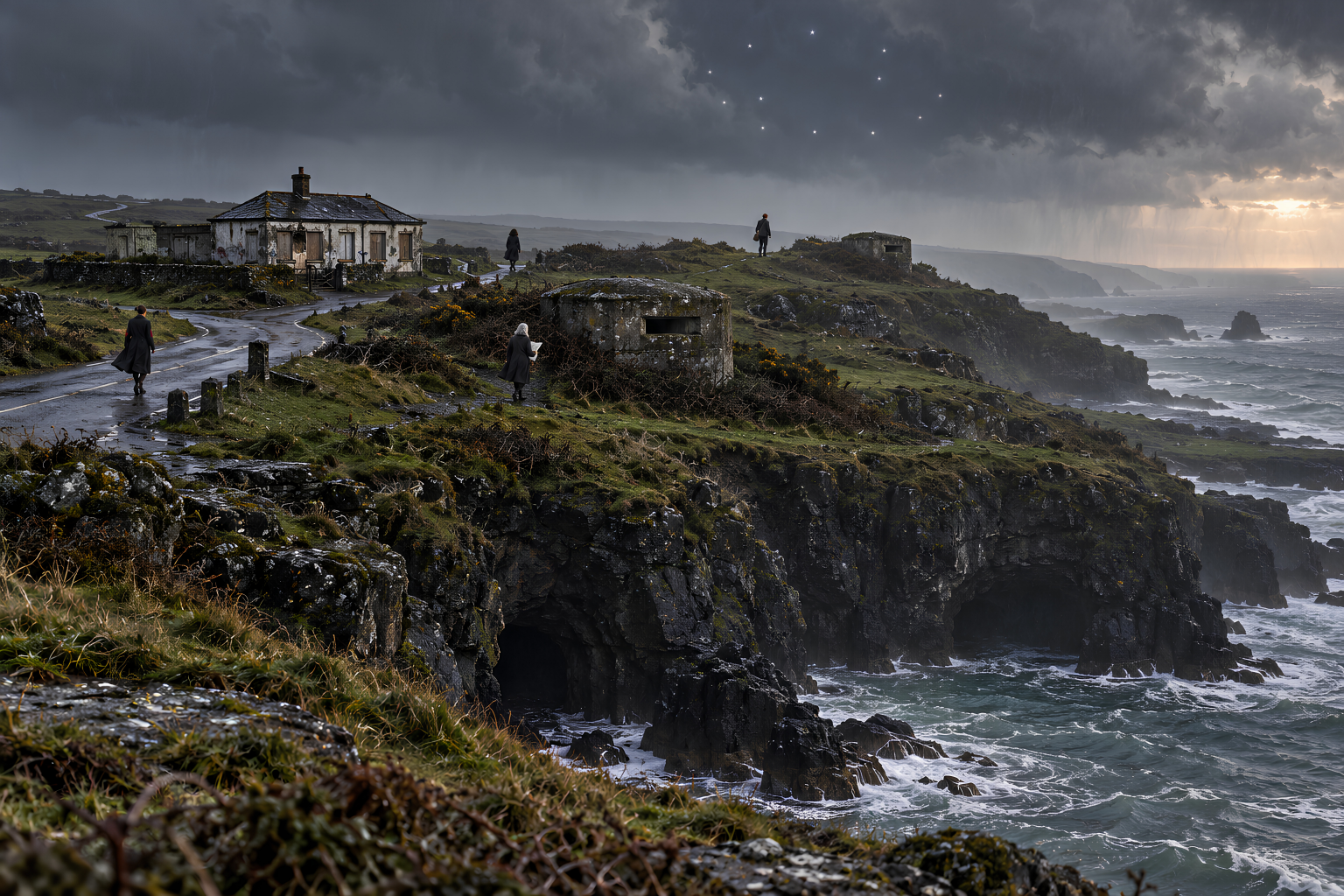
It was not an impressive place at first glance, which is how old places survive. A cliff of dark shale and grass. A narrow road with passing spaces. A disused coastguard station boarded up and tagged by bored teenagers. Concrete bunkers from the war slumped among brambles. Below, half-hidden by tide and shadow, sea caves opened in the rock like mouths refusing confession. The fault ran offshore and inland both, an old fracture in the crust, mapped, monitored, underestimated.
The first to arrive was not Luna, though she was closest. She stopped half a mile from the headland when a line of sheep blocked the road and refused to move. They stood shoulder to shoulder, rain silvering their wool, every blunt face turned toward the cliff. The car filled with the smell of wet wool and lanolin. Not one of them made a sound. Luna sat behind the wheel with both hands resting on it and waited. She had learned patience from tides and revenge from men; the first had proved more useful. After seven minutes, the sheep parted. She drove through without thanking them.
Nessa arrived next, by a route no navigation system admitted recommending. Her hired car, which she had begun to regard as an accomplice of poor character, died beside the boarded coastguard station. She stepped out and looked toward the sea, and saw the tide standing still halfway up the rocks.
Amara reached the headland in the stolen van with the heater on full and the windows down because the electrical charge inside had become uncomfortable. The radio hissed as she turned off the engine. From the hiss came half a syllable, almost a word, shaped by too many mouths. She hit the dashboard. The radio fell silent.
Drew’s train did not reach Briarhaven. It stopped two miles outside town after the driver reported livestock on the line, though none could be found. Drew got out through a door that should not have opened, walked along the track in the rain, crossed a field, and came over the ridge above Saint Oran’s Head just as the light began to fail.
They did not yet see one another. The land arranged itself between them: station, bunker, road, cliff, rain, distance. Each arrived carrying the day in a different form. Luna carried blood on her coat and grief under her tongue. Nessa carried maps, peppermints, and a rage for the badly explained. Amara carried tools, stolen transport, and a signal still trembling in the nerves of her hands. Drew carried mud on the soles of his shoes from a hotel room that should have been clean.
Below them, in the sea caves, water withdrew from stone with a sound like breath drawn through teeth.
The sky over Saint Oran’s Head darkened before sunset. For a few seconds, not long enough for certainty, the first stars appeared in daylight: twelve pale points scattered around a place where a thirteenth did not shine. Then cloud closed over them, and the modern world returned with its rain, its warning signs, its broken signals, its four approaching figures pretending not to understand why they had come.
The fault beneath the headland answered them once, deep in the Earth. Not a quake. Not yet. A pulse.
Luna stopped walking. Nessa looked up from her instruments. Amara’s hands sparked blue in the rain. Drew closed his eyes and listened.
The same pressure moved through all four of them, ancient and intimate, like a hand pressing from the other side of a door.
They had all spent centuries mistaking survival for purpose. That day, purpose found them anyway, without apology and without asking whether they were ready.
None of them yet knew the others had come. A few hundred yards of rain and rock lay between them, no more. And under Saint Oran’s Head, something old enough to know their first names had already begun to count.