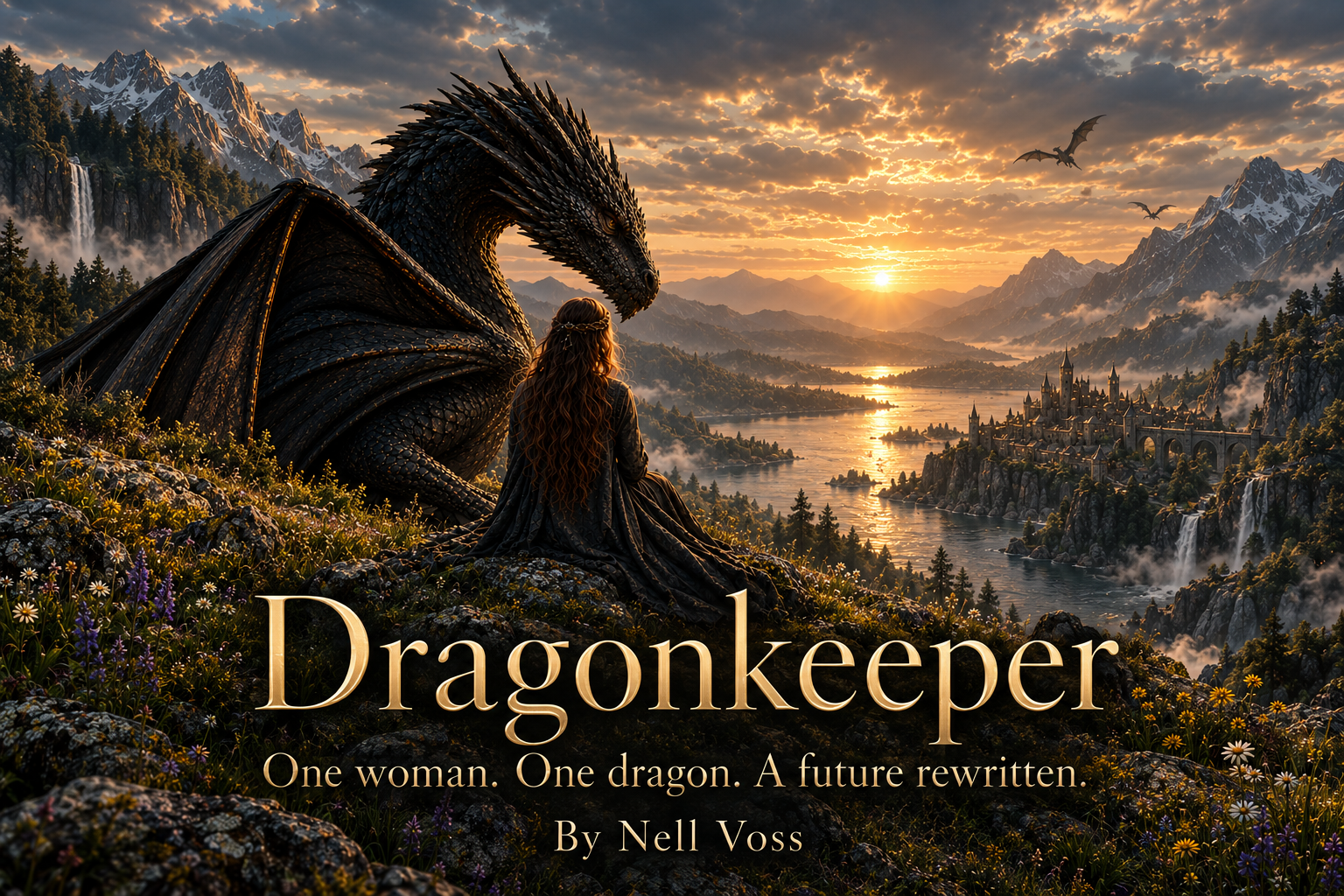
DRAGONKEEPER
Episode 1 · By Nell Voss
The Choosing
The forest did not care for the century turning, which was one of the reasons Catryn had chosen it. Down in the cities, great clocks had been lit in the public squares a month ago, their faces glowing above the crowds, counting the days until the old century died and the gods, in their excellent and inconvenient mystery, decided what humanity deserved next, and whose bodies would be made to carry the answer. There would be bells in the capitals, prayers broadcast in every official language, interviews with theologians whose collars cost more than a winter’s worth of grain, and children set to singing the old hymns in voices too bright to know what they were celebrating. Confectioners would sell sugar eggs wrapped in gold foil. Bookmakers would take wagers on which province would be blessed. And the great Houses would bring their dragons out onto the balconies, hooded and harnessed, to be admired by people who had never once thought to ask them how they felt about being admired.
The forest kept its own calendar. It marked time in thaw water, foxglove, antler shed, blackberries, the sour reek of mushrooms after rain, and the long patience of trees that had been old before Catryn’s family first learned to put a dragon on a banner and call the resulting arrogance heritage. It kept other dates too, ones no almanac recorded: the night each autumn when the stream ran briefly uphill, the pale lights that rose from the bracken after the first hard frost, the hour in late summer when every bird in the valley fell silent at once and no one had ever been able to say why. The forest had outlived a great many centuries and had not yet been impressed by one.
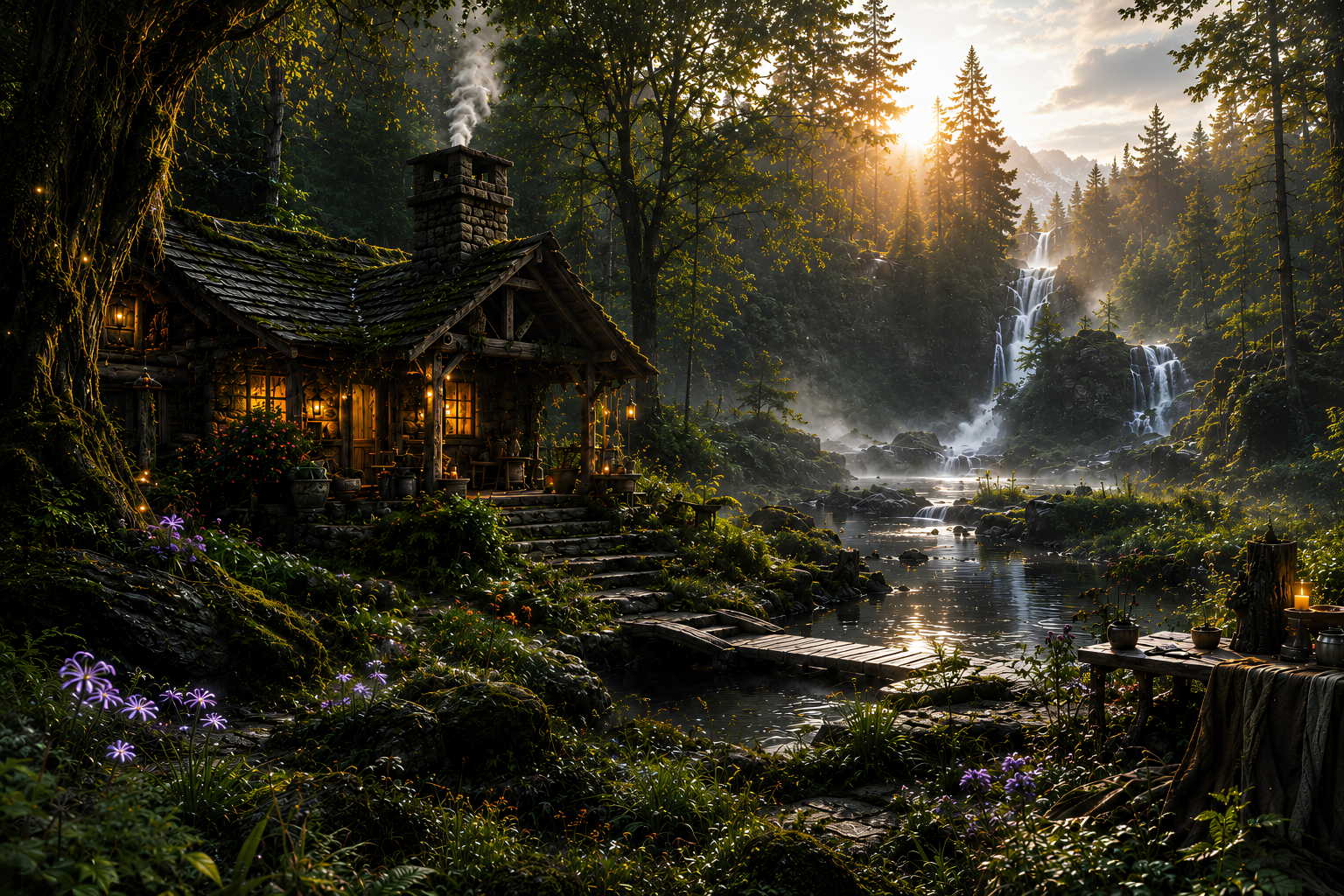
Her cabin stood in a shallow fold of northern woodland where the pines gathered close but did not crowd. It had two rooms, a crooked stone hearth, a pantry dug into the hill behind it, and windows small enough to discourage curiosity. Moss grew on the roof despite her yearly attempts to scrape it clean, and in spring the threshold disappeared under a disorderly congregation of thyme, nettle, and one stubborn white rose that had no business surviving so far from cultivated soil.
Catryn blamed the rose on her grandmother, though the old woman had been dead for years and had never set foot in this particular wilderness. Lady Enid had grown white roses against the north wall of the Veyr kitchen gardens, where nothing else would take, and had refused every gardener who offered to move them somewhere more flattering. “A white rose goes where it’s needed,” she had told Catryn once, snipping a bloom with the same small silver scissors she used on letters she disliked, “not where it’s admired. Rather like a decent woman. Or a good knife.”
Some people left jewellery behind. Her grandmother had left disobedient plants and inconvenient standards, and Catryn had yet to decide which was harder to keep alive.
At dawn, Catryn carried two buckets from the stream and found that something had been at the turnips again. The culprit had left hoofprints in the wet soil, delicate as punctuation, and bitten only the largest leaves with the luxurious selectiveness of the truly unthreatened. She stood over the damage for a while, water dripping from the bucket rims onto her boots, and considered the moral failing of deer. City people liked to imagine woodland creatures as pure-hearted. City people, in Catryn’s experience, had rarely had to defend a turnip bed from a doe with the appetite of a minor baroness.
“May your children have opinions,” she told the hoofprints, which was one of her milder curses.
The forest gave no answer, though the trees around the clearing shifted their needles in a wind Catryn could not feel against her face. That happened often near her cabin. Not enough to frighten her, and not often enough to become ordinary. The old maps, the forbidden ones her grandmother had kept wrapped in oilcloth beneath the lining of a cedar chest, had marked this part of the north with a broken ring: thin place, old growth, unreliable boundary. Catryn had selected it for precisely that reason. Machines failed more often here. Signals wandered. Strangers lost paths they had followed perfectly well the day before and came out hours later with mud on their knees and the offended expression of people who had been personally corrected by geography.
She took the water inside, set one bucket beside the hearth and the other near the washstand, then began the small labours by which she had kept herself alive and mostly unbothered since leaving the House of Veyr. Ashes out. Fire coaxed. Oats soaked. Tea measured. Snare checked. Herbs turned where they hung from the rafters in dry, fragrant bundles. Catryn preferred morning because it gave a person work before thought could grow extravagant. Her hands knew what to do, and the hands were more sensible than the mind. They did not revisit marble corridors, or the stink of oiled leather, or the sound a young dragon made when a handler corrected it with a silver hook and everyone in the viewing gallery pretended not to hear.
The wireless sat on the shelf beside a cracked jar of honey, sulking in its wooden case. Catryn had bought it from a man in Harthwick who had sworn it could catch the capital broadcasts even in bad weather. He had been lying, of course, but not exceptionally for a merchant. On clear days the set received music, shipping bulletins, weather reports, market gossip, and the occasional sermon if the wind was in a vindictive mood. During storms it received static, distant bells, and once, unmistakably, a woman reciting names in a language Catryn had not heard since childhood. She had not turned it off quickly enough that day. For an hour afterward she had sat with her hand on the cold stove and remembered her grandmother’s voice correcting her pronunciation of draconic vowels, patient until the third mistake and ruthless after the fourth.
“Again,” Lady Enid would say, rapping the table with one knuckle. “You are saying it like a clerk reading out a tax. A dragon does not hear the word, child. It hears what you meant by it. If you mean nothing, it hears nothing, and it will think less of you for wasting its time.”
“What should I mean?”
“Whatever is true.” A sniff. “Which is why most of this family never got past three words.”
Now the wireless remained silent because Catryn had removed its power cell before breakfast and placed it in the flour tin, a decision that was neither mature nor especially useful. The Choosing would be announced before noon. Avoiding the broadcast would not prevent the gods from doing whatever they intended, but Catryn had long ago accepted that a significant portion of private dignity consisted of refusing to sit still while other people made a spectacle of things that should have been handled with awe and dread.
She ate standing up at the counter because the chair by the window had developed a wobble and she had not yet forgiven it. The oats were over-salted. The tea tasted faintly of smoke, and sat warm beneath her breastbone long after she had finished it, a small, steady heat she put down to drinking it too fast. Outside, the clearing brightened by degrees, mist lifting in torn veils from the low ground between trees. In places where sunlight touched the grass, small motes hovered and vanished, not insects exactly, though they moved with a restless, living intention. There were more of them than usual this morning. They had gathered thickest by the threshold, drifting about the white rose like sparks above a forge that had forgotten to be hot, and once or twice they seemed to lean toward the window where she stood. Catryn had learned not to stare at them too long. Magic in the forest disliked being studied. It behaved like an elderly relative at a wedding: present, influential, and inclined to make trouble if directly addressed.
By midmorning she had mended the lower hinge on the pantry door, sharpened three knives, bundled dried yarrow into paper twists, and carried the deer-chewed turnip leaves to the compost heap with more ceremony than they deserved. All the while she felt the day waiting beyond the trees. It was not a premonition, or at least she told herself it was not. Catryn did not care for premonitions. They were untidy things, beloved by priests and women who wrote pamphlets about moonwater. What she felt was more practical, and therefore worse: the pressure of a world she had left behind continuing to exist without anyone’s permission.
At noon she put the power cell back into the wireless.
The set crackled, spat, and produced a burst of applause so sudden that Catryn nearly dropped the honey jar. The sound filled the cabin in a vulgar rush. Brass music, bells, a crowd roaring from some great square far to the south, and over it all the polished voice of a public herald trained to make catastrophe sound like tradition.
“—confirmed by the High Sanctum at first light and witnessed by representatives of the Twelve Houses, the College of Veil Physicians, and the Office of Civic Devotion.
The Sanctum reminds citizens that the quickening may take until the following dawn to complete, and that the identities of the chosen mothers will be announced only after their safety has been secured. Celebrations are already underway in Veyr, Orlanth, Merrow, Kesta, and the eastern provinces, where temple bells have rung since dawn in honour of the gods’ continued favour.”
Catryn leaned on the table with both hands and stared at the radio as though bad posture might intimidate it into silence. The herald’s voice had the particular brightness of a man who had never been required to clean blood out of grout. Continued favour. That would be the official phrase. It would be printed on banners, embossed onto ceremonial invitations, repeated by schoolchildren, and carved somewhere above a door through which no frightened woman had ever been allowed to leave once the physicians had finished smiling at her.
The broadcast shifted to a woman from the Sanctum, older by the sound of her, with a tremor in her consonants that might have been age or well-rehearsed feeling. “We ask all citizens to receive the Choosing with gratitude, sobriety, and reverence. Those blessed to bear the eggs of the coming century are not merely mothers of dragons, but mothers of renewal. Through them, the covenant endures.”
Catryn laughed once, a dry and joyless sound that startled even her. Through them. That was how they always put it. Never through their torn bodies, through their ruptured organs, through the year in which they were painted gold and fed sugared figs while men with rings on every finger discussed the future ownership of the creature growing inside them. The chosen mothers were not hidden from death; they were decorated for it. If their bodies did not split beneath the miracle, there were always knives enough to finish what worship had begun. The world admired sacrifice most when it could arrange the flowers.
Her grandmother had said that once, in a way. Not in those words. Lady Enid Veyr had not been a woman given to maxims unless they could draw blood. She had been small, silver-haired, and bent by the end, with hands that shook only when she was tired and a temper that improved no one. She kept boiled sweets in one pocket and a dragon-scale charm in the other, and mixed them up often enough that Catryn had once spent an afternoon sucking solemnly on a piece of shed scale while her grandmother pretended not to notice. At supper, when Catryn’s tongue was found to have turned faintly blue, Lady Enid had only remarked that it was good for the constitution, and that a Veyr ancestor had once eaten an entire claw sheath for a wager. He had died at thirty-four, falling off a balcony, but Catryn had taken the point, which was that her grandmother would always choose to be on her side before she chose to be right.
It was Lady Enid who had taken Catryn, at midnight, the winter she turned eleven, away from the formal galleries and down into the old west aerie where the retired dragons were kept from guests.
“Look properly,” her grandmother had said.
Catryn had looked. That had been the problem.
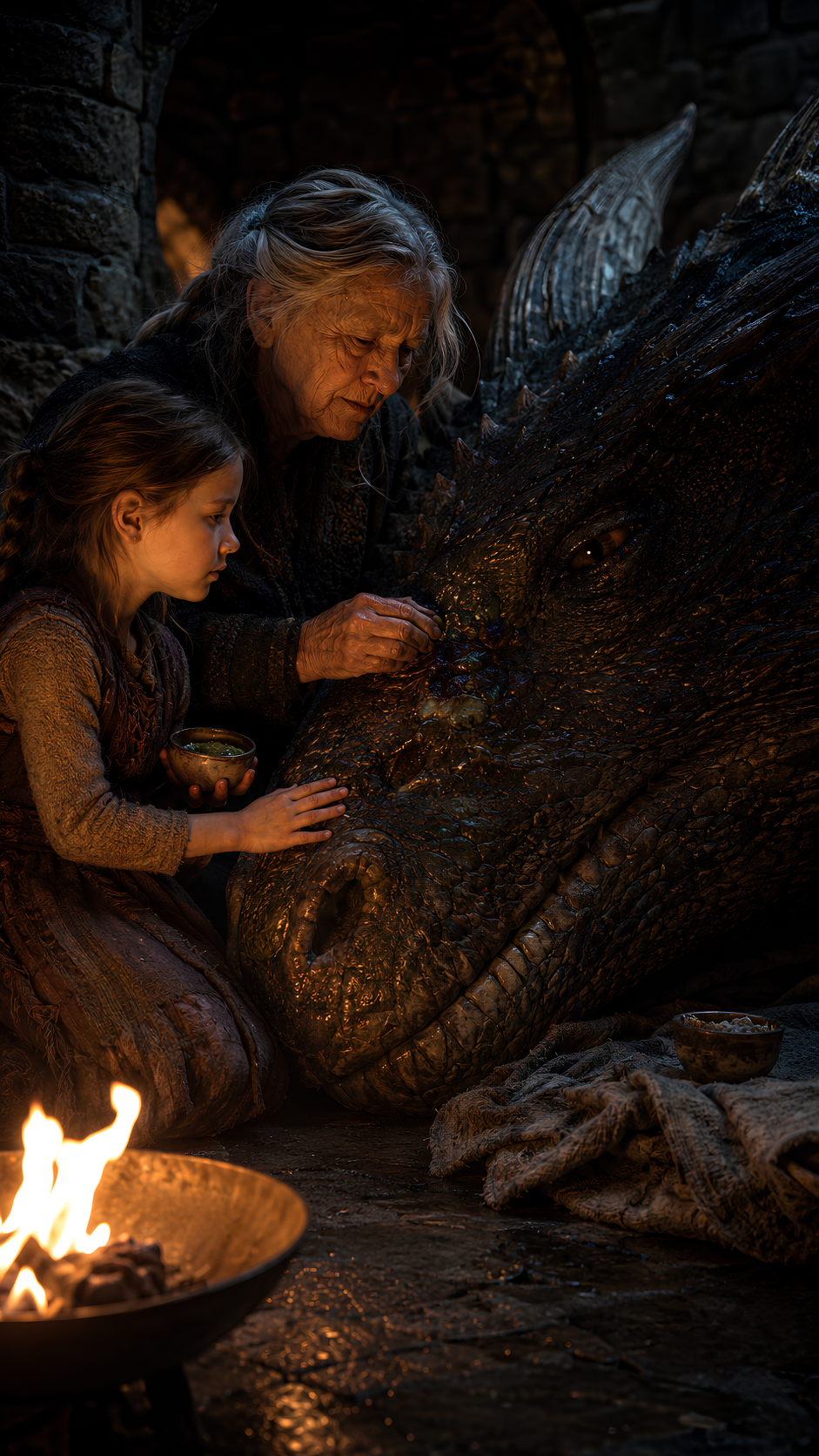
The dragon was called Asterion, though no one in the household used the name unless visitors were present. He had been enormous even in age, blue-black along the spine and pale beneath the throat, with one horn broken cleanly at the base. In the family portraits he appeared behind Catryn’s great-grandfather in ceremonial harness, wings spread, eyes bright with such fierce attention that the painter had clearly been frightened and flattered by his own subject. The creature in the west aerie barely raised his head. His wings lay folded too close to his body, the joints thickened from disuse, the membrane scarred where old restraints had rubbed.
The eyes the painter had made so bright had dulled to the colour of a hearth the morning after. The air around him was warm as a bread oven and smelled of cold stone, old smoke, and something like heated copper, and each slow breath he drew stirred the straw a full yard from his nostrils. When Catryn approached, a feeling moved through the air and entered her without words: not speech, not thought, but a pressure of weariness so immense that for a moment she forgot how to stand.
Her grandmother had set one hand on Catryn’s shoulder. “That,” she said quietly, “is what obedience looks like when men have praised it for too long.”
Then she did something Catryn had never seen anyone in the family do. She stepped over the chalk line the handlers painted on the flagstones, lowered herself, with some difficulty and a muttered remark about her knees, until she was no taller than the dragon’s resting head, and spoke to him in draconic. Not the clipped command-forms of the training yards, but the old, open vowels she had spent three winters drilling into Catryn at the kitchen table. Catryn could follow perhaps one word in five. She understood the tone, which was a way her grandmother spoke to no one else alive.
Asterion’s eye opened fully. The pressure in the air shifted and eased a fraction, the way a held breath eases.
“Put your hand on him,” Lady Enid said. “There, below the scale-ridge, where the harness never sat. And tell him something true.”
Catryn’s hand had shaken. His hide was hot and dry and smoother than she had expected, like a river stone that had lain all day in the sun. She could think of nothing grand enough to say, so in the end she said the only thing she was certain of, in the clumsy draconic of an eleven-year-old who still muddled her vowels.
“I’m sorry.”
For a moment the weariness thinned, and beneath it Catryn felt something else, faint and far down, like a coal at the bottom of a grate: surprise, and then something that might, in a creature less exhausted, have been warmth.
“Good,” her grandmother said, and her voice was not quite steady. “Remember that. They will tell you he is a weapon, or a treasure, or a gift from the gods to this particular family, which is the same thing said more expensively. He is none of those. He is a person who has been made very tired.”
On the long stair back up to the galleries, Catryn had asked why she had been brought down at all.
“Because one day,” Lady Enid said, “they will put a silver hook in your hand and tell you it is an heirloom. I should like you to know what it is for.”
At the time, Catryn had not understood all of it. She understood more later. She understood enough, after Lady Enid died, when Catryn’s father informed her that grief was natural but duty would steady her, and that she must begin attending the training yards properly now that there was no one left to excuse her from them.
Lord Maelor Veyr had been handsome in the way portraits liked and servants did not. He smelled of vetiver, ironed linen, and the faint metallic tang that clung to the dragon yards. He never raised his voice. He considered raised voices a failure of breeding, though apparently not the chaining of divine creatures.
Catryn attended one training session after her grandmother’s funeral. Only one. A young bronze, scarcely three years out of the shell, had refused a command to lower its head before a visiting minister. It had not attacked. It had not threatened. It had merely stood where it was, trembling, eyes fixed on a strip of sky visible above the training wall. The handler used the silver hook, its haft chased with the Veyr crest, behind the jaw: a sharp inward pressure too precise to leave a mark where guests might see. The dragon made a sound Catryn felt in her teeth. The minister examined his gloves.
Her father, beside her, sighed as though embarrassed by a poorly tuned instrument. “They must learn it before they are large enough to make the lesson expensive.”
That night Catryn packed two shirts, her grandmother’s oilcloth maps and as many of her books as a satchel would bear, a knife with a cracked horn handle, a grief she had not yet found anywhere to set down, and as much money as she could lift from the steward’s strongbox without attracting immediate attention. The theft offended her family more than her departure, which confirmed several things she had suspected about them. By dawn she had left the estate through a drainage arch beneath the south orchard, ruining a good pair of boots and acquiring a lifelong dislike of pears.
The wireless crackled again, dragging her back to the cabin.
“—historic decline has prompted renewed calls for unity among the Houses. The official number, confirmed moments ago, is nine.”
The cabin seemed to shrink around the word.
Catryn had expected a low number. Everyone had expected a low number, however loudly the Sanctum insisted that faith was not arithmetic. The last century had brought forty eggs, and of those forty dragons, fewer than twenty still lived. Some had died in border wars. Some had sickened in fortified breeding sanctuaries, though the Houses disliked the term breeding when donors were present. Some had gone mad in compounds too small for creatures born with the memory of other skies. Barely thirty dragons from all the previous centuries remained alive in the world, most held by families like hers and nations too proud to admit that possession had become extinction by slower means.
Nine was not a warning. Nine was a door closing. Nine was the gods beginning, with great courtesy, to leave the room.
The herald’s voice trembled now, though whether from awe or fear Catryn could not tell. “Citizens are asked to remain calm as the Sanctum completes its verification rites. The chosen mothers will be honoured in accordance with law, custom, and the sacred protections owed to their station. We go now to Veyr House, where Lord Maelor has issued a statement on behalf of the western dynasties.”
Catryn turned the set off so quickly the final syllable snapped in half. She knew precisely what her father would say: something measured and reasonable about the western dynasties being best placed to offer the chosen mothers their protection, by which he would mean an opening bid.
For a while she did nothing. The cabin settled around her with small familiar sounds: the creak of cooling iron in the stove, rainwater ticking somewhere in the guttering, a mouse performing illegal architecture behind the pantry wall. She had not heard her father’s voice in seven years and saw no reason to spoil a respectable record. Nine eggs. The gods had taken the old human certainty, already fragile, and pressed one finger through it. There would be committees, councils, emergency devotions, security decrees, markets plunging, temples filling, the Houses sharpening their smiles. They would call for unity because all frightened powers preferred the appearance of order before the knives came out.
Catryn put the wireless cell back in the flour tin and made herself wash the bowl from breakfast. It was not necessary. It was not even helpful. But soap, hot water, and a stubborn oat crust offered a scale of problem the hands could understand.
By afternoon, travellers began using the ridge road.
Not many. The ridge lay two miles east of the cabin, beyond a stand of black pine and a streambed that behaved differently depending on whether it approved of the weather. Catryn had chosen her home partly because no sensible person came this way without a reason and no foolish person came twice. Still, on festival days or during state announcements, sound carried strangely through the trees. She heard hooves, wheels, once the distant cough of an engine labouring over wet stone.
Voices reached her in scraps.
“Only nine—”
“—my sister swears one’s in Kesta—”
“—Sanctum men everywhere—”
“—a reward, they’re saying, for any word of—”
“—not enough, not nearly enough—”
“—gods are punishing us. It’s an omen, I tell ya—”
Catryn stayed inside and cleaned things that did not need cleaning. Her cabin had never looked so aggressively maintained. She scrubbed the table, mended a sleeve, sorted dried beans, checked the door latch twice, and reorganised the shelf where she kept her grandmother’s books under a folded blanket. The books were old, illegal in three provinces, and boring in the way dangerous things sometimes were. The court romances had all the exciting covers; the banned dragon texts were mostly diagrams, field observations, and arguments between scholars who had hated one another across several centuries.
Near dusk, she took down the smallest volume. Its leather cover had cracked at the spine, and several pages had been repaired with silk so fine it was almost invisible. On the flyleaf, her grandmother had written: For Catryn, who looked properly. Burn this if you must. Read it first. Lady Enid’s notes crowded the margins throughout in the same sharp, impatient hand.
Dragons communicate affectively before linguistically, one passage read. Emotional contact should not be mistaken for submission, nor silence for incomprehension. A dragon may understand and still refuse. It must first feel itself regarded with affection before it is inclined to listen.
Beside it, her grandmother had written: Obviously. Men needed three hundred pages to discover manners.
Catryn smiled despite herself. The expression felt rusty. She carried the book to the chair by the window, remembered the wobble, and sat there anyway out of exhaustion. Outside, the evening gathered blue among the trunks. The white rose by the threshold shone faintly in the last light, and beyond it the forest thickened into shadow. Somewhere high overhead, geese moved south in a ragged line, their calls briefly stitching the air.
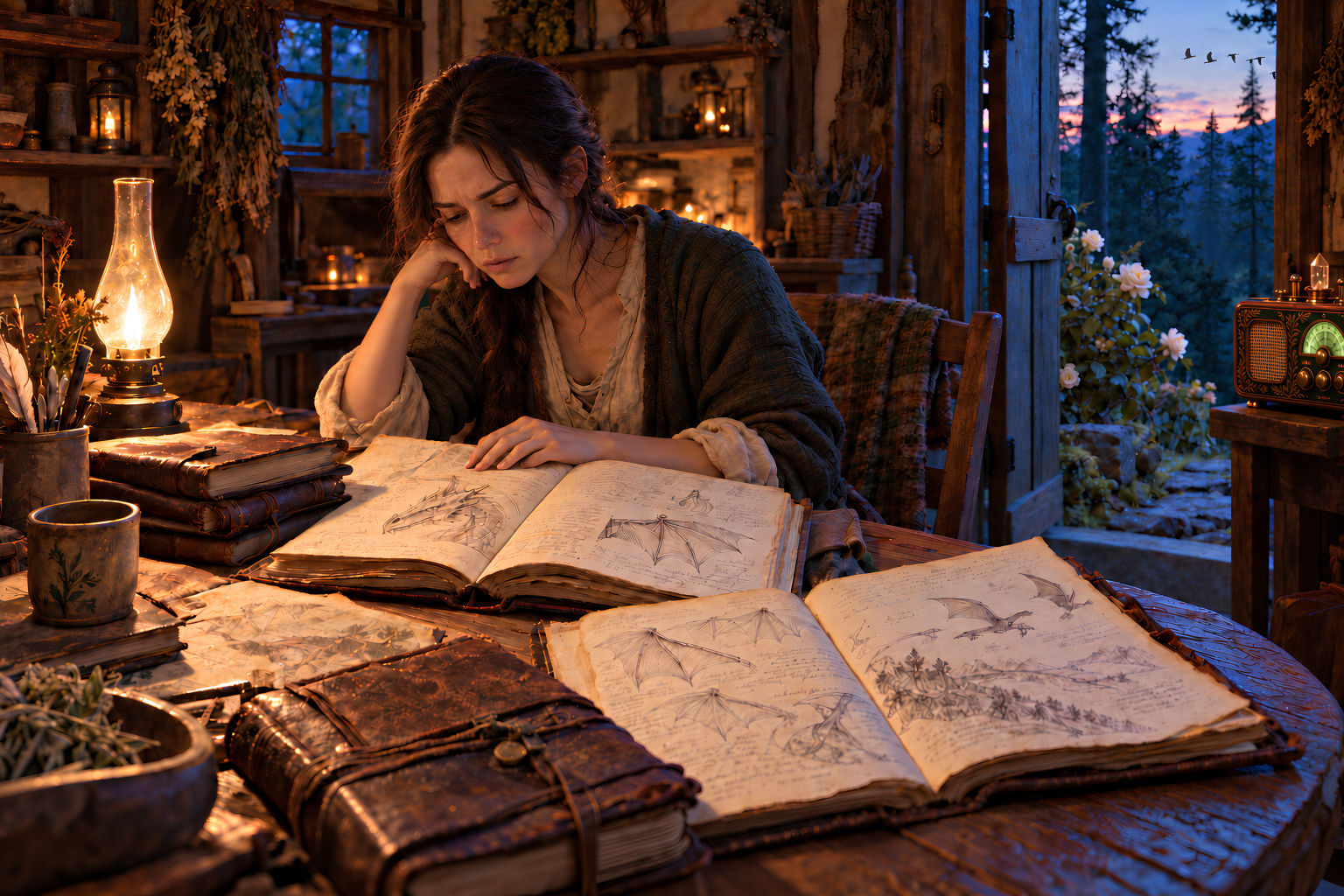
She read on, pouring herself over the pags until the light failed and the words began to swim, and then a little longer, out of stubbornness.
Dragons reached maturity in their seventh year. Dragons chose bonds only after maturity. Beside this, Lady Enid had written: As should we all. Forced imprinting caused distress patterns frequently misinterpreted as aggression. Confinement before full wing development impaired not only physical growth but realm-sense, the strange faculty by which dragons remained connected to whatever country of fire and distance had first made them. Ancient accounts described dragons as larger, steadier, more socially complex, less prone to the collapses and rages documented in modern compounds. The scholars, being scholars, had disagreed about cause. Catryn did not. A creature born for sky would not thrive in a room, however expensive the room and however often its owners used the word sacred.
On the final page, beneath a chart of quickening dates from the last three centuries, her grandmother had written something smaller, the nib pressed so hard it had torn the paper: Not one account in this book was written by a mother. Ask why.
At full dark she permitted herself to turn the wireless on again.
The news had worsened, as news tended to do when left alone. Some chosen mothers had been identified, though only by first name and province until formal presentation. A weaver’s daughter from Orlanth. A magistrate’s widow in Merrow. A schoolteacher from the eastern archipelago. A farm girl whose family had already been photographed weeping outside their cottage. The announcers spoke in reverent tones about honour, divine selection, national pride, the privileges and protections that would now surround the women for their final year. Catryn listened to the spaces between phrases. No one said fear. No one said blood. No one asked whether any of the women had tried to run before the guards arrived.
Then came the silence before the next report, brief but unmistakable.
“The Sanctum has confirmed that only four chosen mothers have been identified and are presently in custody.”
Catryn’s hand tightened around the edge of the table.
“In custody,” she said aloud.
The announcer continued, unaware, of course, of her correction. “Verification rites confirm that all nine Choosings have been granted, and that the remaining five mothers are presently quickening. Authorities urge citizens not to spread unconfirmed rumours regarding concealment, abduction, or divine withdrawal. Any woman experiencing unexplained warmth, fever, or disturbance of sleep should present herself at her nearest temple without delay. All healers, midwives, household physicians, temple attendants, border officials, and private security forces are instructed to report signs of unregistered Choosing immediately. Interfering with the recovery of a chosen mother is punishable under covenant law.”
Catryn, who had a faint warmth beneath her breastbone and a pot of over-brewed tea to blame for it, did not consider herself addressed.
Recovery. That was another good word. Gentle as a blanket over a trap.
By the time the broadcast moved to interviews with sanctified physicians, Catryn had heard enough. She took out the cell, returned it to the flour tin out of habit, and, for the first time in years, she prayed. Not to the gods currently being congratulated on every frequency, but in the way her grandmother had taught her: to no one in particular, with no expectation of reply, which Lady Enid had maintained was the only honest way to go about it. She prayed for the five who had not been found. She prayed they had found cellars, and kind neighbours, and roads that forgot to lead anywhere. She prayed they would not be carried into some rival House while lawyers and soldiers negotiated possession. And in the darkest corner of herself, where she kept the things she would never say aloud, she prayed that if no hiding could be found, some of them had already met a quicker mercy than the one waiting for them; better that than another dragon born into a cage, and another woman spent to fill it. She thought of the four already taken, carried into silk rooms, fed sweet milk, praised by strangers, measured by physicians who would call every invasion a precaution: the most valuable women in the world, and the least free. She thought of the others somewhere under the same sky, perhaps alone, perhaps afraid, perhaps foolish enough to believe the reverence would protect them. By the end of the evening she had stopped praying for them and was praying, with rather less conviction, for a clear and quiet mind.
The forest pressed close to the windows. In the dark glass Catryn saw herself reflected: thirty-one years old, hair escaping its knot, sleeves rolled to the elbow, ash on one cheek, mouth set in the expression her grandmother used to call your father’s face, though never where her father could hear. She looked nothing like a saint.
She looked like a woman who had spent the day arguing with deer and losing.
“Not my world,” she said. “Not anymore.”
The room received this with the tactful silence of rooms accustomed to human dishonesty.
Catryn slept badly. The day would not stay where she had put it; it kept returning, room by room, like a guest who had forgotten a glove. Toward midnight a heat crept outward from somewhere at the centre of her, a dry, restless fever that turned the blankets to sackcloth and every position into an argument. After midnight, rain began tapping at the roof, soft at first and then with the steady persistence of a person who had been told to wait outside and meant to make a point of it. She dreamed of the west aerie, though in the dream it had no walls. Asterion stood beneath an enormous sky, wings whole, horn unbroken, and around his feet grew the white roses from her threshold in such profusion that the ground looked snowed upon. When he lowered his head, she felt not weariness but recognition, vast and sorrowful and almost kind, and something in her that had been tired for seven years lifted its head to meet it. Behind him, something moved in the clouds. Not a dragon. Not quite not a dragon, either. A shape made of heat and distance, turning once behind the veil of rain, and in turning, it noticed her.
She woke before dawn with her heart going too hard and sweat cooling at the back of her neck.
The cabin was cold; she was not. The fever had not broken so much as gathered, drawing itself out of her limbs and settling into one low, steady warmth. Rainwater whispered in the gutters. In the hearth, last night’s coals had fallen into themselves and gone dull beneath a skin of ash. Catryn lay still, staring at the dark rafters, waiting for the dream to leave her body. Some dreams did that. They took their images away politely and left only the sour taste of bad sleep. This one remained. It sat in her chest like a second heartbeat.
No. Lower than that.
For a long time she did not move. The mind, when faced with impossibility, has a vulgar little instinct for negotiation. It offered indigestion first, because the stew had contained onions of uncertain age. Then swelling from bad water. Then some forest magic, inconvenient but surely temporary, perhaps punishment for insulting the deer. Her body refused each explanation with the calm authority of fact.
Catryn pushed back the blanket.
Morning had begun without asking her permission. A seam of sunlight slipped through the shutters and lay across the bed in a pale gold band. It touched her thighs, her shift, the curve of her abdomen rising where no curve had been the night before. Not softness. Not ordinary flesh. A full, taut, impossible swell beneath the linen, heavy as fate and warm under her shaking hand.
She did not scream. Screaming belonged to people who believed sound might alter reality. Catryn sat upright too quickly, gasped at the pull through her middle, and then nearly fell from the bed in her hurry to stand. The room tilted. One hand went to the wall. The other remained pressed against her belly, fingers spread wide as though she might hold herself together by force.
“No,” she said, and then again, lower, angrier, because anger was easier to breathe through. “No, no, absolutely not.”
The cabin offered no opinion. The white rose outside the window, traitorous and serene, had opened another bloom in the night.
Catryn crossed the room in three unsteady steps and dragged open the drawer beneath the table. Calendars, old receipts, packets of seeds, a broken compass, twine, a whetstone, three buttons, and the small leather almanac she had bought in Harthwick at the new year spilled beneath her hands. She had bought it for the planting tables and the moon phases, and had never once turned to the back, where every almanac printed this century carried, by order of the Office of Civic Devotion, a page headed in red: Signs of the Quickening.
She found it. Her hands made a poor job of holding it still.
A warmth beneath the breastbone on the day of the turn. A fever on the first night, often accompanied by dreams. At first dawn, the swelling. Unseasonable behaviour in plants and animals near the chosen. Any woman so affected must present herself at once to her nearest temple. Concealment is a crime against the covenant and against the gods.
Beneath it, someone at the printers had added a small, cheerful engraving of a woman kneeling at a temple door, haloed, smiling, and very clearly not yet dead.
Catryn went to the flour tin. It took her three attempts to seat the cell in the wireless, and she despised every one of them, because some childish part of her still hoped an official voice might tell her this was a dream, or a fever, or a mistake: anything but what her body already knew.
The set crackled into life mid-sentence. “—overnight recoveries in Kesta, Orlanth, and the eastern provinces, including a young seamstress taken into Sanctum care shortly before dawn, bringing the total to eight. Eight mothers recovered.” The herald paused, as though even he could hear what came next. “One still missing.”
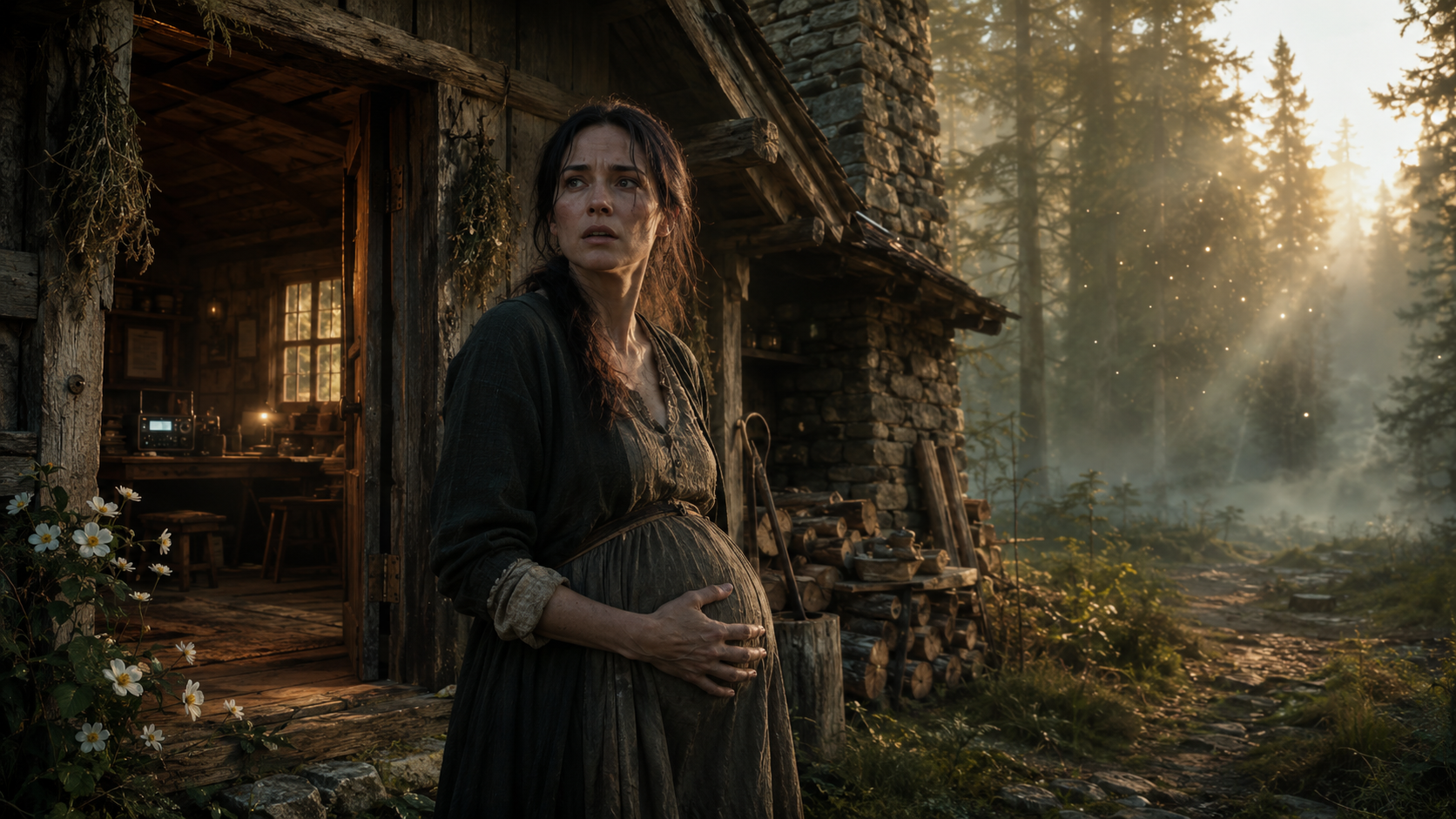
Her knees gave before the rest of her agreed to it. She sank onto the floorboards beside the table, the almanac still clutched open in one hand, breath coming sharp and shallow. The boards were cold through her shift. On the shelf above her, the wireless had moved on from the herald to a children’s choir, and the old hymn of the Choosing came down over her head in bright, untroubled voices: “Blessed the vessel, blessed the flame.” Somewhere in the pantry wall the mouse resumed its intrusive architecture, which seemed monstrously indifferent under the circumstances.
The weight beneath her ribs shifted.
It was slight. No more than a pressure, a warming, the faintest internal answer to the violence of her fear. Catryn went still. The air in the cabin tightened around her, and the wireless gave a thin, rising whine and died mid-verse, though no one had touched it. Only then did she notice how completely the forest had fallen silent. No birds called. No branches moved. The gutters had stopped their dripping, and behind the pantry wall even the mouse had paused, as though it too had been asked to listen.
Against her palm, beneath skin and muscle and the altered architecture of her own body, something living leaned toward her terror and answered with its own.
Not words. Never words.
A small pulse of bewilderment touched her, bright and frightened and wholly innocent, like a hand reaching out in the dark for a wall that ought to be there. Catryn, who had spent seven years making a religion of distance, bowed over the impossible curve of herself with a sound that was neither prayer nor grief.
Look properly, her grandmother had said.
So she did. She closed her eyes, stopped bracing against the feeling, and let it in the way she had once let in Asterion’s sorrow in the west aerie, with Lady Enid’s hand hard and steady on her shoulder. It was nothing like that. Asterion had felt like a great house with every room shut. This was a house with no rooms yet at all, only light: a brightness like sun through closed eyelids, a heat that did not burn, and beyond it, so far down that she could not tell whether she felt it or remembered it, a country she had never seen. Red cliffs beneath a white sky. Wind that tasted of iron and distance. Wings, a great many of them, turning on currents of air as wide as oceans.
Realm-sense, the scholars had called it, and argued for three hundred pages over whether it existed.
Catryn opened her eyes. The motes from the clearing had found their way in through the gaps in the shutters and were drifting over her in a slow, glittering congregation, settling on her hair, her knees, the backs of her hands, without heat and without weight. The forest, it seemed, had stopped minding whether it was studied.
She had begun to cry without noticing it, not with the clean violence of panic but with a quieter, more humiliating grief, the kind that escaped while the body was busy surviving. And with it, unbidden, came the last real conversation she had ever had with her grandmother.
Lady Enid had been dying for most of a month by then, and conducting the business with the impatience she brought to everything. She lay in the narrow bed in the east tower, her rings loose on her fingers, the dragon-scale charm on the coverlet where she could reach it. Catryn had been reading aloud from a court romance so dreadful that they had both stopped pretending to follow it.
“I ought to have done more,” her grandmother said, out of nowhere. “Burned the yards. Opened the aeries. Something vulgar and effective.”
“You took me to see him.”
“I took you to see him.” A breath that caught and rattled. “That was cowardice dressed up as education. I was hoping you would do it for me.”
“Do what?”
The old woman had looked at her for a long time, with eyes that had never once in their life missed anything. “Whatever is true,” she said. “When it comes to it. You’ll know.”
She had died four nights later. Within the month Catryn had run, and she had spent seven years telling herself that running was a kind of answer. It was not. It had only been a way of waiting for the question.
Now the question had come, and it was warm beneath her hand.
“No,” she whispered, though she was no longer speaking to the gods. The gods had done what gods did: reached into a life and rearranged it without explanation.
Her anger at them would have to wait. “No, little one. You will not go to them. You will never go to them.”
The words steadied as she spoke them. She knew precisely what waited beyond the trees. Her father would call the egg destiny. The Houses would call it law. Priests would gild the cage before the bars were even forged, and the Sanctum would send soldiers with reverent mouths and loaded weapons to escort it there. Catryn knew them too well to imagine mercy. They would bless the child, catalogue it, guard it, train it, ruin it for the sake of a banner, and tell one another the whole time that love required discipline. She pressed her palm more firmly to the living warmth inside her, as if the vow might pass through flesh and be understood before language, before memory, before the world had any chance to lay its hands upon what was hers only to protect.
“I have a year,” she said, and this time her voice did not break. “If that is all the gods have left me, then I give it to you. Every day. Every breath. I will spend what remains of my life keeping you from them, and if they come through these trees with their prayers and papers and polished knives, they will have to pass through me first. Do you hear me? You will know the sky. You will know kindness. You will never learn to lower your head because some gilded fool mistakes cruelty for care.”
The warmth did not answer. Of course it did not; it had no words to answer with. A dragon does not hear the word, child. It hears what you meant by it.
So Catryn said it again, and this time not in the common tongue. She said it in draconic, in the old open vowels her grandmother had drilled into her at the kitchen table, patient until the third mistake and ruthless after the fourth. She had never once got them right. She got them right now: not because she had remembered them, but because for the first time in her life she meant every one of them entirely.
The answer came like sunrise.
It moved through her hand and her ribs and her spine, no longer bewilderment but something steadier, wondering and warm as a hearth on the first night of winter, and so wholly trusting that it broke something in her that fear had not managed to touch. In the grate, the dead coals woke beneath their skin of ash and glowed a deep, contented red. The motes flared gold and scattered like startled sparks. Outside the window, the white rose trembled on its thorned stem though the morning air was still, and opened, one after another, every bud it had left.
Catryn bent until her forehead almost touched her knuckles. She had no sacred oil, no witnesses, no temple bell to carry the promise into heaven. Good. Let heaven lean down and listen for once.
Beyond the rose and the wet grass and the trees that had hidden older fugitives than her, the forest exhaled. A wind moved through the pines, soft and low, and the old boundary beneath the earth seemed to turn in its sleep, the way a hound turns once before settling across a doorway.
Catryn stayed there until her breathing steadied. Then she got to her feet, one hand on the table and the other on the weight she would carry now for a year, and looked toward the loose floorboard beneath the hearthstone. Her grandmother’s maps lay wrapped there in oilcloth, beside the Veyr signet ring she had never quite managed to throw into the stream. She would open them within the hour. Before nightfall she would need to decide which roads still existed, which names must vanish, which debts could be called in without bringing ruin to the door, and how much of herself she could erase before the world realised the missing mother had been hiding in the forest all along.
The world did not wait for her to decide.
At the High Sanctum, for the first time in three hundred years, they rang the Recovery Bell. It was the oldest bell in the capital, cast, the histories said, from the melted chains of the first dragon ever kept, and it did not toll so much as groan: a sound so low that it was felt in the stomach before it was heard. Every temple in every province took it up in turn, until the whole land rang with it from coast to coast like a struck anvil.
By midmorning, notices had been nailed to every temple door. There was no likeness on them, since no one knew her face; only the word MISSING in red, and beneath it a reward large enough that farmers stopped in the road to read it twice and went home looking at their neighbours’ wives a little differently.
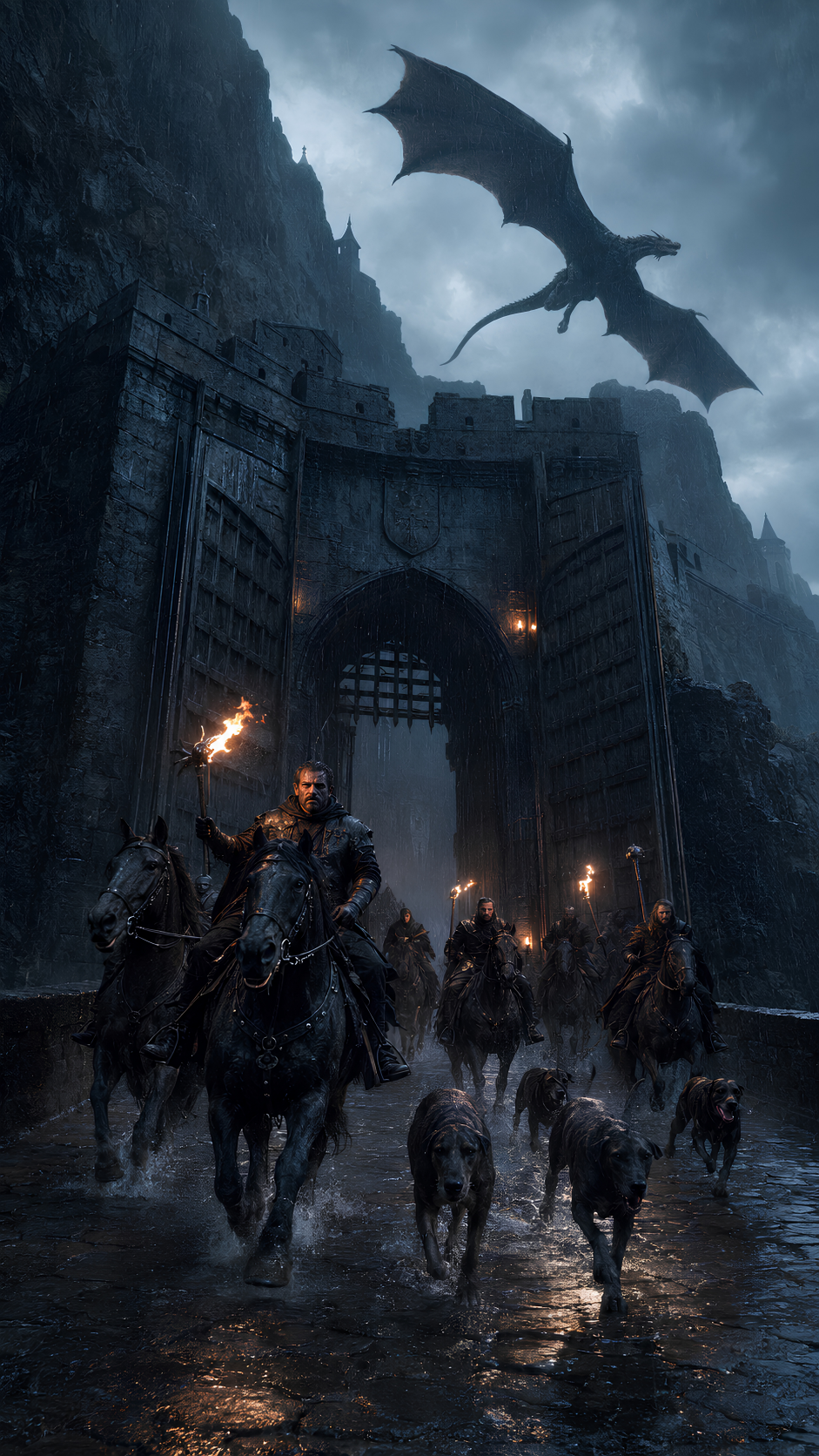
The Twelve Houses emptied their barracks. From Orlanth came lancers in green and silver, riding three abreast beneath banners that snapped in the wind like accusations. From Merrow came the river guard in their oiled black coats, and from Kesta a column of armoured engines that coughed blue smoke and churned the roads to mud. Sanctum Wardens rode out in white and gold, prayers stitched into the linings of their cloaks and carbines across their saddles, and among them went the Veil Physicians in grey, each carrying a quickening-glass: a brass instrument the size of a pocket watch, its needle cut from dragon horn, which swung, the physicians promised, toward any woman carrying the gods’ gift. Behind the armies came everyone else, as everyone else always does: bounty hunters, informers, hedge priests, ambitious constables, and ordinary men with lanterns and good boots who had worked out what a reward of that size could do for a family.
At Veyr House, Lord Maelor stood in the training yards in a coat the colour of wet slate and watched his handlers bring out the bronze.
It was full grown now, ten years from the shell, and it came out into the morning light hooded and harnessed, a handler at each flank and a silver hook at each handler’s belt. It no longer looked at the sky. It had learned. Lord Maelor regarded it as he regarded all sound investments, with quiet satisfaction and no affection whatever, and when the hood was lifted and the great head swung north, nostrils flaring at something no human could scent, he permitted himself the smallest of smiles.
“Find her,” he bellowed out, stomping his foot like a demanding toddler.
He meant the missing mother of course. It had not yet occurred to him to even wonder where his daughter was.
By noon the roads out of every capital were black with riders. They poured north and east and west in long, glittering columns, banners high: hooves and engines, hymns and hounds, a whole civilisation turned in a single morning into a hunt. Above the westernmost column flew the bronze of Veyr, its wings unbound for the first time in years, chains running from its harness to the riders below like the strings of some terrible kite. And in every physician’s hand, in every quickening-glass, the needles shivered, turned, and settled, trembling, toward the north.
In the far north, where the old forbidden maps drew a broken ring, the forest closed its paths the way a woman draws a shawl about her shoulders. Two miles east of a small cabin, on a ridge road no sensible person travelled without a reason, the first hoofbeats were already coming.
Catryn knelt by the hearthstone and lifted the board.
They would come seeking a mother. What they would find was a war.
They had not yet met the Dragonkeeper.