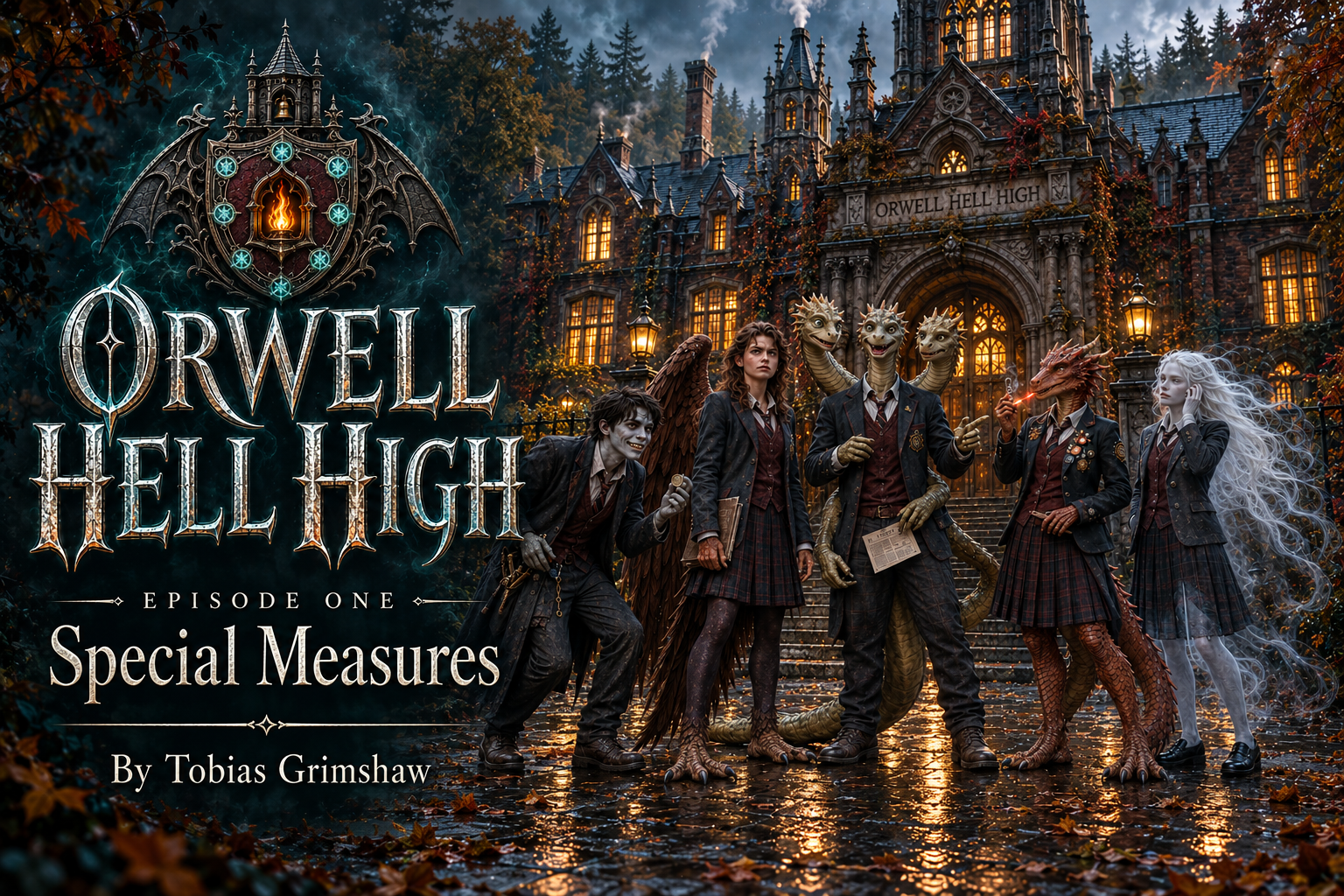
ORWELL HELL HIGH
Episode 1 · By Tobias Grimshaw
Special Measures
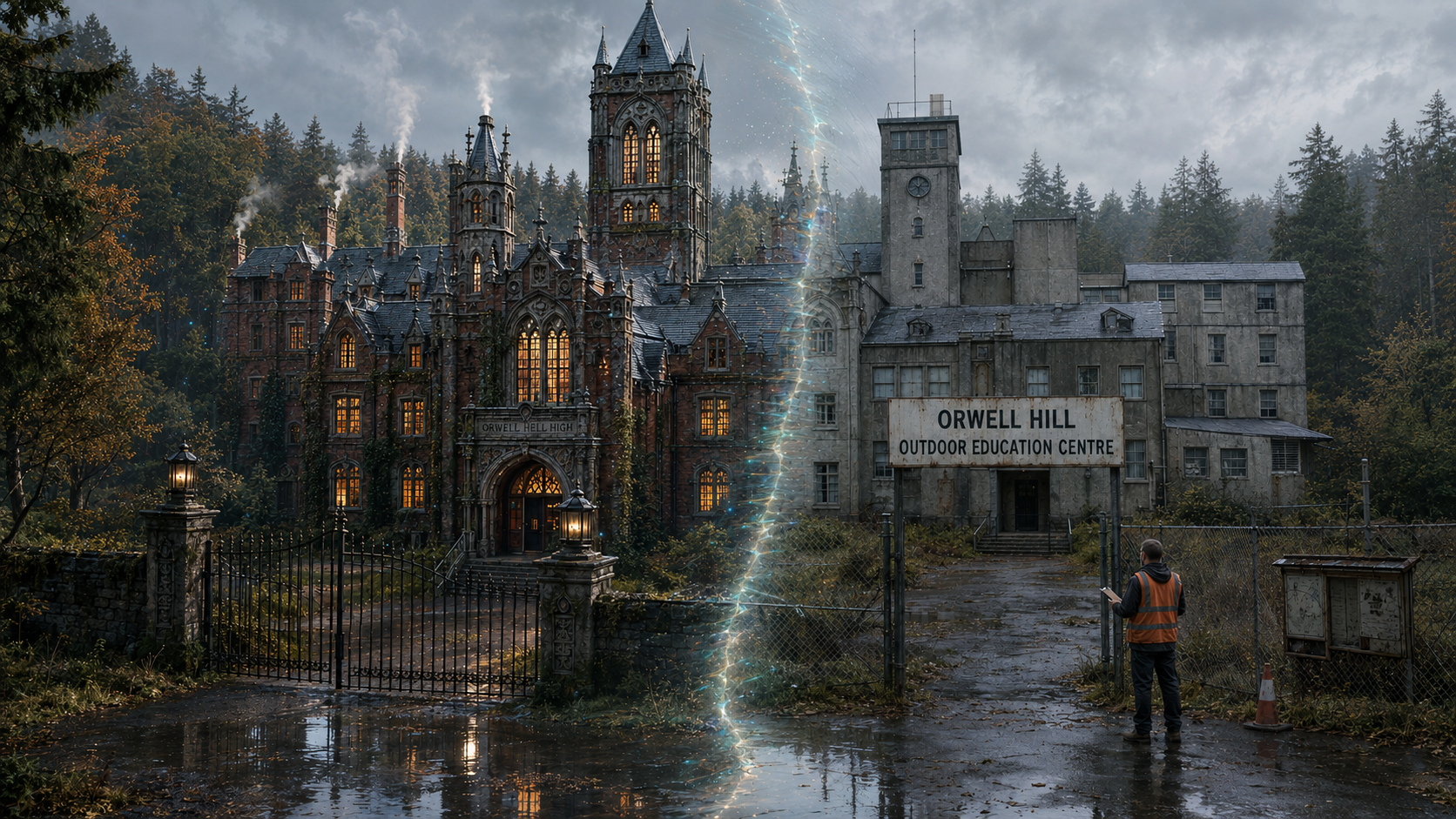
At eight twelve on a wet Monday in October, a bakery van slowed beside Orwell Wood. The driver had supplied every farm shop and disappointing hotel in the district, yet he could not remember the turning which his satnav now insisted lay twenty yards ahead. Through the rain he saw a padlocked Forestry Commission gate, three bins with their lids blown open and a sign warning of Japanese knotweed. His satnav showed a large grey seemingly abandoned building called ‘ORWELL HILL OUTDOOR EDUCATION CENTRE’. The driver called the machine a liar and reversed into a ditch. Forty yards beyond his windscreen, hidden behind six dripping yews, Orwell Hell High was getting ready for school.
It had occupied the same fold of forest since 1688, although very little of the original building had survived the pupils. The founders’ house remained at its centre, built of black stone with narrow windows and chimneys thick enough to conceal a family of wyverns. A railway vampire had paid for the east wing in 1846 and expressed his wealth through turrets. The gymnasium, put up after the Second World War, resembled a municipal punishment. Behind it stood a temporary classroom installed in 1987, its walls now held together by ivy and an enchantment nobody could find the paperwork for. At the western end, a bell tower rose above the firs. Its copper roof had gone green; its clock gave the right time twice a month and resented being corrected.
The school had been founded for young monsters whose existence made ordinary education dangerous. Its first minute book recorded a werewolf boy chained in a parish coal cellar during arithmetic and a banshee girl expelled after the choirmaster told her to project. Their families bought the ruined hunting lodge in Orwell Wood, engaged a witch who knew more about concealment than teaching, and opened the doors to nine pupils. Orwell Hell High now taught the subjects required by the Board of Monstrous Education, along with Controlled Transformation, Practical Concealment and the management of appetites likely to distress the neighbours. Its purpose still appeared above the entrance in the founders’ severe lettering: FOR THE INSTRUCTION AND SHELTER OF THE MONSTROUS YOUNG.
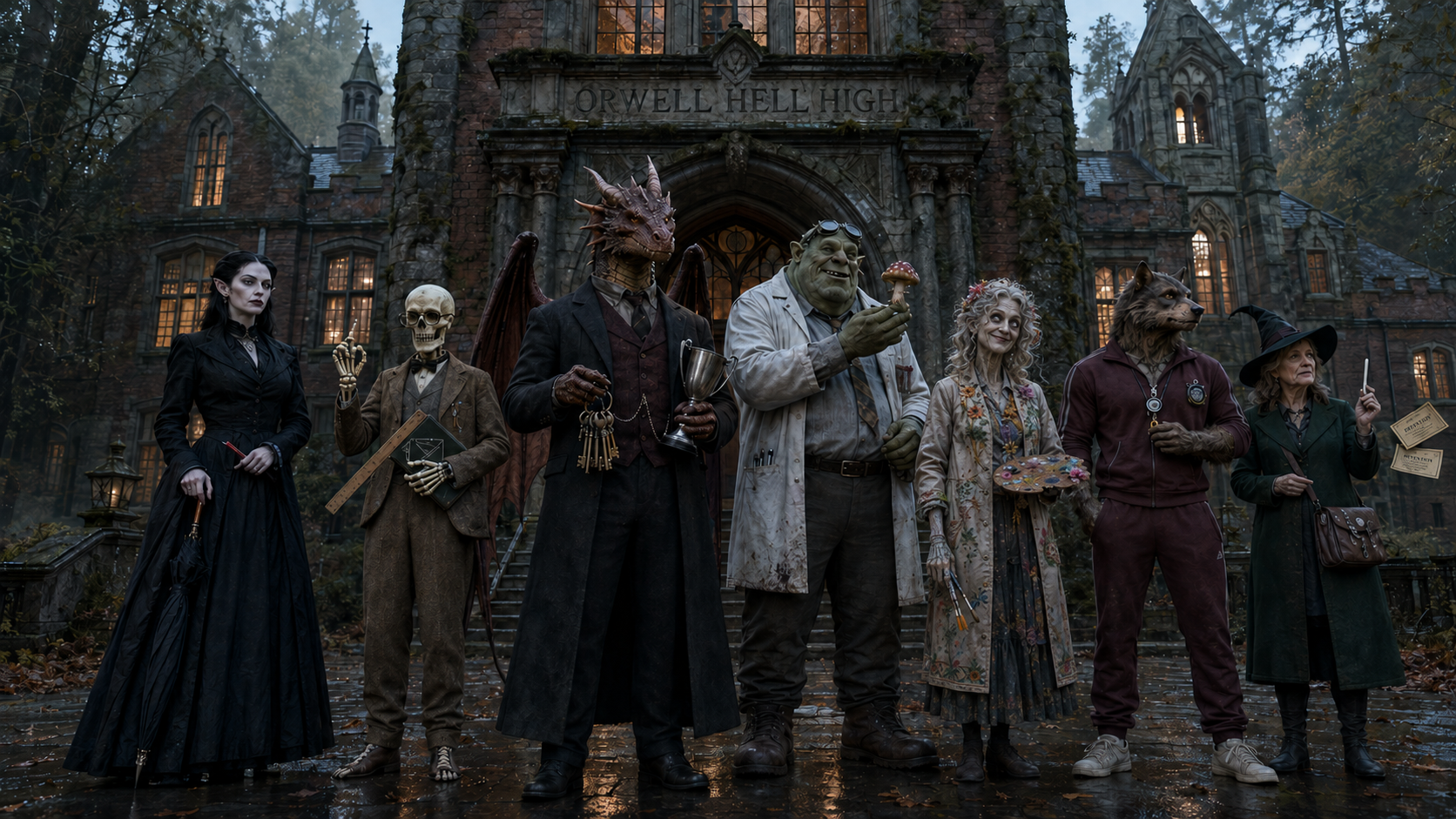
The ordinary world was kept out by the Veil. It lay over the grounds like a second weather, bending maps, roads and human attention. Walkers remembered an urgent appointment; surveyors discovered that their pencils had snapped. Dogs saw the school clearly and objected, though dogs objected to so much that nobody treated this as evidence. The power beneath the old stones reached through the gate, the roofs and the bell tower, and on a healthy morning the forest closed around the school without a seam. This morning the seam had begun to itch.
Mr Gable noticed it first. The school caretaker was a gargoyle: six feet of dark granite, with folded wings and a face medieval masons had given the expression of a man disputing a restaurant bill. He worked from sunset until the first bell, when stone was most comfortable, and slept through much of the day on the chapel roof. Seventy-three years of service had made him loyal to the building and suspicious of everybody inside it. He knew every boiler and buried passage, including the doors that opened only when insulted in Latin. He also knew each of the roof pigeons by sight and maintained a separate ledger of offences against them.
At ten past eight he stood on the gatehouse parapet with a broom in one hand and a pigeon feather pinched between two stone fingers. The road beyond the gates appeared, vanished, then appeared again as a wet silver strip between the trees. Gable leaned forward. Gravel sifted from his elbow and pattered onto the drive.
“I saw that,” he told the forest.
The forest rearranged itself. A beech slid across the view with the embarrassed haste of somebody pretending not to have been listening. Gable looked down towards the iron gatepost, where seven small creatures had been carved around the school crest. Green fire glimmered in their open mouths. Rain and distance made it hard to count them, and the first pupils were arriving. He put the feather into an evidence envelope, made a note against Pigeon Four, and climbed down to deal with a drain which had spent the weekend swallowing footballs.
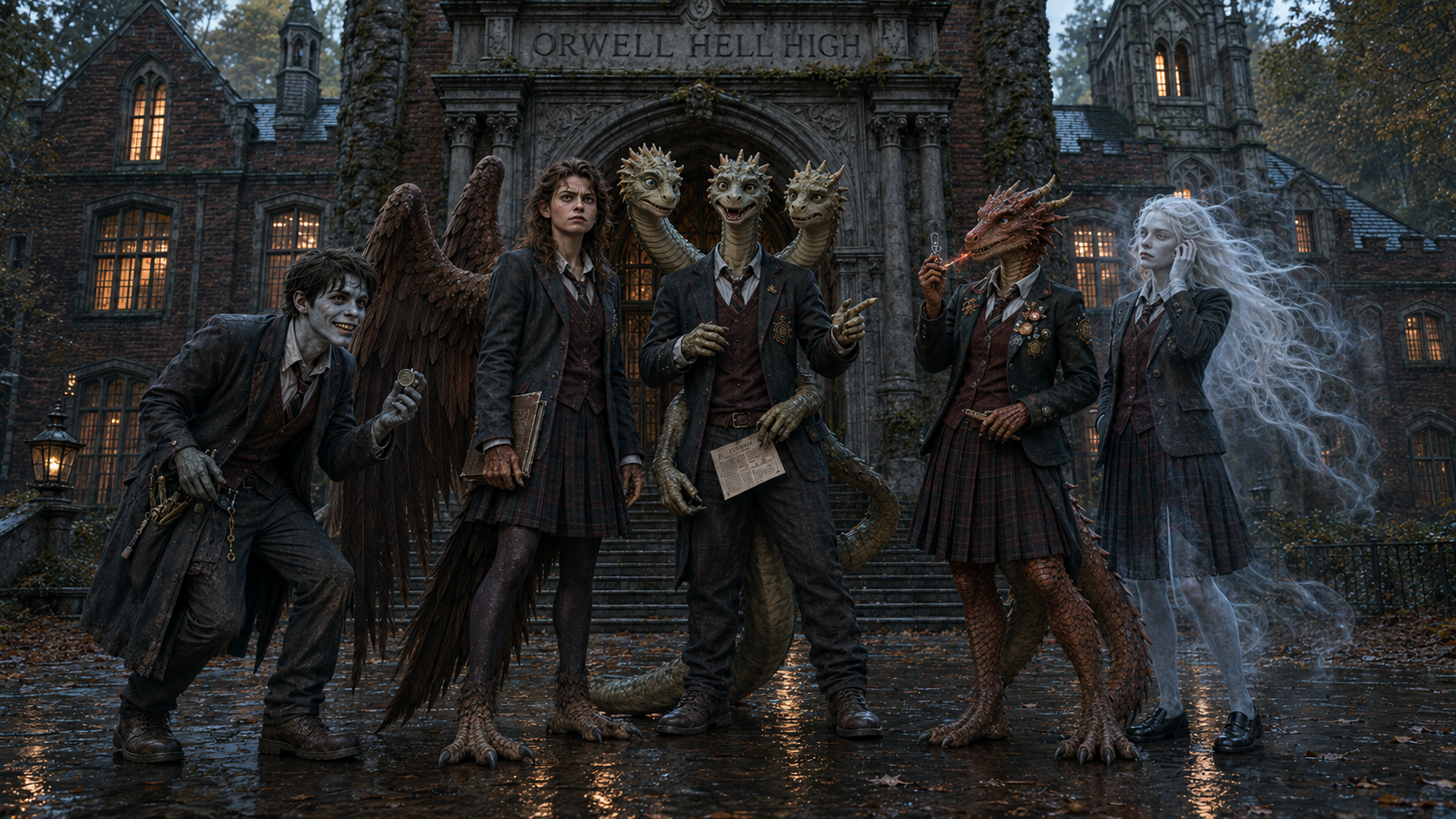
Mara Quill crossed the Veil at eight twenty, came over the wall on a gust of wet wind and landed beside him. She was a harpy, though the school uniform tried hard to deny it. Brown-gold wings rose from her shoulder blades; smaller feathers ran from her collarbones to the nape of her neck, where they lifted whenever she was suspicious, angry or accused of being either. Her hands were human enough until the second knuckle. Her feet ended in black hooked claws which made polished floors a negotiation. The official blazer had two extra slits for wings and the general shape of a collapsed tent.
She had wrapped her exercise books in a bread bag. Her feathers had received no such protection. Rain ran from the long flight feathers and gathered around her shoes while she wrestled the blazer into place.
“Morning, Quill,” Gable said. He lifted the drain cover. Something below growled around a football. “Use the door today.”
“I always use the door.”
“You have just landed inside the wall.”
Mara glanced back at it. “I’ll use the door on the way out.”
Gable’s eyes narrowed. A teaspoon of gravel came loose from one ear, his usual response to logic from a pupil. Before he could issue a rule with a date and subsection, Milo Gutteridge slid head-first from the gutter above the entrance and landed beside Mara with a cheese sandwich in his mouth.
Milo was a goblin, small even by goblin standards and narrow enough to regard drainpipes as a transport network. His skin had the grey-green cast of putty left near a radiator. Two long ears protruded through his hood, and his fingers were fine, strong and seldom in the pockets assigned to them. He collected secrets, loose change and objects whose owners had failed the moral test of leaving them unattended. Most of the school called this stealing. Milo called it early adoption.
“Morning,” he said around the sandwich.
The bread was green at the corners. Mara looked at the open downpipe above him. “Did you spend the night in there?”
“Only registration.” He brushed leaves from his hair and examined the drain Gable was working on. “That’s my ball.”
“It has your name on it?” Gable asked.
“It has somebody’s name on it. I found it first.”
The thing beneath the drain belched. Milo reconsidered ownership. He fell into step beside Mara under the entrance canopy, where the stone griffins dripped on anyone who had escaped the rain. One had acquired a traffic cone during the night. Gable suspected Pigeon Four, largely because he preferred the alternative.
The doors stood beneath a plaque green with age: ORWELL HELL SCHOOL, FOUNDED 1688; REBUILT 1741; REBUILT AGAIN 1812; CERTIFIED PROBABLY SOUND 1996. The name had acquired High during an educational reorganisation in the seventies. Nobody had been able to discover what had become low.
Inside, the entrance hall smelled of wet fur, floor polish and the faint medicinal spice of Nurse Serekh’s bandages. Four hundred pupils between eleven and eighteen attended Orwell Hell High, although this number changed according to the phase of the moon and whether the ghosts were counted. About half boarded in the upper wings, where room allocations took account of nocturnal habits and flammability before friendship. Above the reception desk hung the school motto, CONTROL, CONCEALMENT, CONSIDERATE FEEDING. The final word had been added after the 1923 governors’ luncheon.
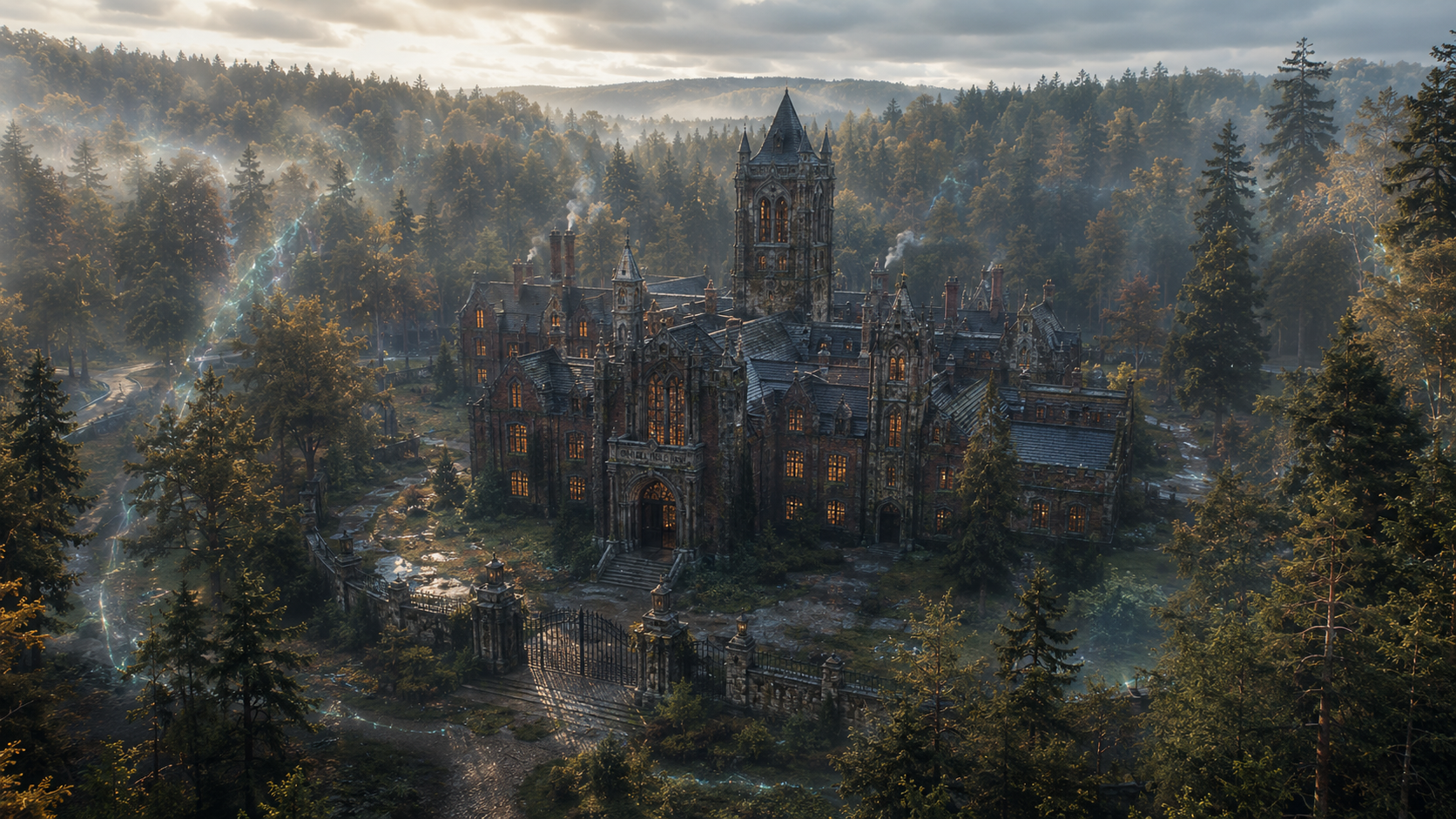
Mrs Prudence Grindle guarded the reception hatch. She was a troll in a brown cardigan with wooden toggles, broad enough to block the corridor without leaving her chair. A pair of small tusks rested on her lower lip. Trolls had once demanded tolls beneath bridges; Mrs Grindle had found administration more satisfying. She could smell an unsigned form through a locked drawer and no pupil, parent or member of staff reached the headteacher’s office without first paying her preferred tribute in complete paperwork.
This morning she had arranged three stacks of assembly notices in front of her. Each was thick enough to stun an ogre. “Serious faces in the hall,” she said as Mara and Milo passed. “There is an announcement.”
“What sort?” Mara asked.
“The sort you will hear in the hall.” Mrs Grindle’s eyes moved to Milo’s blazer. “Your badge is missing.”
Milo looked down with convincing surprise. “The stitching must have failed.”
“It has been pinned to the inside of my handbag since Friday.”
“Then we know where it is.” He smiled at her. “Excellent administration.”
Mrs Grindle made a mark on the top sheet. Milo’s smile thinned. Forms frightened him because they remembered things.
Near the staircase, Nurse Miriam Serekh was wrapping a first-year kelpie from ankle to thigh. The injury appeared to be a bruised knee. Nurse Serekh was a mummy, preserved several thousand years before the invention of the school medical service and unimpressed by most developments since. Linen covered her from neck to wrist; gold scarabs fastened the cuffs of her white coat. She regarded dust as a symptom, decay as poor self-discipline and every bruise as the possible collapse of a dynasty.
“Keep the limb elevated for forty days,” she told the kelpie. “No chariot racing. Change the poultice when the moon enters the house of—” She squinted at the laminated treatment chart Mrs Grindle had attached to her clipboard. “Wednesday.”
The kelpie’s webbed toes disappeared beneath another turn of linen. Mara and Milo moved on before Nurse Serekh remembered vaccinations.
Nia Ashdown waited at the foot of the stairs, writing the announcement date at the top of a fresh page. Nia was a young dragon with russet scales along her temples, two polished black horns and small wings she kept folded with military neatness through the slits in her blazer. Heat followed her. On cold mornings other pupils stood near her under the pretence of friendship, while she pretended not to notice and corrected their grammar. Her family had supplied Orwell Hell High with governors, prize-winners and a portrait in the library which breathed smoke whenever anyone whispered. Nia believed institutions were noble things periodically inconvenienced by the people running them.
She looked at the sandwich in Milo’s hand. “Food is prohibited in assembly.”
“This stopped being food on Thursday.”
“Then it’s a biological hazard.”
“Mr Grubb says those are educational.” Milo slipped it into his pocket.
Mara saw Nia’s eyes settle on her damp blazer and then move away. The glance lasted less than a second, which made it worse. “Do you know what the announcement is?” Mara asked.
“Mrs Grindle said we would hear it in the hall.”
“You asked?”
“Of course.”
“And she didn’t tell you.”
A thread of smoke escaped Nia’s left nostril. “She commended my appropriate use of procedure.”
Behind them came the Pikes, filling most of the staircase. Kit, Bram and Tansy were a hydra: three long-necked heads rising from one sturdy green body, with four arms between them and one school tie which none could agree how to wear. The Board counted them as a single pupil at lunch and three pupils when issuing detentions. Kit, the left head, planned things; Bram, in the middle, tested the load-bearing qualities of school property; Tansy, on the right, read instructions and suffered from having done so. Their body had been fitted with a specially altered blazer. One sleeve had already been torn off.
“Kit says we have to sit on one chair,” Bram announced.
“The rule says one place per pupil,” Kit replied.
“We are three pupils during detention,” said Tansy. “Mrs Grindle confirmed it in writing.”
“That was an administrative classification,” Nia said.
All three heads turned towards her. “What are we now?” they asked, slightly out of time.
Nia opened her mouth, encountered the limits of policy and closed it again. A faint thread of smoke left her nose.
Winnie Keene stood apart from the argument beside the old radiator. She was a banshee, pale-haired and slight, with the exhausted eyes of somebody living in a world that had been left too loud. Two felt pads covered her ears beneath her hair. Banshees heard sounds before they happened and others long after everybody believed they had stopped: grief in an empty chair, a death approaching along a road, the particular whine of a fluorescent tube about to spoil the afternoon. Their own voices could crack stone. Winnie kept hers low and apologised when doors rattled.
“The bell’s wrong,” she said when Mara joined her.
Above them, the clock mechanism ticked behind the wall. “It’s always wrong,” Mara said. “Last Thursday it rang for lunch during a fire drill. Fenwick ate half the hose.”
Winnie pressed two fingers beneath her right ear. “There’s another note under it.”
Mara listened. She heard wet shoes, the Pikes debating personhood and Mrs Grindle telling a parent that urgent did not constitute a signature. Somewhere above, pipes knocked in the walls. “What sort of note?”
“Low.” Winnie looked towards the doors. “Like a glass when you run your finger round it, except the glass is the school.”
The first bell clanged before Mara could answer. Dust fell from the rafters. A flock of tiny black shapes escaped the belfry and became smoke over the courtyard.
Pupils began moving towards the assembly hall. Lydia Wisp floated through the closed doors to avoid the queue. Lydia was a ghost who had entered Year Nine in 1897 and remained there through a disagreement between the attendance system and death. She was friendly, vague and capable of passing through any locked room, though books tended to remain behind. When embarrassed she faded from the head down, leaving two shoes and an apology.
Robin Mott followed in the shape of Mrs Grindle until the real Mrs Grindle cleared her throat behind him. Robin was a shapeshifter, curious and theatrical, whose face copied whatever had most recently impressed or alarmed him. Every borrowed form retained one dark lock of hair over the forehead. Robin believed this detail had escaped notice. He returned hurriedly to his own face and joined the queue without being asked.
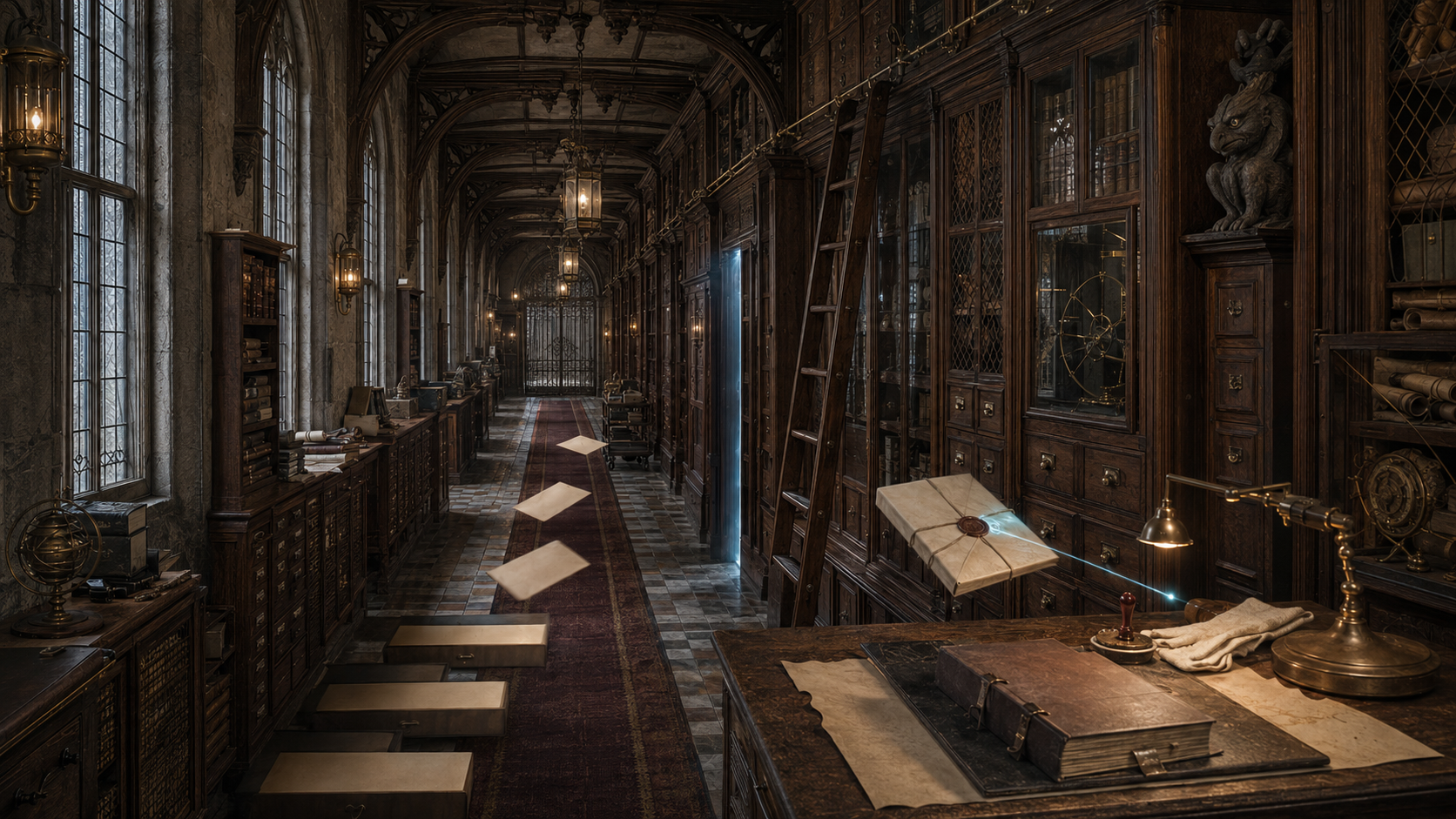
The route to the hall passed most of the school’s working organs. Orwell Hell High had grown without a plan, as old institutions do when they expect the walls to accommodate every new idea. Corridors rose by half a floor, narrowed around forgotten chimneys and occasionally arrived back where they had started. A pupil late for History could plead architecture once. On the second occasion Madame Vane supplied a map drawn in 1792 and asked whether standards had declined.
The science corridor smelled of pond water and burned sugar. Mr Grubb, the school’s ogre science teacher, had wedged himself in the laboratory doorway with a crate of luminous fungi balanced against his chest. He was moss-green and immensely broad, with one lower tusk missing and safety goggles so small they protected a thoughtful portion of his forehead. Ogres had a reputation for solving problems with clubs. Mr Grubb preferred controlled trials, although the distinction became narrow when the equipment refused to cooperate.
“Mind the spores,” he told the passing pupils. A lilac mushroom unfolded on his shoulder and sneezed. “They’re shy.”
“One has attached itself to your ear, sir,” Tansy said.
“Building trust,” said Mr Grubb, and carried the crate inside.
Across the corridor, Miss Nettle was drawing a chalk circle around a row of confiscated mobile phones. She was a witch and taught Practical Concealment and Human Studies, two subjects which required pupils to pass through an ordinary shopping centre without levitating, feeding or referring to money as tribute. Her pointed hat had been sat on so often that its tip leaned to one side. Bundles of rosemary and old charging cables protruded from her coat. She distrusted new technology, especially since a translation spell had caused her phone to speak fluent crow.
“No crossing the circle,” she said. “The devices are being made less interesting to humans.”
One phone developed scales and swallowed its own case. Miss Nettle watched it go. “The principle is sound.”
The art room opened onto the next landing, and flowers had crept into the corridor overnight. They came through cracks in the skirting, curled around the fire extinguisher and opened pale blue heads whenever a pupil laughed. Their maker, Ms Vera Morrow, stood on a chair fastening a garland above the hall doors. Ms Morrow was a zombie. Death had left a silver-green shadow along one cheek and a delicate gap at her wrist, but it had done little to diminish her beauty and nothing at all to sober her taste. She wore embroidered velvet over paint-stiffened boots, fresh flowers threaded through her dark hair, and earrings made from two dollhouse chandeliers. Her smile made nervous first-years drift towards her before they remembered that one of her hands was usually elsewhere.
Today the left hand was painting tiny eyes on the flowerpots while the rest of Ms Morrow adjusted the garland. “A little higher, darling,” she told it.
The hand gave her two fingers in reply and added eyelashes. “Accessible, but with boundaries,” Ms Morrow said. She noticed Mara looking at the flowers. “Assembly deserves foxgloves. Nothing improves institutional dread like a poisonous bell.”
Mr Fenwick came out of the gym carrying a net bag of tennis balls. He was a werewolf and head of Physical Education, dressed in a maroon tracksuit with the school crest strained over one shoulder. Even in human shape, hair covered his hands and sharpened ears stirred above his close-cropped head. The moon would be full on Wednesday. By Monday he was already tracking anything round, moving and faintly yellow with professional interest.
One ball escaped the net and bounced down the corridor. Every muscle in Mr Fenwick’s body tightened. He caught the rail with both hands.
“Sir?” Mara said.
“I have it under control.” His eyes followed the ball as it bounced once, twice and disappeared under a bench. “Proceed to assembly.”
His right foot scraped backwards against the floor. The bench behind him creaked.
“Should we—” Winnie began.
“Proceed, Keene.” Fenwick’s voice came through clenched teeth. A moment later something heavy went over the bench behind them.
The pool doors opened and Ms Marina Shoal rolled out in her wheeled tank, bringing half a corridor’s worth of water with her. She was a mer-person from the waist down: blue-green scales, a strong silver tail and fins that flared when annoyed. From the waist up she wore a whistle, a tailored swimming jacket and the expression of a woman whose lesson plan had been weakened by other people’s lungs. On land she travelled in a glass tank mounted on brass wheels. Its left wheel squeaked, and Mrs Grindle had issued six memoranda about the puddles.
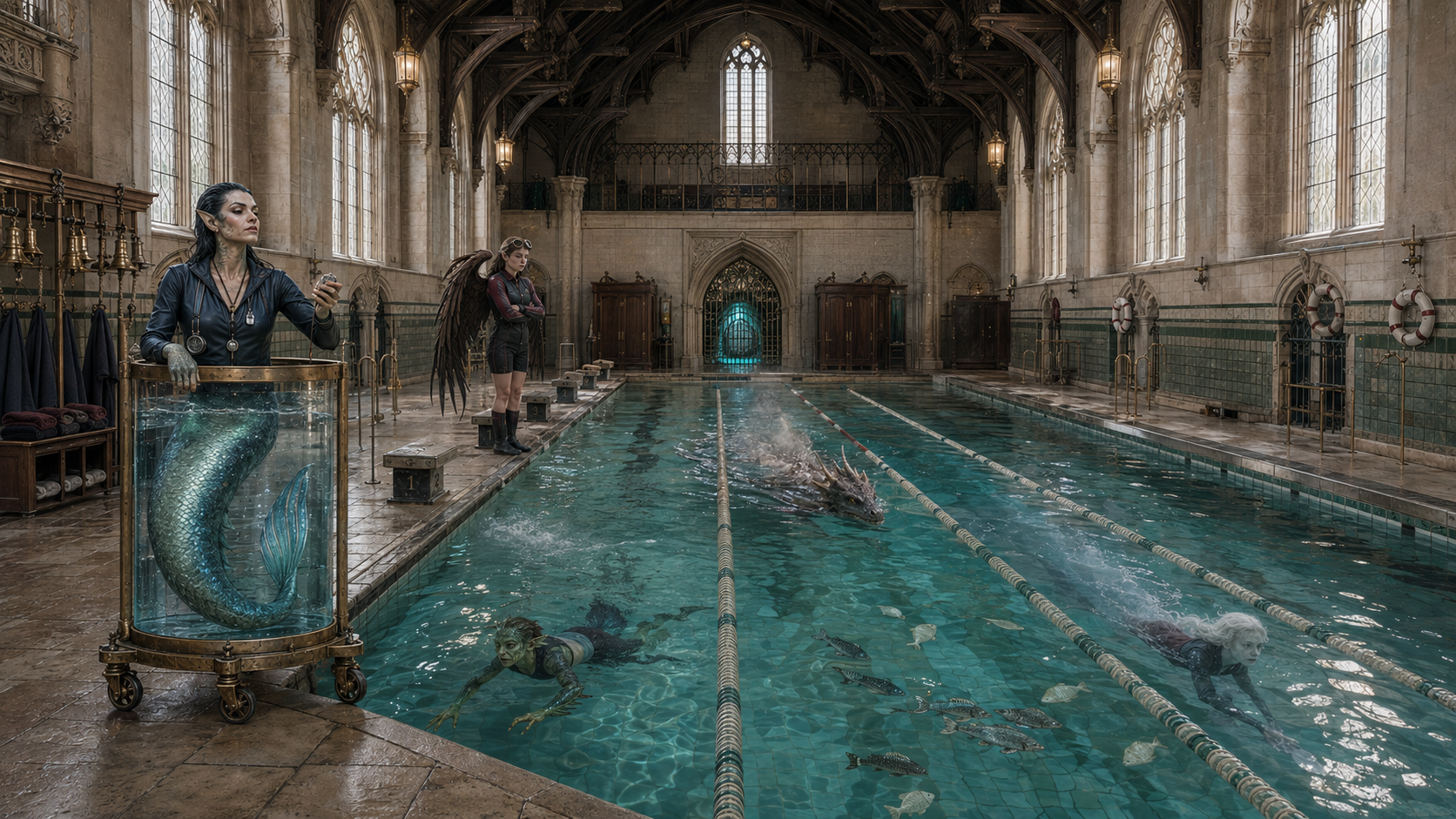
“Year Ten,” Ms Shoal called as pupils pressed themselves to the walls, “tomorrow’s underwater endurance assessment has been shortened to eighteen minutes. I have listened to your concerns.”
“We can’t breathe underwater,” said a minotaur boy.
“That concern has been noted repeatedly.” Her tail struck the tank, sending a small wave over the rim. “Bring towels!”
At the hall doors, Mr Marrow counted the pupils as they entered. He was a skeleton and taught Mathematics with a severity sharpened by three centuries of other people saying they hated fractions. His bones were yellowed ivory, his gown was black and his spectacles rested on a nose he did not possess. He kept spare chalk in his ribcage and detached a finger whenever the interactive whiteboard required precision.
“One body,” he said as the Pikes approached.
“Three minds,” Kit replied.
“Four arms,” Bram added.
Tansy held up Mrs Grindle’s detention letter. “Contradictory legal status.”
Mr Marrow considered them. “Two seats. I will record the half as recurring.”
Inside, Madame Vane had taken the chair furthest from the windows. She was a vampire, as the black lace at her throat, old-fashioned mourning dress and complete absence from the gilt mirror behind her would have told anybody who had missed the fangs. Madame Vane taught History and Dead Languages. She had been present for portions of the curriculum and marked inaccuracies as personal insults. Popular entertainment had exaggerated the ash; daylight gave her migraines and an unpleasant rash. She carried a black parasol in school and had once assigned six weeks’ detention to a pupil who opened the curtains “for atmosphere”.
Beside her, Mr Marrow used one shinbone to straighten the printed agendas. Miss Nettle took the next chair with chalk on her sleeves. Mr Grubb smelled gently of compost. Ms Morrow’s detached hand crept along the curtain rail and tucked a nasturtium behind Mr Fenwick’s ear. He did not notice; someone in the third row had a tennis ball protruding from a bag.
At the centre of the stage stood Dr Ignatius Cinder, headteacher of Orwell Hell High and, unmistakably, a dragon. He had reduced himself to a size suitable for corridors, but tailoring could do nothing about the dark red scales, the horns swept back from his brow or the heavy wings folded behind his suit. A long tail lay around the legs of the lectern. When annoyed he breathed smoke. When seriously alarmed he breathed fire, then blamed the central heating. During summer holidays he slept in a chamber beneath the north mountain with his head on a bed of confiscated jewellery, examination medals and drawing pins sorted by colour.
Dr Cinder had been headteacher for a hundred and sixteen years. He believed deeply in the school, distrusted the Board and could not pass a reflective surface without checking whether his tie had slipped between his scales. This morning the tie was straight. The cuff of his green suit was scorched, and two threads of smoke escaped his nostrils while he read a letter bearing the black seal of the Board of Monstrous Education.
The staff knew something was wrong. Madame Vane had lowered her parasol. Mr Marrow had stopped correcting the margins. Mrs Grindle entered from the back with her papers held against her chest, and the hall settled as efficiently as a village under a troll bridge.
Mara sat between Milo and Winnie. Nia took the seat directly in front of them, already holding a pencil above her notebook. The Pikes occupied two benches across the aisle and continued their constitutional dispute in whispers. Around them were goblins, ghouls and junior giants with their knees against their chins. A pair of sirens shared noise-cancelling headphones. Three young vampires had been permitted tinted glasses on medical grounds and were comparing the labels.
At nine o’clock, the bell gave one ordinary strike. Beneath it, so low Mara felt it in the bones of her face, another note began to hum.
Winnie caught Mara’s sleeve. Her nails found the damp cloth beneath Mara’s feathers.
Dr Cinder tapped the microphone. It screamed, coughed up a blue spark and whispered, “Help me,” before settling down.
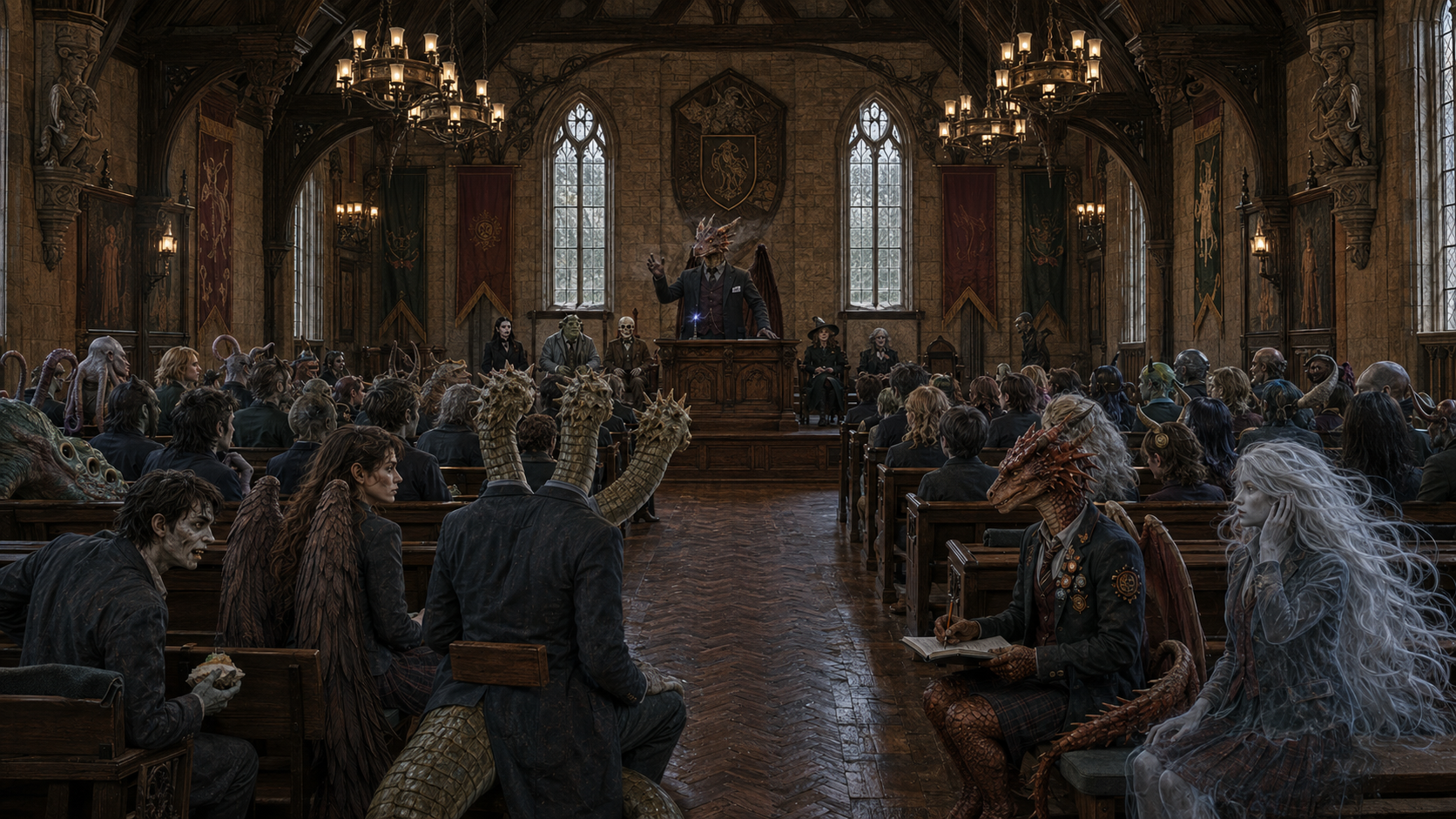
“Pupils and colleagues,” he began. “For three hundred and thirty-eight years, this school has remained open through plague, fire, war, six changes to the national curriculum and the brief appointment of a cannibal as catering manager. I mention this because the Board appears to regard survival as something requiring periodic permission.”
Nobody laughed. The smoke from his nostrils had thickened.
“In ten weeks, Orwell Hell High will receive a Continuance Inspection.”
A groan moved through the hall. It started among Year Eleven, where experience had made the pupils bitter, and reached Year Seven as something close to enthusiasm.
Tansy Pike raised her hand. “What are they continuing?”
“Us,” said Kit. He sounded disappointed by the answer.
“Why?” Bram asked. “Have we stopped?”
Dr Cinder folded the letter once, very carefully. “The Board will inspect teaching, safety, concealment and the management of predatory instincts. If we fail, the school may lose its licence. You would be transferred to other institutions.”
This time the hall went properly quiet. Mr Fenwick’s claws clicked against the stage as he shifted his feet. Milo took the sandwich from his pocket, considered it, and put it away again.
“Which institutions?” Nia called. Her pencil waited above the paper.
“That,” Dr Cinder said, “would be decided by the Board.” His tail tightened around the lectern until the wood creaked.
Mrs Grindle leaned towards the microphone. “Subject to Form R-Seventeen, proof of next-of-kin survival and a complete inventory of detachable parts.”
“Thank you, Prudence.” A flame appeared at the edge of Dr Cinder’s nostril. He pinched it out. “The Board has sent an inspection liaison to assist our preparations. Mr Silas Sable.”
The only person onstage who might have passed for human rose from a chair in the wings. Mr Sable wore a grey suit of such faultless dullness that Mara’s eyes kept sliding away from it. His pale, handsome face suggested careful measurements: every feature in proportion, every hair persuaded into place. The Board employed monsters of every known species, yet he displayed no scales, scars, feathers, fangs or useful deformity. Whatever he was, he had taken pains to leave no clue on the surface.
“My purpose is to help,” he said. His voice was pleasant, dry and low. “I hope you will regard me as part of the school.”
Milo leaned close to Mara. “Which part?” He gave Mr Sable’s suit a doubtful look.
Winnie’s grip tightened on Mara’s sleeve. Both felt pads had slipped away from her ears. “The bell.”
No bell was ringing now. The second note continued beneath the silence, too low for Mara to hear and strong enough to make the water tremble in Ms Shoal’s tank.
“What about it?” Mara whispered.
“It sounds hurt.” Winnie turned towards the tall windows.
Outside, something gave a deep metallic twang. The view through the glass shivered. Fir trees flattened into grey streaks; for half a second the forest vanished, revealing a wet public road running straight to the front doors. A white delivery van emerged between two yews, struck the gate and sounded its horn.
Four hundred young monsters looked round. Even Mr Fenwick forgot the tennis ball.
Mrs Grindle consulted the large watch pinned to her cardigan. “Human male at the gate. High-visibility vest. Approximately fourteen minutes until he becomes impatient.”
Dr Cinder’s wings snapped open, knocking the school banner sideways. “Code Beige!”
The hall broke apart according to Code Beige, the school procedure for unexpected humans. It had last been revised in 1957 and assumed that a visitor would arrive on foot, speak only English and accept tea before asking questions. Miss Nettle leapt onto a bench and sent a disguising spell through the hall in a cloud of lilac chalk. The spell gave a goblin six beautiful human ears, removed a cyclops’s only ear and transformed the Pikes’ scales into matching brown cardigans without reducing the number of heads.
“Hold still,” she shouted. “Human anatomy is interpretive at this distance.”
Mr Grubb carried his fungi into a cupboard labelled SPORTS EQUIPMENT. The cupboard took one look and tried to close itself. Ms Morrow’s spare hand painted WELCOME, LOCAL HERITAGE PARTNERS across the school motto, adding daisies around LOCAL. Madame Vane withdrew into the projection booth and locked it before anybody could suggest she was a drama prop. Ms Shoal rolled at speed towards the swimming pool, her squeaking tank pursued by Mrs Grindle with a yellow hazard sign.
Mr Marrow hurried towards the biology room, shedding a hand at the doors. Outside, Mr Gable folded his stone wings, climbed onto a plinth and became an architectural feature with a mop behind his back. Nurse Serekh began bandaging a row of pupils whose visible features had resisted Miss Nettle’s spell.
Nia produced the red leather Human Encounter Manual. It opened with an offended squeak. “The procedure appoints a calm senior pupil to escort the intruder.”
“Visitor,” Mara said, pushing the manual down.
“Page twelve says intruder.” Nia pulled it back.
“Page twelve predates satnav.” Mara checked the date on the spine. “Possibly roads.”
Nia’s cheeks warmed. A lick of fire escaped her mouth and caught the corner of the page. She slapped it out with her sleeve, leaving CALM SENIOR PUPIL edged in smoke.
Dr Cinder came down from the stage. He had forced his wings beneath a long brown coat, producing the silhouette of a wardrobe being burgled. “Ashdown, you know the protocol. Quill, you know when to ignore it. Go together.”
“That seems inefficient,” Nia said. Smoke escaped between her teeth.
“So does rebuilding after discovery. Take Gutteridge, Keene and the Pikes.” He lowered his voice. “Keep the human away from the west corridor. The lost-property cupboard has not been fed.”
At the front doors, Mrs Grindle opened the outermost one by the width of a clipboard. The driver stood in the rain with a parcel scanner bagged against the weather. His badge said KEV. Water ran from his beard onto a vest the colour of orange marmalade.
“I’ve got forty-eight boxes of exercise books for Orwell Hill Outdoor Education Centre,” he said. “Satnav brought me through a hedge.”
“The approved access route is printed on page two of your supplier agreement,” Mrs Grindle replied. She did not widen the door.
“My supplier agreement hasn’t got a page two.” Kev checked the plastic bag as if one might be hiding there.
“Then you have arrived without a complete document.” Mrs Grindle made a small, condemning mark on her clipboard.
Kev stared at her. Mara watched the first signs of human despair enter his face. Adults often acquired this expression during conversations with Mrs Grindle; species offered no protection.
Nia stepped forward with a smile rehearsed for prize-giving. “Welcome to Orwell Hill. We are ordinary schoolchildren participating in a local heritage activity.”
Behind her, Bram had bitten Kit. Tansy was saying, “Please don’t make this worse,” while making it worse by waving all four arms. One hand struck a display of attendance certificates.
Kev looked at them. Miss Nettle’s spell had given each hydra head a different moustache.
“Drama,” Mara said. “Very experimental.”
Kev wiped rain from his scanner. His expression suggested that he had delivered to worse. “Where do you want the books?”
The van was packed to its roof. Milo disappeared through the loading hatch, and boxes began travelling in a fast, uneven chain through the ventilation system. Two dropped into the staff lavatory. One vanished into a ceiling tile with a sound of private satisfaction. The other forty-five reached reception in four minutes, which interested Kev less than the missing signature.
“Need the head to sign.” He held up the screen. “Can’t leave till I get the head.”
“You may have any of ours,” Bram offered.
Kit elbowed him with their shared elbow. Mara stepped on their shared foot.
“Dr Cinder is in a meeting,” she said.
“I’ll wait. Any chance of a loo?”
Nia prised apart the burnt pages of the manual. “Human sanitation is covered in Appendix—” Her claw caught in the melted leather.
“This way,” Mara said. She closed the book before Nia could locate the relevant century.
They guided Kev through a school made ordinary with the sort of haste that produced stranger results. The entrance plaque had been covered with a poster advertising teamwork; Ms Morrow’s flowers pushed curiously around its edges. A cauldron had become a lamp. In the trophy case, silver cups tried to bite one another beneath a tea towel while a small shield whispered threats in Latin.
The pupils knew where the dangerous things were. Kev did not, and his bladder gave him the blunt forward confidence of a man for whom marvels had become obstacles. He walked past Robin Mott wearing the caretaker’s face, Lydia Wisp emerging halfway through a radiator and Nurse Serekh carrying a jar marked LEECHED—RINSE BEFORE REUSE. Each sight found a sensible shelf in his mind. Mara could almost watch him putting them away.
At the biology room, Mr Marrow stood on a low platform with his arms held stiffly at his sides. A label on his gown read LIFE-SIZE ANATOMICAL MODEL—PLEASE DO NOT TOUCH. Kev stopped in the doorway.
“We had one like that at school,” he said. “Plastic, though.”
Mr Marrow’s jaw fell off. It struck the linoleum and bounced once.
Kev picked it up and handed it to him. “There you go, mate.” He patted the skeleton on the shoulder.
Mr Marrow accepted the jaw, speechless for perhaps the first time since 1742. Mara hurried Kev onward before professional pride recovered.
They were passing the west corridor when the lost-property cupboard began to growl. Its brass handles trembled. A small trainer, heavily chewed, lay outside the doors like a warning placed by somebody with one remaining foot.
Kev stopped. “What’s in there?” He bent towards the sound.
“Boiler,” Mara said. Her claws pressed small crescents into the floor.
“Sounds rough.” He leaned closer.
The cupboard doors flew open. A darkness full of coat hooks lunged into the corridor and seized the back of his orange vest. Kev shouted. Mara drove her claws into the boards, caught his belt and pulled. Nia wrapped both arms around Mara’s waist; the Pikes caught Nia, arguing throughout about which hands had the better grip. Milo seized a radiator pipe and held Tansy’s collar. For several seconds the cupboard and the pupils kept Kev between them like a disputed raffle prize.
The seam of his vest began to tear. Winnie stepped to the keyhole, her face very still. “Drop it,” she said.
She barely raised her voice. Every window in the corridor developed a hairline crack. Dust leapt from the light fittings; somewhere upstairs, a piano closed its lid. The cupboard released Kev and slammed its own doors, trapping a guilty strip of orange fabric inside.
Kev inspected his vest. Mara waited for shouting, police, or the arrival of people with clipboards less reasonable than Mrs Grindle’s.
“Knew it,” he said. “Same model as ours. Landlord won’t replace it.”
Dr Cinder appeared at the end of the corridor with smoke rolling from the collar of his coat. He took the parcel scanner and signed with one claw. The name I. CINDER smouldered briefly on the screen.
Kev put the scanner away. “You want somebody looking at that boiler.” He rubbed the torn edge of his vest.
“We are expecting an inspection,” Dr Cinder said grimly. Smoke seeped through a buttonhole.
“Good luck with that.” Kev had the solemnity of a man offering condolences at a funeral and no intention of attending it.
The van left at nine seventeen. Beyond the gate, the public road softened, narrowed and folded between the trees like a ribbon pulled under a door. The sign for Japanese knotweed returned. Kev drove away without looking back, already dictating a complaint about access which would be classified by the delivery company as resolved—customer not found.
Around the school, Code Beige came undone. Mr Gable climbed down from his plinth and discovered a pigeon on his head. The disguised lamp bit Miss Nettle. Mr Marrow found his missing hand in a Year Eight locker and issued it a detention. Ms Shoal’s tank left a long wet trail back from the pool, over which Mrs Grindle placed a form requesting that somebody else place a sign.
Dr Cinder returned to the hall and dismissed assembly without mentioning the Veil. He called the failure “a localised optical irregularity”. Mr Sable, standing half a pace behind him, repeated the phrase as if testing whether it would survive in an official report.
Lessons resumed because schools are capable of placing almost any terror between registration and lunch. In Mathematics, Mr Marrow asked Year Nine to calculate the probability of discovery given one human visitor and four hundred unreliable witnesses. Milo wrote depends what the human saw and received no mark, though Mr Marrow drew a small, unwilling tick beside it. Miss Nettle spent second period trying to remove the Pikes’ moustaches. Tansy’s came away at once; Bram’s migrated to his forehead; Kit’s expressed a wish to remain until Christmas.
Mara watched the windows. The forest held steady beyond them, but twice she saw the same rook fly backwards into the same branch. At lunch Winnie left most of her soup untouched, one hand pressed to the table as though feeling a train through the rails.
“Still hearing it?” Mara asked.
Winnie nodded. “Fainter.”
“Better faint?” Milo said. He had acquired two bread rolls and a teaspoon from sources he declined to identify.
Winnie looked towards the entrance hall. “Further away.”
Nia sat across from them with the Human Encounter Manual open beside her tray. The burnt page had been repaired with red tape. “Dr Cinder said it was an optical irregularity.”
Mara tore a piece from her roll. “Dr Cinder also wore a coat over six-foot wings and told a delivery driver he had a boiler in the corridor.”
“That was concealment.”
“So is lying.”
Nia’s pupils narrowed to black slits. For a moment heat came off her strongly enough to soften the butter between them. Then she closed the manual. “If the Veil failed, Mr Gable will file a maintenance report.”
“And Mrs Grindle will file the report in a locked cabinet.”
“Because pupils are not responsible for magical infrastructure.”
Mara glanced at Winnie’s hand on the table. The spoon beside it was trembling. “The infrastructure seems to disagree.”
Before Nia could answer, a folded note landed on both their trays. It bore Mrs Grindle’s handwriting and the words HEADTEACHER. TWELVE FORTY-FIVE. JOINT ATTENDANCE. SHOES CLEAN. A second, smaller slip attached to Mara’s instructed her to stop scratching the floors.
Dr Cinder’s office occupied the old solar above reception. The ceiling had been raised twice to accommodate his horns and still showed a black groove where he stood too quickly. His hoard rose behind the desk in careful heaps: confiscated jewellery, house trophies, obsolete coins and several thousand drawing pins separated by colour in glass jars. Dragons accumulated treasure according to temperament. Dr Cinder had spent a century in education and now coveted stationery.
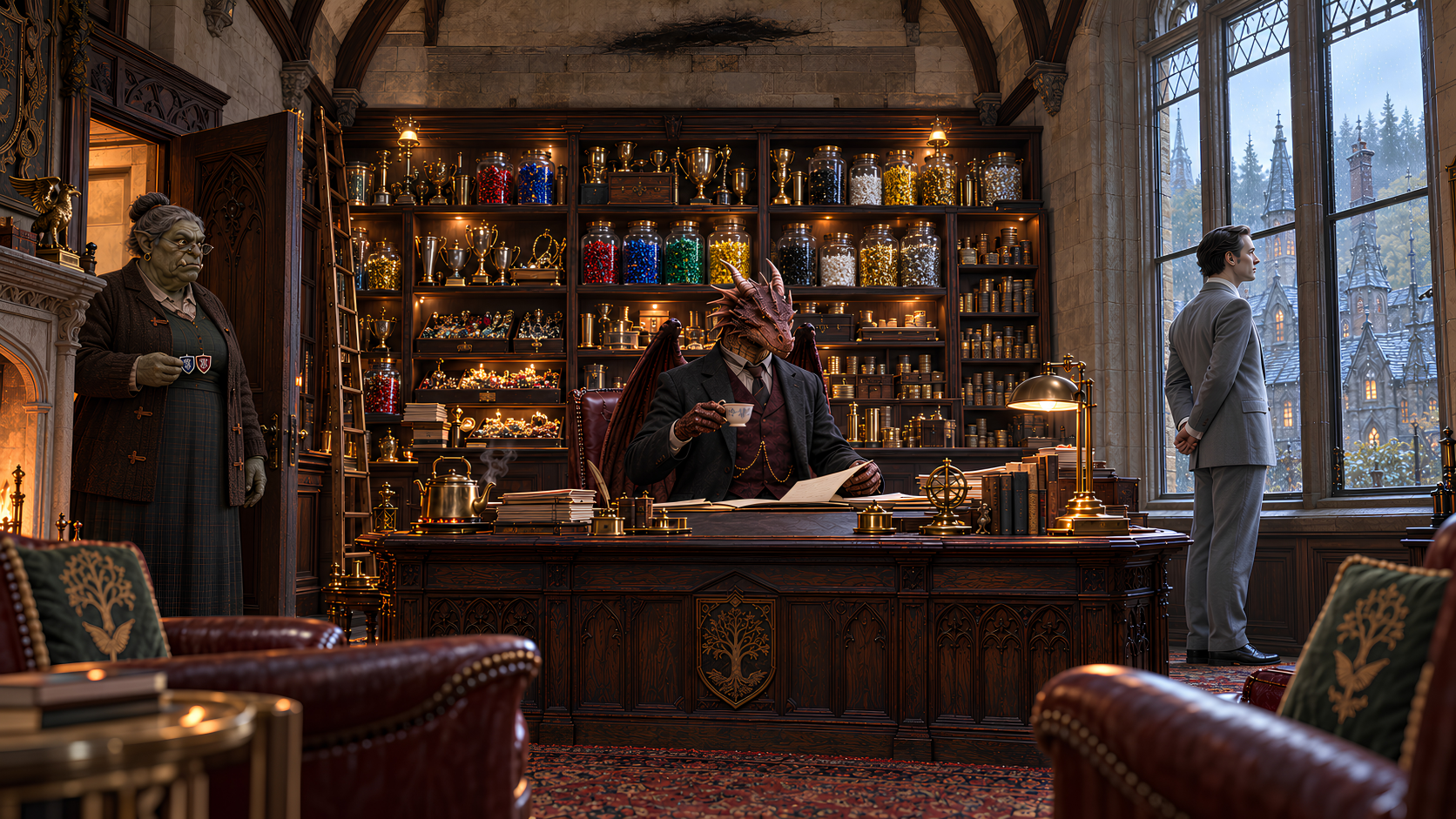
Mr Sable stood at the window with his hands behind his back. In daylight his grey suit matched the sky so closely that his head and cuffs appeared to have been arranged around an absence. Mrs Grindle remained at the door, holding two enamel badges.
“You both showed qualities this morning that the inspection team will wish to see,” Dr Cinder said. His tone made those qualities sound expensive. “Initiative. Knowledge of procedure. An ability to prevent an adult male from being eaten by school furniture.”
“Mara ignored the manual,” Nia said.
“Nia set fire to it,” Mara replied.
“A minor combustion during active consultation.”
Dr Cinder closed his eyes. Smoke spread across the desk and curled around a jar of blue drawing pins. Mr Sable watched the two girls with the mild attention of a man comparing tools.
“The Board expects pupil participation,” the headteacher continued. “I am appointing you joint pupil representatives for the Continuance Inspection.”
Mrs Grindle pinned a badge to each blazer. The badges read PUPIL VOICE, though on Mara’s the final letter had been scratched almost through. Nia’s puff of fire burned a hole through her new badge. Mara’s neck feathers swelled until she had to leave sideways while Milo waited outside pretending he had seen nothing.
“Jointly important,” he said. “How intimate.”
“Gate after lessons,” Mara said, pushing her feathers flat. “Bring something narrow.”
“Morally?” Milo’s face brightened at the possibility.
“Physically.” Mara pointed towards the tool cupboard.
“Much easier.” He slipped away through the wall vent.
The rain stopped before dusk, leaving the grounds rinsed and raw. Water ticked from the yews. Most day pupils had gone; the boarders’ windows glowed above the dining hall, and somewhere in the gym Mr Fenwick blew a whistle at a game which appeared to involve screaming. Mara found Milo behind the bicycle shed with a screwdriver, a bent dessert spoon and an object which had once belonged to Mrs Grindle’s filing cabinet.
Winnie was waiting at the gate. Nia stood beside her with her arms folded.
Mara stopped. “Who told you?”
“Your feathers,” Nia said. “They point towards wrongdoing.”
“We’re checking a maintenance report.”
“There is no report yet.”
“That’s what we’re checking.”
Nia looked at Milo’s tools. The dessert spoon had STAFF ONLY stamped on its handle. She drew breath through her nose, held it, and came with them.
They found Mr Gable crouched beside the inner gatepost. The iron panel beneath the school crest stood open under his chisel. Up close, the seven carved creatures were easy to see: wolf, serpent, raven, fish, moth, bull and a little dragon above the hinge. Six held dim green flames in their mouths. The dragon was black.
Mr Gable turned his granite head. “Pupils are forbidden beyond the white line.” He raised the chisel towards a faded stripe across the drive.
Milo looked down. His shoes were already beyond it. “Is that recent?”
“The line or the rule?” Mara asked.
“Either.” Milo kept his feet where they were.
Gravel trickled from the caretaker’s ear. Mara crouched beside the panel. Within it, silver threads ran through a web of copper roots and disappeared into the stone. One silver strand had been severed. The ends were smooth, bright and separated by the width of a knife blade.
“What does it do?” she asked.
Gable looked at Winnie before answering. “Carries the Veil into the gate. The old magic runs through the whole school. You don’t need the theory to keep your claws out of it.”
Mara held her hand near the cut without touching. Cold moved across her palm. “Lightning?”
“No.”
“A storm?” Nia asked. The question sounded rehearsed, as if she preferred it to what she could see.
“No storm gets inside a locked iron box.” Gable tapped the open panel. “And storms tear. This was cut.”
Winnie moved closer. “Can you mend it?”
“I can join the wire. Whether the magic agrees is its own business.” He took a coil of silver thread from his tool bag. “The panel was locked when I found it.”
Milo examined the little lock. “Does anyone else have a key?”
Gable’s gaze shifted to him. “Why?”
“Professional interest.”
“Three keys. Mine, Mrs Grindle’s and the head’s. Mine hasn’t left the chain around my neck in forty-one years.” He pulled a black cord from beneath his work coat. An iron key hung against the stone of his chest. “Before you ask, goblin, no.”
Milo’s fingers withdrew from the air between them. He pushed both hands into his pockets with injured dignity.
Footsteps sounded on the drive. Dr Cinder approached through the wet dusk with Mr Sable beside him. Their reflections stretched thin in the puddles. The headteacher saw the open panel, the black carving and the four pupils gathered around it. He stopped hard enough for his claws to score the gravel.
For one breath his face lost its headteacherly arrangement. His pupils widened. Smoke rose from his mouth in a dark roll, and the old scar beneath his left horn showed white against the scales. Then he buttoned his coat.
“Routine storm damage,” he said. “Mr Gable will have it repaired tonight. There is no reason for pupils to concern themselves.”
Nia stared at the clean silver ends. Milo looked at Gable’s key. Winnie turned her head as if listening to somebody retreat along a distant corridor.
Mara’s neck prickled. Her feathers rose slowly, one row after another, until the rainwater trapped between them ran cold down her back. Dr Cinder saw. He adjusted his scorched cuff and looked towards the forest.
Beside him, Mr Sable smiled with the calm sympathy of somebody watching a child discover that adults could lie. In the puddle at his feet, the smile looked wider.
Winnie faced the dead carving. “It’s quieter now,” she whispered. “Something’s missing.”
In the little dragon’s open mouth, a drop of rain gathered on the black stone. It trembled against the pull of the earth, then slipped upwards and disappeared between its teeth.
By midnight Mr Gable had joined the severed wire with silver thread and a Latin phrase that had not appeared in a respectable dictionary since the Reformation. Six small mouths on the gatepost glowed green. The dragon stayed black. Gable watched it until his knees began to set, then opened his ledger and entered the matter beneath Pigeon Four, whose offences at least had a culprit.
Across the courtyard, the science corridor slept in its smell of pond water and burnt sugar. Mr Grubb’s fungi had been rescued from the sports cupboard and lined the laboratory windowsill, glowing a shy lilac. Beneath them, in a glass tank labelled GLIM — PLEASE DO NOT TAP, lay the most even-tempered resident of Orwell Hell High. Glim Ooze had no bones, no opinions and no record of misconduct. He spent his days digesting whatever Mr Grubb gave him and his nights being quietly, uncomplicatedly green.
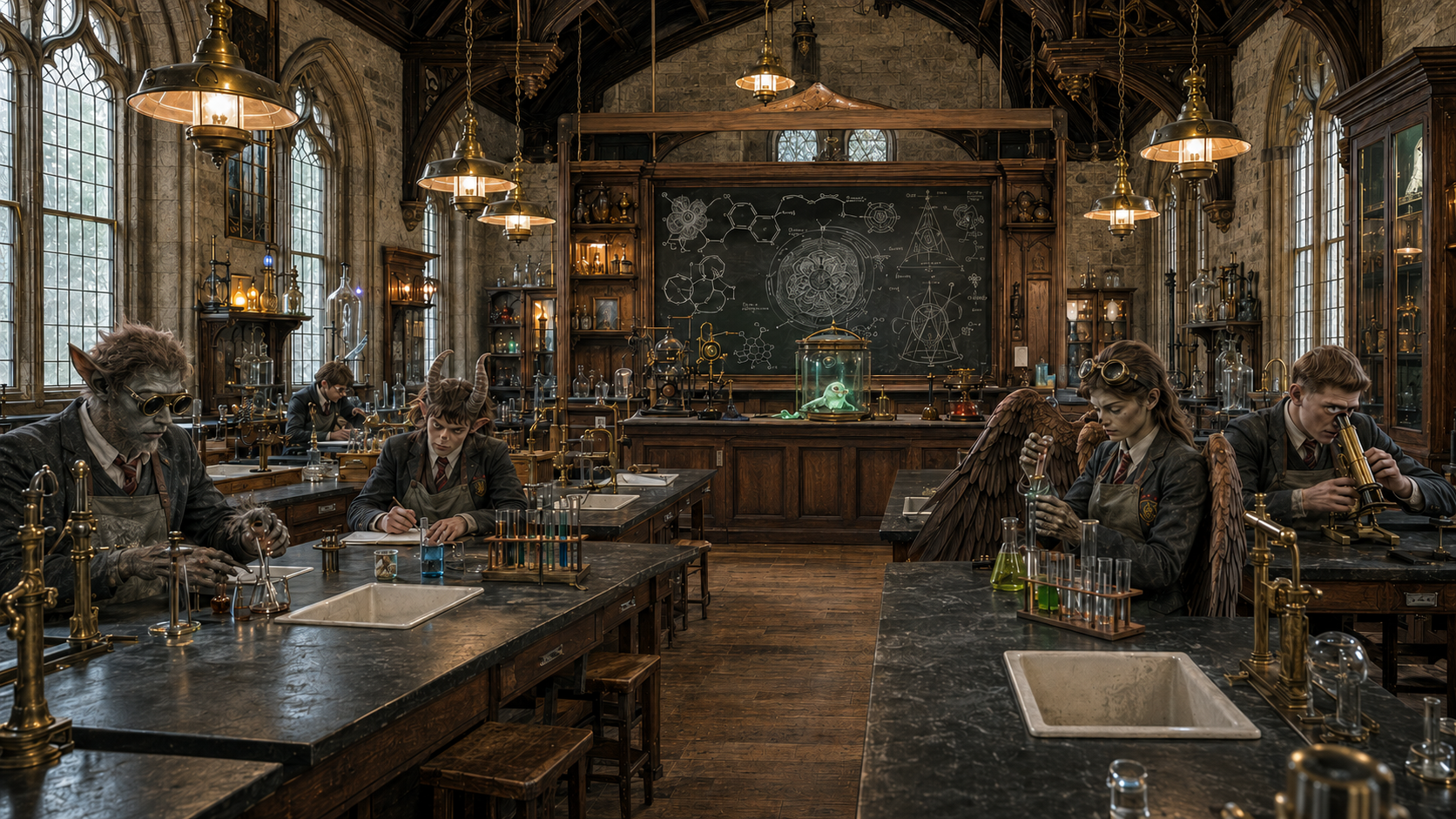
Beside the tank stood his feed: a paper sack folded twice at the top and sealed with tape. On the tape, in handwriting so neat it might have been printed, somebody had written Glim — one scoop daily. Approved. It had arrived on Friday, and like most things that arrive in schools on a Friday, nobody had asked where from.
At a quarter past two the radiator knocked. Glim startled, as he always did, with a small wet hiccup, and for one moment there were two of him. Then the halves found each other, apologised, and became one again — very slightly larger than before. Something glittered in the slime, like sugar that had forgotten it was meant to dissolve.
The lid of the tank lifted a quarter of an inch, and settled.
On the whiteboard above it, in Mr Grubb’s large and trusting capitals, next week’s lesson was already waiting:
MONDAY. YEAR NINE. CELLULAR DIVISION — LIVE DEMONSTRATION!
Someone had underlined LIVE twice…
EPISODE 2 OUT NEXT WEEK!