
IN DEPTH
The Illusion of Expertise: What Real Qualified Personal Trainers Think of Online Coaching
By D. H. Cael
Online fitness sells through bodies, confidence and the suggestion of intimate access. Yet the qualities that photograph best reveal very little about whether a coach can assess risk, adapt exercise safely or recognise the limits of their knowledge. Two qualified personal trainers explain what disappears when visibility is mistaken for competence — and how prospective clients can examine the service beneath the surface.
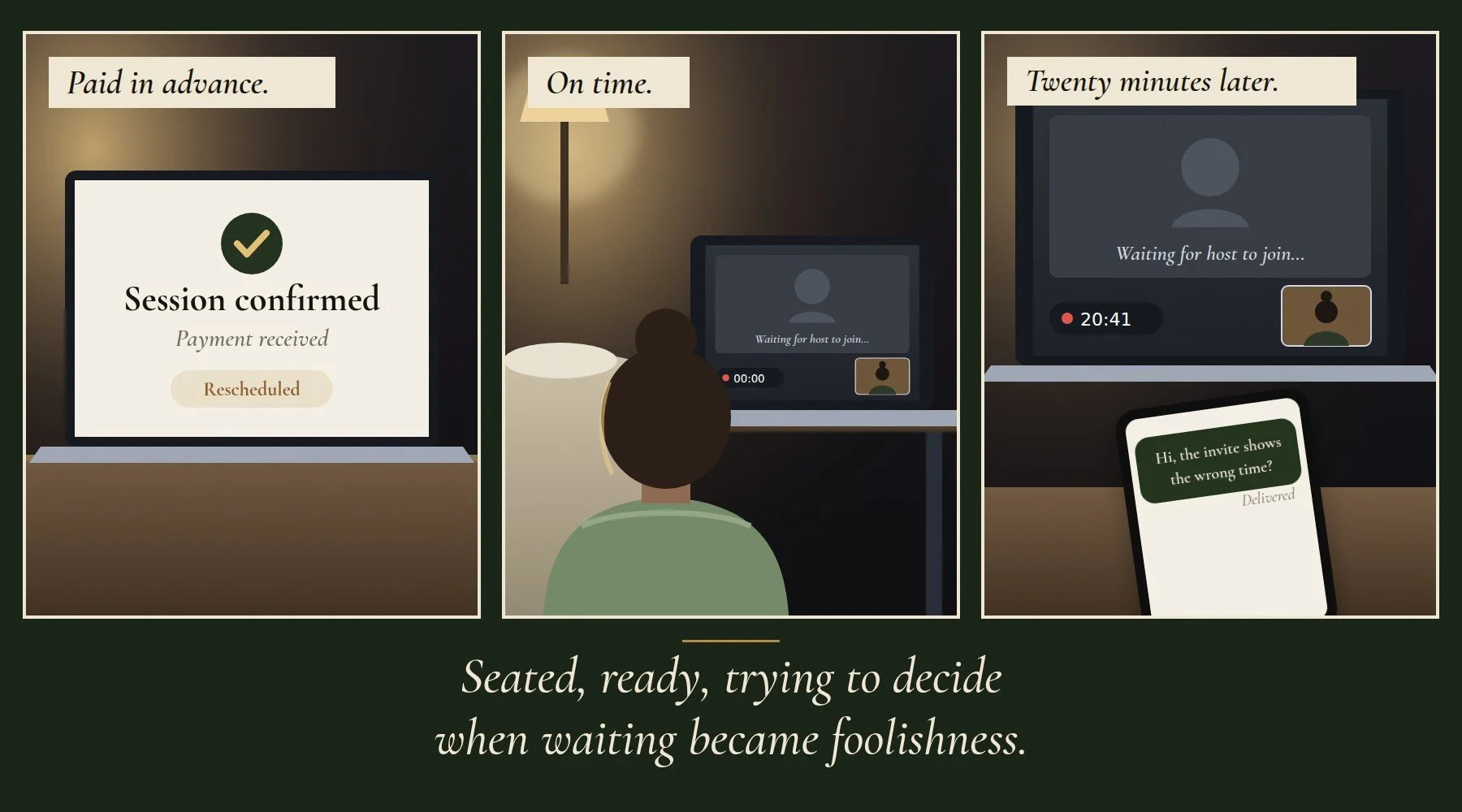
The Empty Appointment
It was evening time, the bedroom was already losing its light and the lamps had been switched on. The adaptable desk stood beside the bed, its height adjusted for whichever version of my body had turned up that day. The room was colder than usual and unusually quiet. On the laptop, a digital meeting space waited with the blank patience of an empty hotel lobby.
I had paid in advance via their online booking system. The appointment had already been cancelled once, ten minutes before it was due to begin, then rearranged through a system whose clean typography and automatic confirmations had conveyed a kind of administrative serenity. But now the invitation displayed the wrong time... My message asking for clarification had gone unanswered, so I had joined anyway. Fifteen minutes passed, then twenty. I watched my own small image in the corner of the screen: seated, ready, trying to decide when waiting became foolishness.
This was not my first encounter with an online coach whose apparent attentiveness dissolved at the point it required ordinary professional discipline. Another had approached me, asked detailed questions about my disabilities, health conditions and medication, then failed to confirm the consultation we had arranged. After a week of silence, she returned with a casual explanation and proposed 6am the following morning as the solution to a disruption she had created.
Neither incident, viewed alone, amounted to a scandal. Missed messages and poor diary management are common enough. What stayed with me was the distance between the sophistication of the presentation and the frailty of the service beneath it. The accounts looked coherent. The language sounded informed. The payment mechanisms worked beautifully. The coaching itself seemed to exist in a more provisional state.
I had approached these services with a little more knowledge than some clients might possess. My background included athletics, gymnastics and structured training, as well as a REP’s (Register of Exercise Professionals) recognised personal-training qualification completed through intensive in-person teaching, practical assessment and full-day examinations in London. I later undertook further training concerning disability, illness and more complex physical needs. I understood programming, adaptation and scope of practice. I also understood why knowledge does not make a person entirely self-sufficient or fully able to train themselves in the way they need.
Even a qualified coach cannot easily stand outside their own fatigue, pain or fluctuating health. Experienced athletes use coaches; clinicians consult colleagues. I wanted an observing intelligence beyond my own body, someone able to notice what I could not see and to provide structure when illness made self-management harder. Online coaching seemed capable of meeting a practical need – it was accessible. There were periods when leaving the house was difficult, if not impossible, when travelling to a gym consumed the energy intended for training, and fixed appointments turned access into another test I was likely to fail if my body was not cooperating that day.
What I found when I entered into the world of online coaching was a market exceptionally good at producing the appearance of help. But falling horrifyingly short of any real professionalism and meaningful support.
So, after several dreadful experiences with online coaches -- I decided to investigate this ever-growing industry to figure out what the hell was going on!
The two in-person trainers I later interviewed approached the subject of online coaching from different points in the profession. Peter* has spent more than twenty-five years in the field and holds over a dozen professionally recognised qualifications. Naya* is younger, she is also formally trained and qualified and with a career formed partly inside the digital culture now reshaping fitness. Their experiences differ in age, setting and perspective. Their concerns repeatedly meet in the same place: the fitness industry has expanded and outpaced the regulation and professional standards needed to govern it.
The result? Illness, injury and even death. The public’s ability to distinguish professional skill from a convincing imitation of it has become a far more complicated task inside the world of online coaching.
Competence in Good Lighting
The online coach rarely arrives looking like a dubious proposition. More often, they appear while you are doing something entirely ordinary: scrolling in bed after a difficult day, waiting for the kettle, avoiding an email, wondering whether you have enough energy to exercise tomorrow. Their account feels less like an advertisement than a window into a life that has somehow acquired better management. The room is calm, the kitchen is clean, the training plan is already written. Their body appears strong in the places contemporary fitness culture has taught us to notice, and their face carries the relaxed assurance of someone who has stopped negotiating with themselves.
This is part of what makes the content so attractive. The creator is not merely demonstrating an exercise; they are presenting an entire atmosphere of competence. Their clothes fit properly. Their meals arrive in matching containers. They seem to wake early without resenting anybody. Even the chaos has been edited into something useful: a bad day becomes a lesson in discipline, an injury becomes a story of resilience, an old photograph becomes proof that change is available to anyone sufficiently committed. The lighting remains excellent throughout, which is considerate of the lighting.
For a viewer whose own life feels less composed, the appeal can be surprisingly powerful. Perhaps their routine has been disrupted by work, illness, caring responsibilities, grief or the ordinary attrition of trying to remain functional. Perhaps exercise has become another subject about which they feel guilty. The person on the screen appears to have solved the very problems that continue to resist them: motivation, consistency, confidence, appetite, time. Their content offers information, but it also offers relief from uncertainty. Here is somebody who seems to know what to do next.
The effect depends on a subtle confusion between different forms of success. The creator may genuinely understand their own body, may have trained with intelligence and persistence, and may be sharing advice that is useful in a general sense. Yet the visual language of the account encourages the audience to infer much more. A well-developed physique begins to stand in for an understanding of anatomy, assessment and individual variation. Confidence in front of a camera begins to resemble professional judgement. The discipline required to publish every day begins to suggest that the same care will be applied privately to a client.
These qualities are related only loosely. A person can be exceptionally successful at changing their own body while knowing very little about how another person’s body will respond. They may understand the habits, injuries, tolerances and motivations that shaped their own progress, while remaining unable to recognise what is happening when somebody else moves differently, fatigues unexpectedly or arrives with a history that does not fit the programme. Personal achievement can be impressive without being transferable.
The difficulty is that expertise itself is largely invisible online. The most important parts of responsible coaching — hesitation, caution, referral, adaptation, the willingness to say “I do not know” — produce poor promotional material. They do not fit neatly into a transformation reel. What photographs well is certainty: the finished body, the decisive caption, the clean demonstration, the promise that the method has already been tested.
In this setting, aesthetic coherence begins to perform the work that evidence ought to do. Because the account looks organised, the service is assumed to be organised. Because the creator speaks fluently, the advice sounds settled. Because their own results are visible, their ability to produce results in others seems self-evident. The audience is not necessarily being lied to; it is being invited to complete an argument whose missing steps have been concealed by excellent presentation.
That is how a good body becomes a professional credential without ever having to declare itself one.
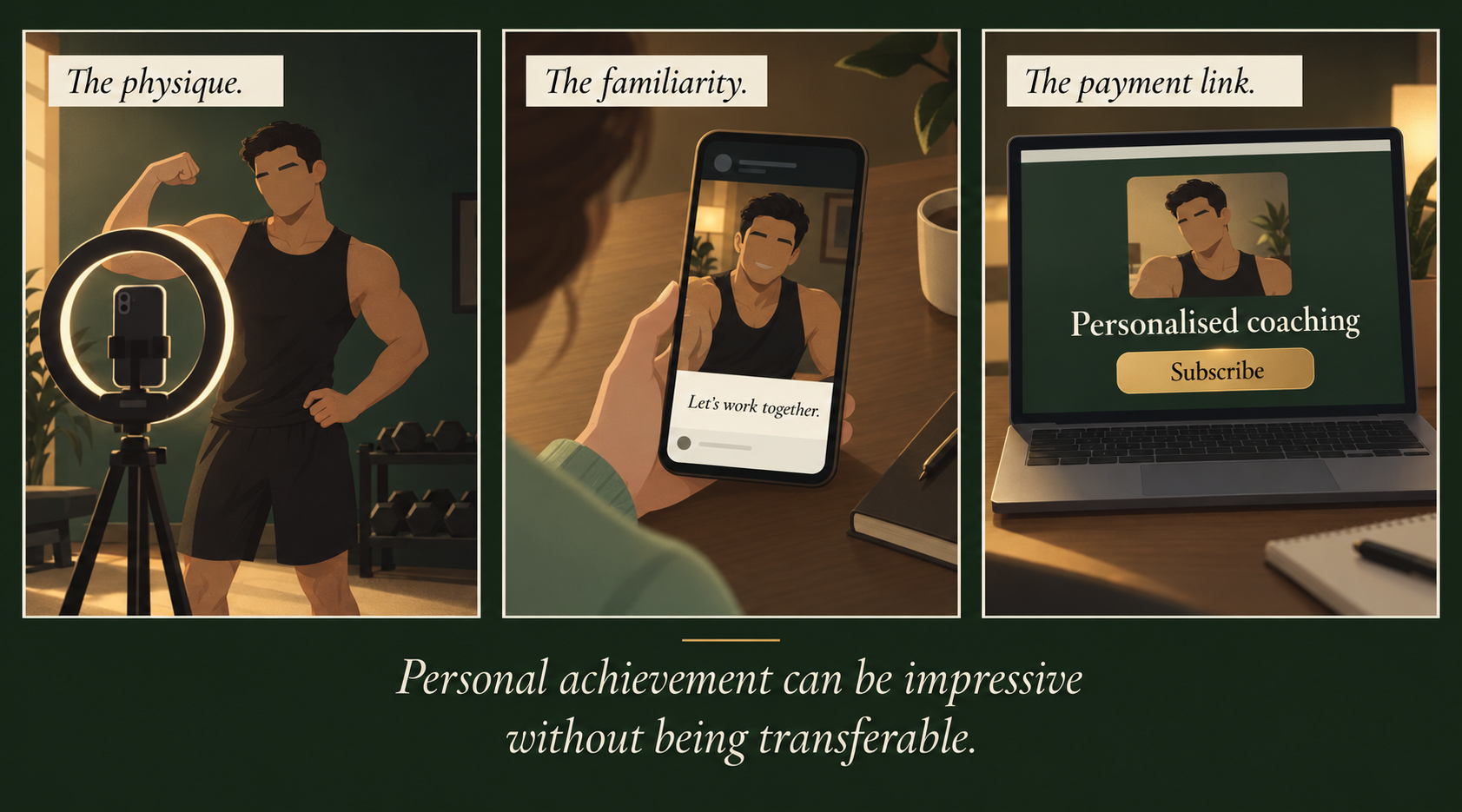
Research into social-media fitness influencers has found that perceived trustworthiness and physical attractiveness contribute to their persuasive force. Work on influencer marketing more broadly has also connected parasocial relationships — the felt sense of knowing a person who does not know the follower in any comparable way — with attitudes and purchasing intentions.
The mechanism is more intimate than conventional advertising. A billboard cannot reply to a message at midnight. It does not discuss ADHD, share favourite television programmes, document a bad morning or confess to once having hated its own body. Influencer culture folds the sales process into the appearance of a life. By the time a coaching offer appears, the viewer may already know the person’s meals, moods, pets, break-ups and preferred brand of headphones. The transaction feels almost like a continuation of familiarity.
The coach’s physique often supplies the visual argument. There it is, renewed daily, apparently proving the method. Yet a body can establish only that a particular person possesses that body at that moment. It does not disclose genetics, training history, injury history, medication, hormone use, disordered behaviour, financial freedom, available time, professional knowledge or the degree to which the image itself has been manipulated. Nor can it show whether the owner knows how to work with a client who is older, postpartum, diabetic, hypermobile, injured, disabled, frightened of gyms or taking medication that affects heart rate and fatigue.
Peter* put the distinction without ornament:
“Just because someone’s got a great physique doesn’t mean they’re equipped to coach. Coaching isn’t one-size-fits-all. It requires knowledge, experience, and an understanding of limits.”
Limits are difficult to monetise. They rarely produce dramatic reels. “This is outside my competence” does not carry the glamour of a universal solution, although it may be the most professionally intelligent sentence a trainer says.
The Work Hidden Inside the Job
The public image of personal training often remains curiously narrow: somebody energetic holding a stopwatch, counting repetitions and instructing a client to continue when they would rather stop. The actual work of the trainer, when performed properly, is less photogenic and considerably more demanding.
A trainer’s responsibility begins long before a programme is written. They must gather relevant information about health, medication, previous injuries, daily activity, sleep, work, stress and practical constraints, then decide whether the client’s goals are compatible with what their body can presently tolerate. That information has to shape the work rather than merely decorate an intake form. An exercise is not appropriate because it appears in a popular routine or because it produced results for the coach; it must be chosen with some understanding of the joints, tissues, movement patterns and physical demands involved, as well as the reasons a particular client may need it adapted, delayed or removed altogether.
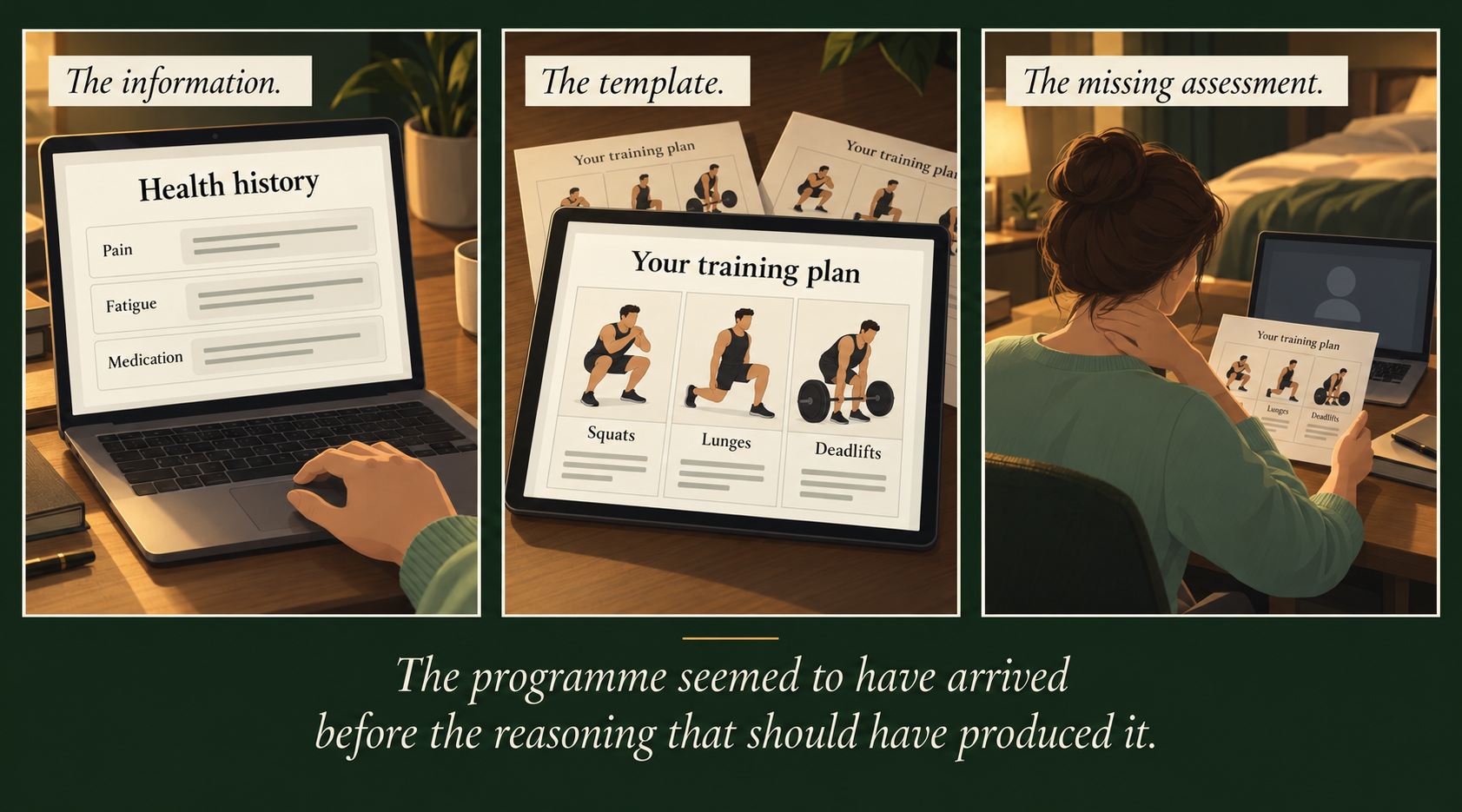
My own experience exposed how readily these safeguards can disappear with online coaches. With both online coaches, the process seemed determined to begin somewhere in the middle. There was little sign of the structured pre-exercise screening I had been taught to regard as basic practice: no careful health questionnaire translated into a meaningful conversation, no systematic review of symptoms, medication, injury history or day-to-day limitations, and no clear attempt to establish what could be undertaken safely before discussion moved towards training itself. One coach asked broad questions about my conditions and medication, but the questions appeared to function as evidence of attentiveness rather than the beginning of a proper assessment. Nothing in the exchange suggested that she understood how those conditions might affect exercise selection, fatigue, recovery or risk.
The contrast with legitimate in-person training was difficult to ignore. My own qualification had involved practical teaching, observed assessment and full-day examinations precisely because health screening is not a ceremonial preamble. It determines whether exercise should begin, how it should begin and whether the trainer is the right person to supervise it. In a responsible face-to-face setting, a real trainer can ask a question, observe the answer in the body and then ask another. They can see how a client walks into the room, how they sit, rise, breathe and protect an uncomfortable area before a formal exercise has even begun. Online, those clues are already reduced; in my case, they were scarcely even sought.
An online questionnaire may collect an impressive amount of personal information while revealing very little about how the client actually moves, breathes, compensates or fatigues. Symptoms are described through the client’s own language, which may be incomplete because they do not know which details matter. A video recorded exercise can conceal the relevant problem through poor lighting, clothing, camera angle or the simple fact that the coach is seeing one selected repetition rather than the movement unfolding across an entire session. Pain may be minimised, instability may be misread as weakness, and a compensation pattern can remain invisible until it has already been repeated under load.
Those limitations make the initial screening more important, not less. Yet the online services I encountered behaved as though distance had somehow removed the need for caution. The second coach moved quickly towards exercises without first establishing a convincing picture of what my body could safely tolerate. I was given a very generic collection of movements sold as a “personalised program” with “customised weekly workout plans”, but in reality there was little explanation of why they had been selected, how they related to my symptoms or what signs would indicate that they should be changed. It seemed very copy, paste and repeat to each client. There was no detailed assessment of pain, fatigue, mobility or the fluctuating nature of my health – there was no assessment of any kind. The programme seemed to have arrived before the reasoning that should have produced it.
When I asked the online coach about his qualifications, training and professional experience, the answers offered little substance. The conversation repeatedly returned to personal transformation: he had rebuilt himself, developed discipline and changed his own body, therefore he appeared to regard himself as equipped to direct other people through the same process. What was missing was any clear account of formal education, supervised practice, specialist training or the limits of his competence. The distinction was damning. In person, uncertainty was a signal to assess, adapt or refer. Online, it was often treated as an inconvenience best smothered with confidence and a payment link.
If I am brutally honest, my opinion of online coaches was fast becoming that they are merely online personalities with a payment link and lack any real capacity to run a business safely – let alone a business that manages peoples health.
This does not make responsible online coaching impossible, but it places a greater burden on the coach to understand what the screen cannot tell them. They must know when written feedback is insufficient, when live observation is required, when an exercise should stop and when the client needs assessment by somebody working within a different professional scope. A coach who fails to recognise those limitations may continue progressing a programme on the basis of incomplete evidence. For a generally healthy client, the result may be frustration or stalled progress. For somebody living with pain, disability, a chronic condition, medication effects or a history of injury, the consequences can be more serious: aggravated symptoms, avoidable setbacks, loss of function, delayed treatment and a growing belief that their body has failed a programme that was never properly designed for it.
The Chartered Institute for the Management of Sport and Physical Activity describes personal training as the planning and delivery of individualised exercise through assessment, adaptation and advice within a clearly defined professional scope. That standard includes pre-exercise screening, informed consent, confidentiality, record-keeping, insurance, safeguarding, appropriate boundaries and the ability to refer a client to a physiotherapist, registered dietitian, medical specialist or another qualified practitioner when their needs exceed the trainer’s competence. In my dealings with these online coaches, none of that professional architecture was visible. The safeguards had disappeared; only the confidence remained, pristine and entirely untroubled by competence.
Online platforms can give inadequate coaching an impressively professional exterior. Health forms, automated consent documents, scheduled check-ins and programmes marked “bespoke” create a visible trail of procedure, but procedure is not judgement. A system may record a client’s medication, pain and limitations with bureaucratic efficiency while the coach proceeds as though none of it has practical meaning. Technology can organise information; it cannot supply the knowledge required to interpret it. In my case, the problem was cruder still: even this administrative theatre was largely absent, and prescription began before any safe or coherent basis for it had been established.
That reversal matters. Health screening is meant to determine the next step; it should not be hurried through after the coach has already decided what they want to sell. Medication may affect energy, heart rate, balance, coordination or recovery. A chronic condition may fluctuate from one day to the next. Previous injuries can alter movement in ways the client no longer notices because compensation has become habitual. When these matters are not properly explored, the coach is no longer personalising exercise. They are asking the client’s body to absorb the consequences of their incomplete knowledge.
The danger becomes acute when a coach treats remote delivery as though it removes rather than increases uncertainty. They may offer advice on rehabilitation, pain, nutrition, mental health or medical conditions without the training required to do so, partly because nobody is physically present to interrupt their confidence. Referral can feel commercially inconvenient: admitting that another professional is needed may mean losing the client, the payment or the flattering position of being the person with the answer. The client is then left inside a service that has gathered intimate health information, assumed responsibility in tone and marketing, yet lacks the knowledge or structure to carry that responsibility safely.
Professional restraint is therefore as important as technical knowledge. A credible online coach must be able to say that a camera angle is inadequate, that a symptom requires medical attention, that a programme cannot safely continue without assessment or that a client’s needs fall outside the service being sold. I encountered the opposite impulse: an eagerness to begin before the necessary questions had been asked, supported by very little evidence that the people asking for my trust understood why those questions mattered in the first place.
When those professional limits are concealed, misunderstood or simply skipped, online coaching ceases to be merely less attentive than face-to-face support. It becomes a service in which serious uncertainty is dressed up as personalisation, while the client’s health and safety are quietly conscripted as collateral for the coach’s confidence. These requirements expose the poverty of the idea that personal transformation qualifies somebody to direct other bodies. Losing weight can teach a person a great deal about their own habits. Recovering from an injury may produce valuable experiential knowledge. Building muscle over several years can involve discipline, patience and serious study. None of it, however, amounts to a licence to practise on strangers. A transformation proves that one person changed one body under one set of circumstances; presenting it as authority over a varied client population is autobiography inflated into expertise, with the client left to discover the difference in their own joints, symptoms and recovery.
Naya* explained how she sees this confusion regularly:
“People mix up different roles — personal training, physio, rehab. They think because something worked for them, it’ll work for someone else. But those are completely different skill sets.”
A physiotherapist is trained to assess and treat injury, illness and disability within a regulated clinical profession. A personal trainer ordinarily works with exercise and fitness inside a narrower scope. Rehabilitation, clinical nutrition, psychotherapy and medical management bring their own training, regulation and responsibilities. The internet flattens these distinctions because the language overlaps. “Recovery”, “mobility”, “hormones”, “healing”, “nervous-system regulation” and “rehab” move freely through captions, where they acquire authority is from the repetition.
The risk sharpens when a coach has learned enough medical language to sound authoritative without acquiring the education, judgement or professional restraint that gives such language meaning. Terms such as inflammation, cortisol, hormonal imbalance, rehabilitation, nervous-system regulation and metabolic health can be delivered with impressive fluency, particularly when accompanied by anatomical graphics and the grave expression of somebody announcing laboratory results. To the client, this vocabulary implies an unseen structure behind the advice: careful assessment, reliable records, evidence-based reasoning, supervision, referral pathways and some accountable person capable of recognising when the situation has moved beyond fitness coaching.
That inference is understandable and potentially dangerous. Clinical terminology is being used to create the emotional reassurance of healthcare without its safeguards. The coach may gather details about pain, medication, disability or illness, then respond with a confident explanation that has never been tested against a proper assessment. Symptoms requiring medical attention can be reframed as poor mobility, inflammation, stress or lack of consistency; referral is delayed while the client continues exercising under advice that sounds precise enough to suppress doubt. The language gives uncertainty a professional accent, but it does not make the uncertainty safe. Sometimes there is no clinical architecture behind the terminology at all—only a creator who has mistaken recognising medical words for being qualified to use another person’s body as the practical examination.
Peter’s* definition of professional responsibility begins at the point money is accepted:
“If you’re taking money from someone, there’s a duty of care. You need to know what you’re doing, and you need to know what you’re not qualified to do.”
The second half of that sentence is the harder one. It requires a person to value the client’s welfare more highly than the sale. In the online coaching I encountered, safeguarding stopped at the checkout.
Reinventing the Ordinary
The commercial pressure operating on trainers is genuine. Qualified professionals now compete in the same feeds as entertainers, bodybuilders, supplement sellers, amateur enthusiasts and creators whose principal talent is holding attention.
Peter* has watched the profession move towards increasingly theatrical differentiation:
“The industry has become more competitive, more sensationalised. People feel they have to stand out — to reinvent something that doesn’t actually need reinventing.”
Some online coaches behave as though exercise was only invented shortly after they acquired a ring light. A familiar movement is renamed, a minor variation is presented as a correction to years of collective error, and a basic training principle reappears as privileged knowledge apparently concealed from the public by physiologists, textbooks and every competent trainer who came before. The performance sometimes depends on making the ordinary look newly dangerous: your squat is wrong, your warm-up is useless, your programme is sabotaging your hormones, and only this creator has noticed. Novelty becomes less a form of education than a method of destabilising the audience’s confidence. If viewers understood that effective training is usually built from unglamorous fundamentals—appropriate loading, gradual progression, recovery and repetition—there would be far fewer revelations to monetise. So, the wheel is polished, "reinvented” and sold back as a breakthrough, while the audience is kept just uncertain enough to need the next correction.
Naya* described the result with the weariness of somebody who has seen the same movement repeatedly unpacked and resold as revelation:
“There’s so much information online now that it starts to blur. You see the same exercises presented as something new, over and over again. It looks like expertise, but it’s just repetition with better lighting.”
This blur serves a commercial purpose even when no deliberate dishonesty is involved. An audience confident in the basics requires less constant instruction. An audience persuaded that fitness is an unstable collection of secrets remains receptive to the next correction, programme or subscription.
The creator economy encourages people to monetise whatever first made them interesting, and in fitness that often means turning personal history into professional authority. Losing five stone becomes a weight-loss system; returning to exercise after childbirth becomes a postpartum specialism; recovering from back pain is promoted as rehabilitation expertise. The story may be moving, disciplined and entirely genuine, but it remains evidence from one body living one life under one set of conditions. A sample size of one does not become a methodology simply because it has good lighting and a discount code.
Good intentions do not repair that gap. Many underqualified coaches probably do care about the people paying them and may work extremely hard, convinced that their own success has given them something valuable to pass on. The danger lies precisely in that conviction: personal experience can produce certainty long before it produces competence. Sincerity may make the advice warmer, more intimate and more persuasive, while doing nothing to make it safer. A person can mean every word and still be catastrophically unqualified to say it.
The Clients Most Likely to Believe
Discussions of online fraud often flatter the person standing safely outside it. The story is usually arranged into two neat roles: the credulous victim who falls for the performance and the wiser observer who would have recognised it immediately. Real decisions are made under less flattering conditions. Trust is shaped by fatigue, money, isolation, previous disappointment and the number of realistic alternatives available. Good judgement does not disappear in those circumstances, but it is forced to work with poorer materials.
Someone with a stable income, predictable health, reliable transport and several competent local gyms can assess online coaching as one option among many. For somebody housebound by illness, it may be the only form of support that appears immediately reachable. A new mother may be trying to train between feeds, pain and sleep broken into useless fragments. A disabled client may already have encountered inaccessible buildings, unsuitable equipment and professionals who become visibly alarmed when asked to adapt anything more complicated than the seat height. Someone recovering from injury may be waiting months for further treatment, while private specialist support costs more than they can sustain.
Against that background, online coaching offers something genuinely valuable: privacy, flexibility and freedom from travel. It can accommodate irregular sleep, caring responsibilities, limited mobility and geographical isolation; for people who find gyms intimidating, it also removes the social ordeal of entering a room where everybody else appears to know what the equipment does. These are not foolish reasons to choose it. They are precisely what makes the offer so persuasive—and what makes it especially serious when accessibility is used to sell support that lacks the competence, structure or care required to provide it safely.
Physical activity can benefit many disabled people and those living with long-term conditions, provided it is appropriate to the individual. The NHS advises anyone with medical concerns, or returning after a long period of inactivity, to seek guidance and ensure that the intensity suits their health and circumstances. Good support should widen access to movement; it should not behave as though every complicated body can be solved by the same PDF and a motivational voice note.
For someone whose health is unpredictable, the appeal of coaching may extend well beyond exercise selection. Illness can turn ordinary life into continuous negotiation: energy is rationed, plans are cancelled and confidence in the body becomes increasingly conditional. The composed figure on the screen offers a seductive alternative—a plan, a rhythm and the reassurance of someone who appears to know what happens next.
That is why the purchase can carry more emotional weight than the service description admits. The client may be seeking structure, recognition or steady human contact alongside physical guidance, and those needs are easily confused with professional competence. A prompt reply can feel like expertise; warmth can resemble safety; shared interests can suggest compatibility. The coach appears to understand the person before offering any evidence that they understand the body.
I was susceptible to that pull despite knowing exactly what responsible coaching should look like. I was not searching for somebody to educate me from scratch; I wanted an external eye, a little structure and the kind of practical steadiness that becomes difficult to manufacture when your body changes the terms without notice. Knowledge had not made me immune to fatigue, isolation or the relief of being approached by someone who appeared willing to take the uncertainty seriously. Qualifications are useful, but they do not make a person less human, nor do they prevent hope from occasionally dressing itself as professional judgement.
I knew what responsible coaching should look like, but that knowledge did not make me immune to exhaustion, isolation or the relief of being taken seriously. I wanted an external eye and some practical steadiness around a body that could change its terms without warning. When someone appeared willing to help, reassurance began to feel like evidence. The problem was not that I lacked knowledge; it was that he sold confidence far more convincingly than he could demonstrate competence.
What the Screen Cannot See
The strongest argument against careless online coaching concerns observation. Exercise is experienced from inside the body and interpreted from outside it. Clients are not always equipped to translate between the two.
A client may know only that a squat “feels strange”, without being able to distinguish pain from fear, poor balance, limited ankle mobility, excessive load, fatigue or faulty technique. A deadlift filmed from the wrong angle can conceal the very movement that matters, while a client may assume the repetition was correct simply because they have never been taught what an error looks or feels like. Symptoms are easily minimised too, particularly when the person wants to please the coach, preserve their progress or avoid being accused of lacking commitment.
This is where a qualified in-person trainer is markedly safer than an online personality armed with confidence and a camera. A competent trainer can watch the whole body in real time, change position, test a different range, reduce the load, stop the exercise and ask better questions as the movement unfolds. They can see hesitation, compensation, instability and fatigue before the client has found the language to describe them. An attention-driven online coach, by contrast, may be more invested in preserving the authority of the programme than interrogating what the body is actually doing. One responds to evidence in front of them; the other risks treating the client’s pain as an inconvenient threat to the brand.
Naya* is sceptical of any coaching model that tries to design an individual exercise programme using written answers alone:
“You cannot properly assess how someone moves without observing them in person at some stage. Bodies rarely behave as neatly as they appear on paper or through a carefully positioned camera. Any online coach claiming otherwise is confusing confidence with competence.”
What an experienced trainer sees is not simply the repetition, but the hesitation, compensation and fatigue gathering around it—information a questionnaire cannot collect and a carefully framed video may never reveal.
“You can see things straight away in person — how someone’s moving, where they’re compensating. Online, you miss a lot if not all of that,” Naya* said.
A capable online coach may reduce some of this loss through live video, carefully specified camera angles, movement assessments, detailed feedback and an initial period of face-to-face work. Technology can support good practice. Research into clinician-led telerehabilitation suggests remote exercise can be safe and useful when it contains genuine assessment, professional oversight, monitoring and an appropriate patient population.
That is a very different proposition from sending a list of exercises through an app and asking the client to report completion.
The online service I purchased amounted to a list of exercises selected with roughly the personalisation of a hotel-gym poster. There was little explanation of why those movements suited my body, how they related to my pain or medical conditions, or what should happen when my limitations inconveniently failed to resemble those of a healthy man performing for Instagram. My health history had been collected, but it appeared to have gone into storage rather than into the programme.
The coach’s most developed nutritional intervention was to request photographs of my meals so that he could estimate their protein content. Apparently, decades of nutritional science had been waiting for a deluded 30-year-old man in Florida to squint at my dinner. I suggested using an established tracking app instead, which lacked the intimacy of photographing a chicken breast but offered the minor advantage of actual data.
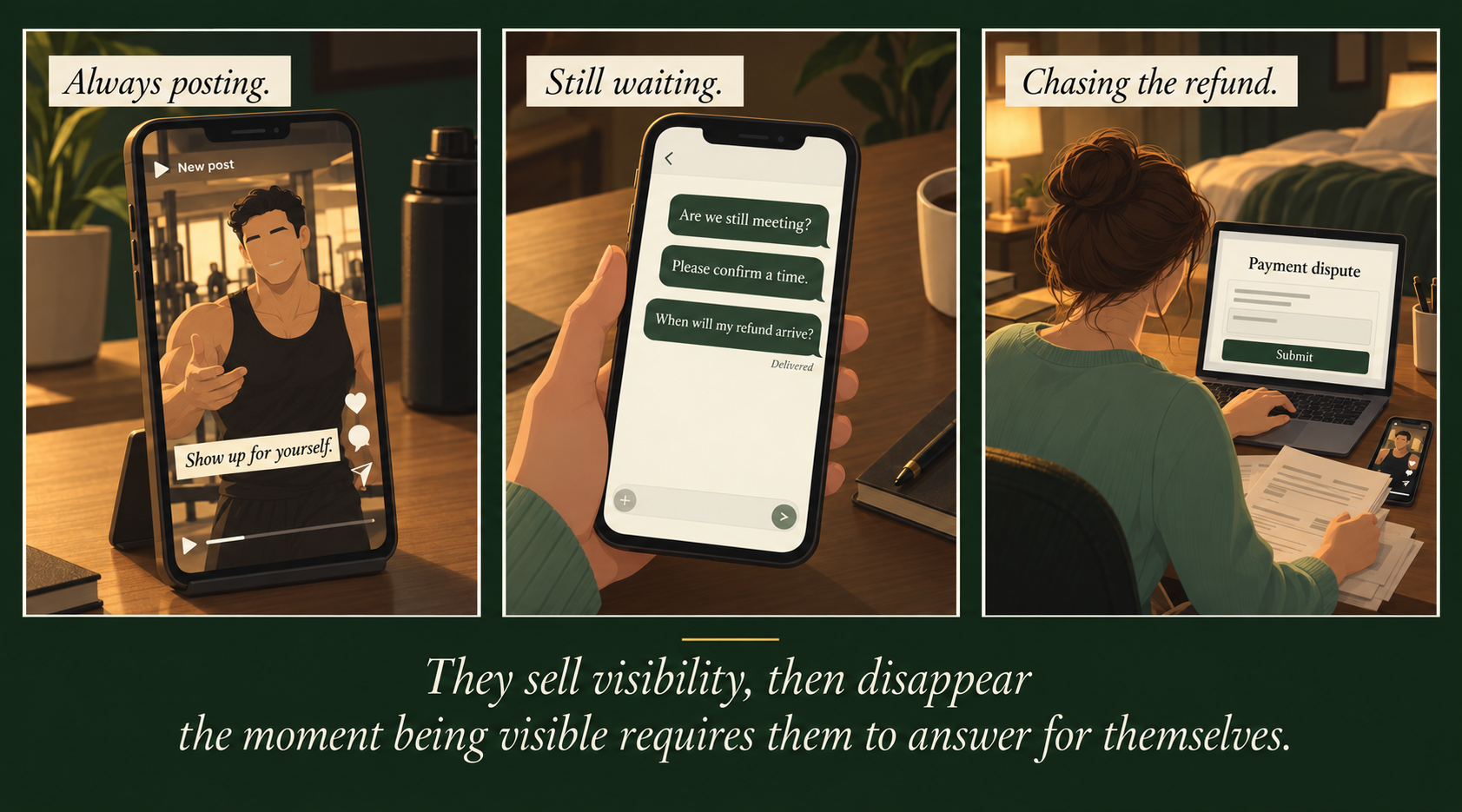
The surrounding business was managed with similar rigour. Despite the fact he posted multiple times a day, the correspondence arrived late or not at all; appointments were cancelled, confused or missed; arrangements required repeated chasing; and a promised refund never materialised, leaving me to recover the money through my bank. By then, the service had cost far more than its price: hours of administration, depleted energy and avoidable stress imposed on someone whose health the coach was supposedly being paid to support. He had marketed accountability while requiring the client to manage his diary, his communication and eventually his unpaid debt. The coaching was barely there; the incompetence however was available everywhere.
Digital tools can create an impressive density of contact: graphs, streaks, notifications, photographs, check-in forms and automated praise. Data accumulation can resemble attentive care. The significant question is what the coach notices, concludes and changes because of it.
Peter* saw the problem as one of accountability as much as geography. He explained in detail that in a gym or any established face-to-face practice, poor conduct has witnesses, consequences and a physical address. “A trainer who misses appointments, mishandles clients or behaves unprofessionally cannot simply retreat into silence while continuing to broadcast a polished version of himself to everybody else. Online, that retreat is considerably easier. Distance allows wounded ego to masquerade as privacy, avoidance to pass for boundaries, and criticism to be dismissed as hostility from somebody safely reduced to a username.”
What particularly angered him was the contradiction between the cultivated “nice guy” persona and the absence of responsibility beneath it. Some creators appeared fiercely protective of their image while showing remarkably little interest in making the business attached to that image reputable, dependable or worthy of the trust it solicited. Accountability became an injury to the ego rather than an ordinary condition of professional work; the client raising a legitimate concern was treated as the problem, while the creator returned to posting motivational content as though basic competence were an unfortunate distraction from personal branding. This was certainly the case from my experience
Peter* then reduced the distinction to its essential point:
“In person, you’re responsible for what happens in front of you. You can’t hide behind a screen.”
Online, however, some coaches do precisely that: they sell visibility, then disappear the moment being visible requires them to answer for themselves.
Intimacy Without Infrastructure
The pandemic normalised remote work, healthcare, friendship, dating, education and exercise at extraordinary speed. Some of those changes improved access and remain valuable. They also accustomed people to treating mediated contact as an adequate replacement for activities once anchored in shared physical space.
Naya* sees online fitness as part of that wider adjustment:
“People got used to doing everything online. It filled a gap, but it’s not the same as being in a room with someone. You don’t get the same feedback or the same understanding of each other.”
The missing feedback is partly physical and partly relational. In a room, a trainer sees the condition in which the client arrives. They notice that walking is slower, concentration is poor or a movement that was comfortable last week now produces apprehension. The client does not have to decide in advance which details are worth uploading.
Online, the relationship may feel more personal while containing less usable knowledge. The coach appears in the client’s phone throughout the day, sometimes beside messages from family and friends. Social media supplies glimpses of private life that would rarely form part of an ordinary professional relationship. The client may know where the coach went for dinner, how they felt after a break-up and which photograph they prefer from a recent holiday. This creates familiarity without the reciprocal responsibility that usually develops between people who genuinely know one another.
When the same person sells coaching, the boundary between audience and client can remain poorly defined. The buyer may be purchasing programming, access, encouragement, attention or some unstable mixture of all four. A delayed reply then carries more emotional weight than a late administrative response should or would. Criticism becomes difficult because the client worries about injuring a relationship that exists largely in their own experience.
No calculated predator is required. A disorganised creator with poor boundaries and an audience trained to experience access as intimacy can produce much the same harm through negligence.
Permission to Step Back
If any part of this arrangement feels familiar, it may be worth examining what is keeping you in it. Perhaps the programme feels increasingly generic, the explanations become thinner whenever you ask a precise question, or every concern is returned to you as evidence that your mindset needs work. Perhaps you have begun preparing your body for the coach rather than expecting the coach to work responsibly with the body you have. That reversal is easy to miss because fitness culture has spent years teaching people that discomfort proves commitment and doubt exposes weakness.
It is possible, however, that the problem is not your discipline. You may simply be paying someone whose confidence exceeds their competence and whose business depends on making the imbalance look motivational.
A qualified professional should be able to respond intelligently when pain, fatigue, illness, medication or changing capacity interrupts the plan. They may reduce the load, alter the movement, postpone progression or advise you to seek medical or specialist support. A poor coach often treats the same interruption as disobedience. The programme remains sacred; the client becomes defective. When reality refuses to cooperate with the spreadsheet, the body is accused of lacking commitment.
That should tell you something.
You are allowed to pause before the damage becomes dramatic. You do not need an injury serious enough to photograph, a bank dispute or a final message drafted with the precision of a solicitor who has not slept. Persistent confusion is sufficient. So is feeling pressured to continue despite worsening symptoms, vague answers or the growing suspicion that the person advising you has no idea what they are looking at.
Taking a break is not abandoning your health. Sometimes it is the first decision in the arrangement that genuinely protects it. Exercise will still exist next month; the dumbbells are unlikely to file a personal grievance. A temporary pause can give you room to seek appropriate medical advice, recover from a setback or find a trainer whose qualifications, ethics and professional standards survive direct questioning.
The right professional will not require you to gamble your health in order to prove your seriousness. They will not interpret caution as betrayal or treat referral as a failure of their authority. They will understand that trust is earned through clear reasoning, reliable conduct and the occasional humility to admit that another practitioner is better placed to help. Any coach who experiences those standards as an attack is revealing considerably more about their ego than your attitude.
Bad coaches often retain clients by making departure feel like defeat. They imply that progress depends on continuing to believe in the programme, even after the programme has stopped giving you any reason to believe in it. This is an effective way to preserve income and a remarkably poor way to support another human body.
When the Subscription Is Really for Belonging
For some people, the arrangement was never entirely about an exercise programme. They subscribed to join a community, enter a private chat, attend livestreams or gain access to a smaller circle gathered around a creator they admired. The official product may have been workouts, accountability or “exclusive content”, but the emotional attraction was often simpler: companionship, recognition and the possibility of briefly mattering to somebody whose attention had become valuable.
There is no shame in that. Loneliness rarely introduces itself with useful administrative clarity. It does not announce that what you need is friendship, affection or a room in which your absence would be noticed. It may present itself instead as curiosity about a paid group, a desire for accountability or the hope that a creator who seems unusually warm might remember your name. A subscription can look easier than admitting that you want company, particularly when it arrives with visible abs and a welcome message.
These spaces can provide genuine community. People meet, encourage one another and form relationships that continue beyond the creator who brought them together. The problem begins when belonging is deliberately tethered to payment and proximity to the central personality. Access is rationed through subscription tiers; attention arrives unpredictably; a brief reply or acknowledgement becomes valuable enough to keep people paying through months in which the practical service offers very little.
The creator may appear to be everywhere—posting, livestreaming, replying to selected comments—while remaining personally unavailable in any stable or reciprocal sense. This is not necessarily deception. No public figure can maintain genuine intimacy with hundreds or thousands of subscribers. Yet the business may continue to profit from the atmosphere of intimacy long after its limits should have been made clear.
You may have joined because the creator made you laugh during an isolated period. You may have found them attractive, admired their body or felt recognised by their disclosures about anxiety, neurodivergence, rejection or shame. You may have wanted a little of their attention and then felt embarrassed when that desire became visible to you. None of this makes you pathetic. It makes you susceptible to the same human needs on which much of social life has always depended, now conveniently fitted with recurring billing.
What matters is whether the arrangement is nourishing those needs or merely keeping them activated.
A community should leave you more connected, not more anxious about maintaining your place within it. Contact should not feel like a prize distributed just often enough to renew hope. You should not have to keep paying in order to preserve the possibility that one day the person at the centre might properly notice you. Affection that exists only above a payment field is customer retention wearing a softer expression.
Desire Is Not a Contract
Attraction deserves particular honesty because fitness culture is built around bodies while remaining oddly coy about what bodies do to judgement. An admired creator may be beautiful, charismatic or sexually compelling. The account may combine physical display with warmth, vulnerability and direct invitations to message. Desire is then folded into a transaction while everybody politely pretends the purchase is solely about macros and progressive overload.
It is possible to have entered the arrangement partly because you wanted to feel closer to the person selling it. That desire may have existed alongside perfectly practical motives. You may also have needed guidance, structure or a community. Human decisions are rarely courteous enough to contain only one reason.
You are still entitled to assess the service clearly. Attraction does not cancel your right to professionalism, and admiration does not create a debt of loyalty. The fact that you once hoped for attention does not oblige you to continue funding somebody who responds inconsistently, treats boundaries as a one-way convenience or allows their ego to occupy the space where responsibility should be.
A creator may be alluring, funny and apparently open while remaining incapable of providing the relationship—or the service—you imagined. That does not mean the feeling was false. It means the object of it was mediated, edited and sold under conditions designed to intensify projection. You were responding to what was placed in front of you. The person behind it may be considerably less available, less attentive and, in some cases, less impressive once required to perform any task that cannot be completed by looking good beside a ring light.
You are permitted to find them attractive and leave anyway.
Go and Find Something Real
There comes a point when remaining inside a paid approximation of connection becomes more painful than admitting what it cannot provide. The private group is active, but you still feel alone after closing the app. The creator occasionally responds, but the attention is too brief and conditional to sustain anything. You know a remarkable amount about their life while they know almost nothing about yours beyond the information supplied at checkout.
That imbalance is built into the arrangement. It cannot be repaired through greater loyalty, more patient waiting or a higher subscription tier.
You deserve relationships in which attention is not a promotional resource. You deserve friendships that survive a declined payment, communities that notice more than your engagement statistics and affection that does not arrive as a reward for remaining commercially useful. The world outside the screen may be less polished and less immediately responsive. People are untidy, occasionally dull and rarely filmed from their best angle. They can also know you in return.
Seeking something real does not require a dramatic purge of every account you follow. It may begin quietly: leaving a group that makes you feel worse, pausing a subscription, contacting somebody you trust, joining a local class or support group, speaking to a qualified trainer in an ordinary gym, volunteering somewhere, or returning to an interest that places people beside one another without requiring anyone to perform intimacy for an audience.
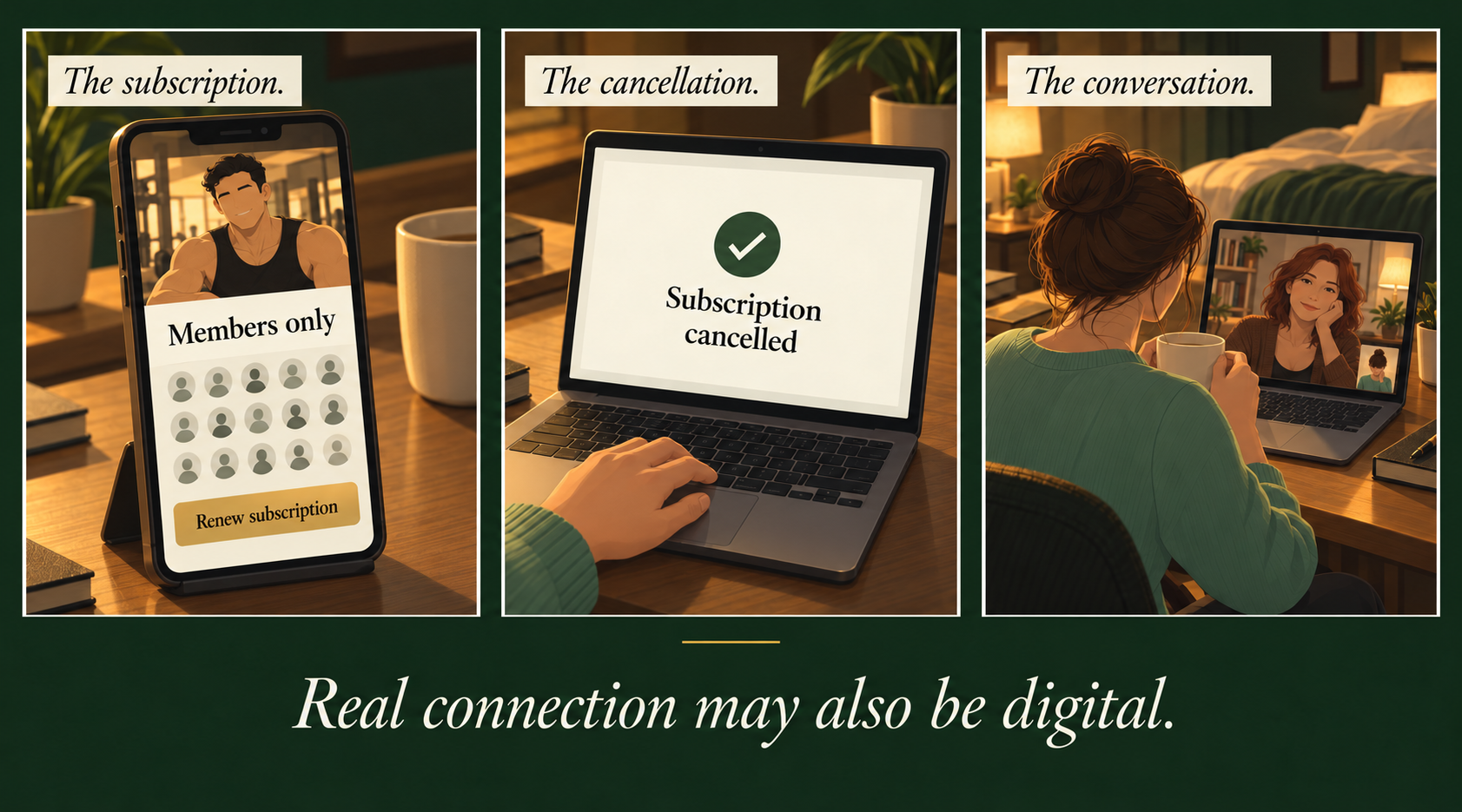
For disabled people, those living with illness or anyone whose circumstances restrict social access, “go outside and meet people” can be glib advice delivered from the luxurious assumption that the outside world is accessible. Real connection may also be digital. The distinction is not between screens and rooms; it is between reciprocity and extraction. A friendship conducted online can be deeply real. A paid relationship built around an inaccessible personality may remain emotionally thin despite endless content and daily notifications.
Look for places where other people are allowed to matter too. Look for communities with shared purpose rather than a single adored figure at the centre. Look for trainers who are interested in your life because it affects the work, rather than because intimate disclosure increases attachment. Look for people whose attention is given freely, imperfectly and in both directions.
The creator with the payment link may be attractive. Their community may look vibrant. Their language may make you feel briefly selected from the crowd. None of this obliges you to remain in a commercial orbit that leaves you lonelier than it found you.
Reclaiming the Story
Never forget the most important part of these arrangements. You may leave.
You may decide that charisma has been doing too much of the professional work. You may recognise that access, encouragement, attraction or familiarity kept you attached to a service that was no longer safe, useful or credible. You may admit that you paid partly because you were lonely and wanted to matter to someone you admired. That recognition should be handled with tenderness rather than contempt. The shame belongs far more properly with anyone who recognised those needs and built a sales funnel through them.
Poor coaching can injure tissue, delay recovery and worsen symptoms. It can also damage the client’s account of what happened, persuading them that an inadequate service failed because they were inconsistent, oversensitive or insufficiently determined. Paid pseudo-intimacy can do something similar, leaving people convinced that they failed to earn closeness when the arrangement was never capable of providing it.
Reclaiming the story matters. Your body was not morally defeated by a generic programme. Your caution is not evidence of laziness. Your loneliness does not make you gullible, and your desire to be noticed does not make you ridiculous. You were offered an imitation shaped to resemble something human.
Sometimes the most disciplined response is to stop cooperating with it.
A trustworthy trainer will still be there when you are ready to begin again. A worthwhile community will not require devotion to one person’s ego. Real friendship and affection may arrive more slowly, without a launch announcement or professionally edited welcome reel, but they contain something the online personality cannot mass-produce: another human being who is present without needing your card details first.
What Survives Scrutiny
Online coaching is not automatically inferior, and in-person training is not automatically safe. The useful dividing line is whether the service can explain and evidence itself once the creator’s physique, charisma and social-media presence are removed from the conversation. A credible coach should become clearer when questioned. A pseudo-expert generally becomes vaguer, more defensive or mysteriously busy.
The first test is simple: can the coach identify the qualification on which their authority rests? “Certified” is a description, not an answer. A prospective client should be able to learn the qualification’s full title, the awarding organisation, the level of study involved and whether practical assessment formed part of it. In the UK, CIMSPA publishes professional standards and provides ways to check recognised training and professional status. Registration does not guarantee brilliance—competent mediocrity remains one of Britain’s most durable institutions—but verifiable education is still more meaningful than a certificate graphic floating beside a motivational quote.
The qualification must also bear some relationship to the work being advertised. A general personal-training credential does not make somebody a rehabilitation specialist, clinical nutritionist, physiotherapist or authority on complex disability, eating disorders, hormones, trauma and every possible stage of pregnancy. When a coach markets themselves towards a specialist population, they should be able to explain what additional education supports that claim, what experience they possess and where their competence ends. A professional who cannot describe their limits probably has not found them yet, which is an exciting personal adventure and a poor basis for handling anybody else’s health.
Insurance deserves an equally direct answer. The coach should know what professional cover they hold, whether it applies to online delivery and whether it extends to clients living in another country. Vague assurances that everything is “sorted” are insufficient, particularly when accompanied by disclaimers attempting to transfer every foreseeable risk to the person paying for the service. A contract cannot turn negligence into personal responsibility by placing it in smaller font.
The consultation should then reveal whether the coach operates a genuine assessment process or merely an efficient collection of intimate information. Responsible screening considers health history, medication where relevant, current symptoms, injuries, previous activity, practical barriers and the client’s actual aims. More importantly, the answers must alter what happens next. Asking about pain, disability or medication is not evidence of care when the same prewritten programme arrives regardless. A health questionnaire that changes nothing is less an assessment than an unusually intrusive mailing list.
Remote delivery makes this judgement more demanding because the coach cannot rely on physical presence to supply information the client has omitted or failed to recognise. They should be able to explain how movement will be assessed, whether live sessions are used, how recordings should be positioned and what kind of feedback the client will receive. There must be a clear process for responding to pain, changes in symptoms, illness or unexpected difficulty. A programme described as individualised should reveal where the individual entered its design; changing the client’s name at the top of the document is not the breakthrough the industry occasionally presents it as.
The same scrutiny should apply to the business surrounding the programme. Contact frequency, response times, session length, cancellations, refund terms, confidentiality, data handling and complaints procedures should exist in writing before money changes hands. These details are not dreary administrative accessories to the “real” coaching. They determine whether the service can be relied upon once the sales call ends. Under the Consumer Rights Act 2015, services supplied in the UK must be carried out with reasonable care and skill. A beautiful checkout page may take payment efficiently, but it cannot perform that obligation on the coach’s behalf.
I had made the position more precarious by purchasing the service from an American coach. The time difference was convenient; the jurisdiction was considerably less so. A UK-based provider would at least have offered clearer domestic routes for complaints and enforcement. With an overseas seller, consumer rights may differ and are often harder to enforce, while card protections such as chargeback or Section 75 depend on how the purchase was made and are mechanisms for recovering money after failure, rather than safeguards built into the service itself. In my case, there was no identifiable UK professional body, local premises or practical complaints route standing behind the coach’s promises. When the refund failed to appear, I was left to pursue the money through my bank, spending more time, energy and stress recovering it than the supposed health professional had spent protecting any of the three. I had bought convenience and inadvertently outsourced accountability.
Independent evidence matters because transformation photos and testimonials are selected by the person selling the service. They may be genuine, but they remain advertising. What carries more weight is the unglamorous material: clear business details, written terms, proper invoices, independent reviews and a complaints route that does not disappear the moment criticism arrives. Fraud and incompetence have always preferred flattering light.
Online coaching can work well when the coach is qualified, organised and honest about its limits. The final test is simple: once the physique, charisma and social-media intimacy are stripped away, is there still a clear service underneath? If specific questions produce specific answers, there may be. If all that remains is “support”, “access” and a payment link, you are not buying coaching. You are renting proximity.
What the Body Cannot Prove
Online fitness culture has made expertise easy to recognise and remarkably difficult to verify. It has its costume: the sculpted body, the grave delivery, the anatomical vocabulary, the transformation photographs and the unwavering certainty of somebody who has never met a question they could not answer with a reel. These signals resemble competence closely enough to borrow its authority. They may equally be the products of genetics, obsession, editing, charisma, personal experience or the simple conviction that possessing abdominal muscles constitutes peer review.
Real professional practice is found in less decorative places. It appears in screening that changes the programme, in the exercise removed when symptoms shift, in the referral made before the client is harmed and in the message answered when promised. It is there in accurate records, clear boundaries and the willingness to say, without suffering a collapse of personal brand, “I am not qualified to advise you on that.”
The qualified trainers I interviewed were not objecting to screens, apps or remote support. Their concern was the culture the screen permits: one in which visibility is mistaken for accountability and confidence can circulate indefinitely without ever having to meet consequence. Much of good coaching depends on qualities that are difficult to perform for an audience—observation, restraint, adaptation, reliability and the emotional stamina to hear criticism without retreating behind a wounded ego and posting a quotation about protecting one’s peace.
A professional reputation should be the result of reputable conduct. Online, the order is often reversed. The image is established first and then defended from the inconvenient behaviour of the business attached to it. Missed appointments become misunderstandings. Poor communication becomes a boundary. Legitimate complaints become negativity. The client asking for the service they purchased is recast as an aggressor, while the coach returns to the feed to explain discipline to strangers.
The evening of the empty appointment, I eventually closed the meeting window. The darkened laptop returned my reflection: the bed behind me, the adaptable desk and my shoulders held slightly forward from waiting. In another tab, the coach remained brightly lit, demonstrating control, consistency and the importance of turning up for yourself.
The screen contained abundant evidence of what he had done with his own body. It contained almost none of the organisation, judgement or integrity required to take responsibility for mine.
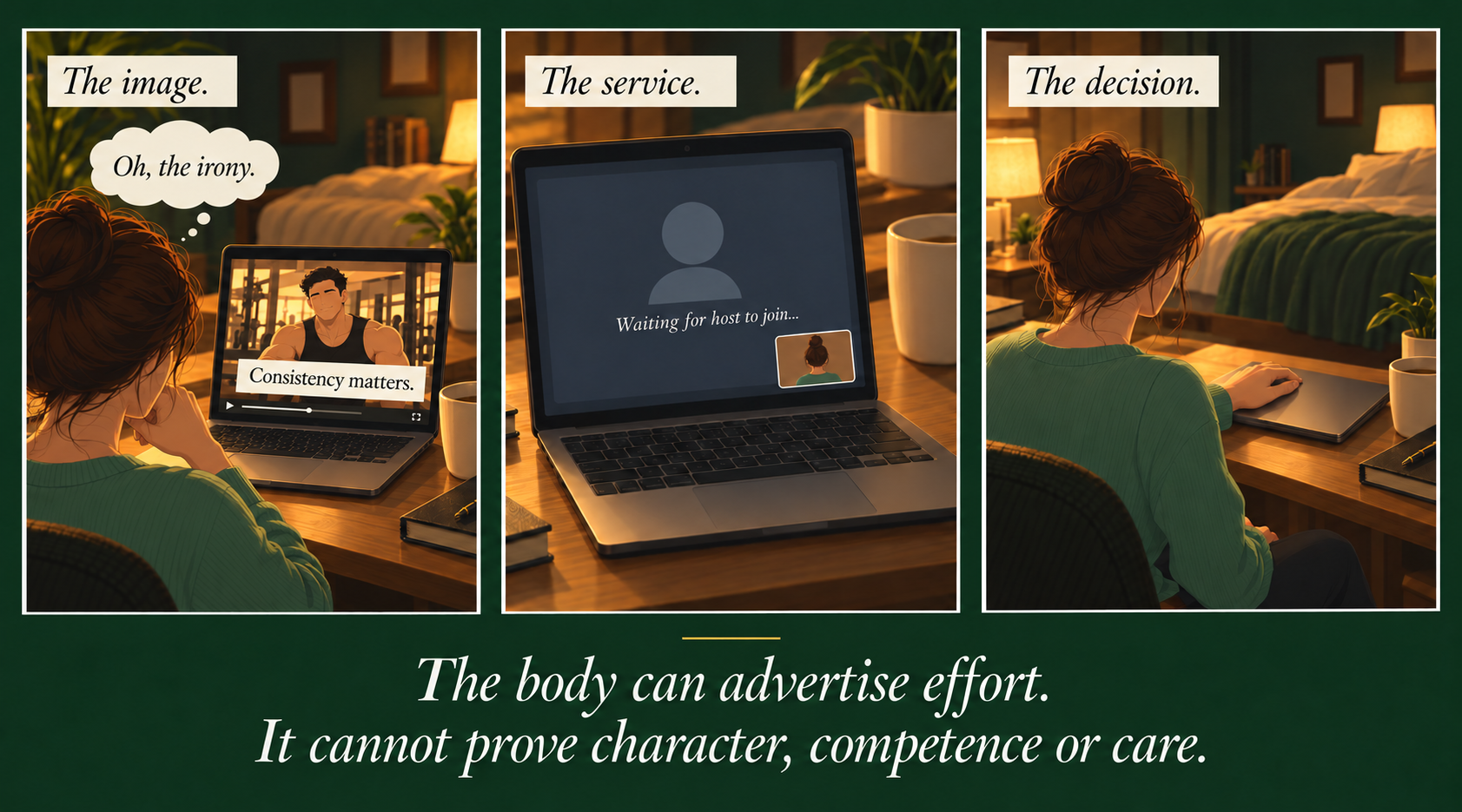
That is the illusion at the centre of online expertise. The body can advertise effort. It cannot prove character, competence or care. A polished image may survive almost anything, particularly when its owner is more committed to managing perception than managing a business. The client, regrettably, cannot recover through flattering lighting.
Worried you may have formed a parasocial attachment to an online persona?
Check out our free Parasocial Recovery Progam: DOWNLOAD IT HERE!
The Investigation Continues
This article examined the professional gap between the appearance of expertise and the reality of responsible coaching. The next series follows what happens when that gap becomes a business model.
The Fitfluencer Trap begins with Part One: The Great Online Coaching Con, examining how transformation stories, selective intimacy and the promise of access convert followers into paying clients before a credible service has been established.
Part Two: When Performance Meets Practice — What Happens After Someone Pays? moves behind the sales page, tracing missed appointments, ignored correspondence, non-delivery, refund disputes, private client harm and the particular cost imposed on disabled and vulnerable consumers.
Part Three: Manufactured Legitimacy — How Platforms, Sponsors and Affiliates Create Trust They Never Verify examines the wider machinery surrounding the creator: discount codes, commercial partnerships, platform visibility and the borrowed respectability supplied by brands that benefit from influence while declining to inspect what it legitimises. It will also consider what happens when audiences are mobilised against criticism, and how those dynamics can intersect with fraud, sexual entitlement, misogyny and rape-culture narratives.
The coach may be only one man with a ring light and a payment link.
The trust surrounding him is rarely built alone.
Thank you for reading.
Sources and further reading
Activity Alliance (2026). Annual Disability and Activity Survey 2025–26.
Brown, R. C. C. et al. (2025). ‘Safety of videoconferencing for physical rehabilitation and exercise: A systematic review and meta-analysis’. Clinical Rehabilitation
Chartered Institute for the Management of Sport and Physical Activity (2018). Professional Standard: Personal Trainer. Version 1.1.
Chartered Institute for the Management of Sport and Physical Activity. ‘Personal trainer’.
Consumer Rights Act 2015. Section 49: Service to be performed with reasonable care and skill; section 57: Liability that cannot be excluded or restricted; section 65: Bar on exclusion or restriction of negligence liability.
Currier, B. S. et al. (2026). ‘American College of Sports Medicine Position Stand. Resistance Training Prescription for Muscle Function, Hypertrophy, and Physical Performance in Healthy Adults: An Overview of Reviews’. Medicine & Science in Sports & Exercise
Durau, J., Diehl, S. and Terlutter, R. (2022). ‘Motivate me to exercise with you: The effects of social media fitness influencers on users’ intentions to engage in physical activity and the role of user gender’. Digital Health
Financial Ombudsman Service. ‘Problems with goods and services: section 75 and chargeback’.
Health and Care Professions Council. ‘Professions and protected titles’.
Health and Care Professions Council. ‘Standards of proficiency: Physiotherapists’.
Information Commissioner’s Office. ‘Special category data’.
NHS. ‘Beta blockers’.
NHS. ‘Physical activity guidelines for adults aged 19 to 64’.
Sokolova, K. and Kefi, H. (2020). ‘Instagram and YouTube bloggers promote it, why should I buy? How credibility and parasocial interaction influence purchase intentions’. Journal of Retailing and Consumer Services
Sport England (2020). ‘Activity habits in early weeks of lockdown revealed’.
UK International Consumer Centre. Advice on overseas purchases and cross-border consumer disputes.
World Health Organization (2020). WHO Guidelines on Physical Activity and Sedentary Behaviour.