IN DEPTH
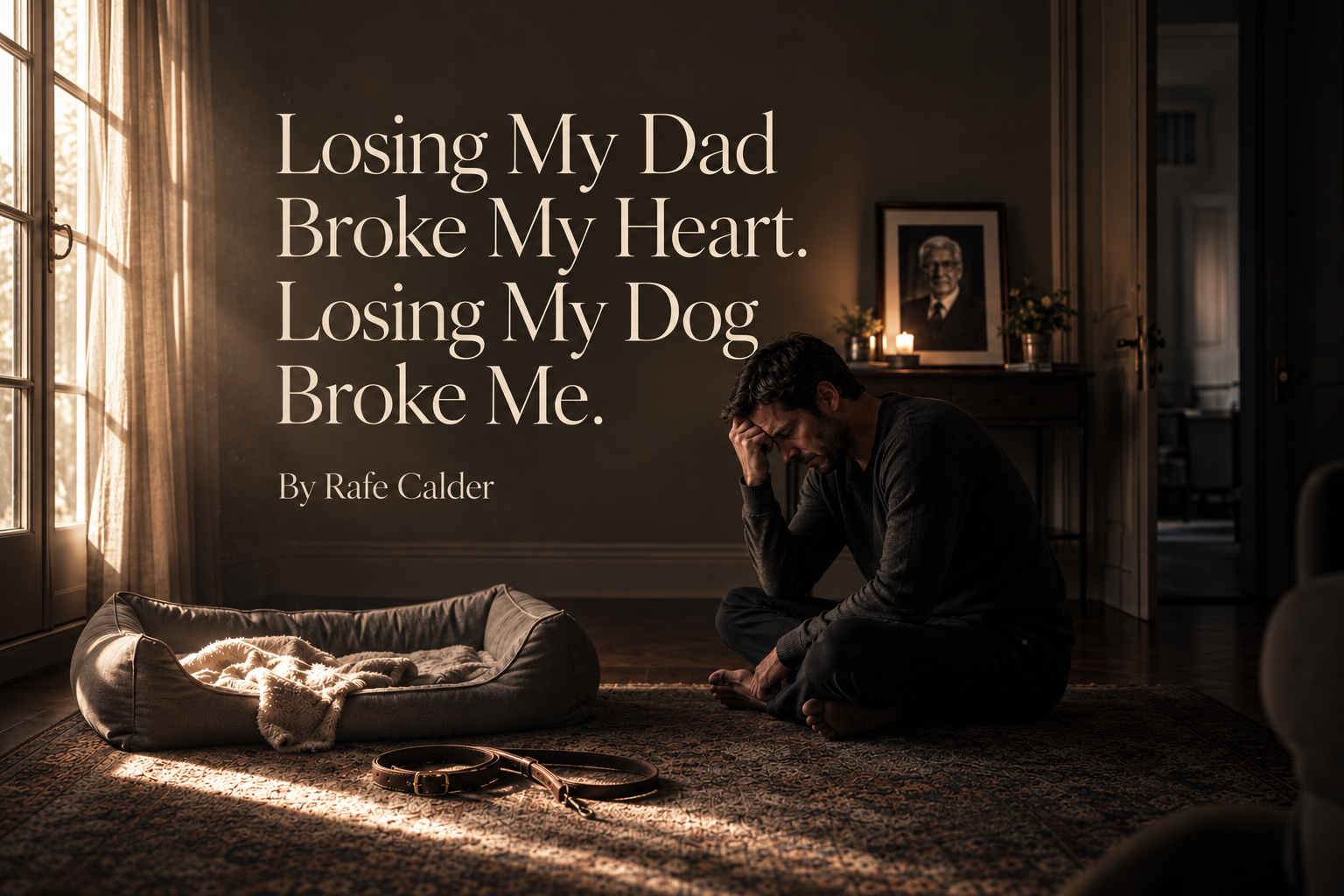
Losing My Dad Broke My Heart. Losing My Dog Broke Me.
By Rafe Caulder
Pet grief is often treated as a smaller, softer form of bereavement, something to be endured privately and explained lightly. For many people, it is nothing of the kind. When an animal has become part of the body-clock, the household, the nervous system and the soul, losing them can be the loss that brings a life to its knees.
The Grief That Would Not Behave
I loved my father wholly. I need to begin there, because grief is easily misread by people who want it to follow a clean moral order. A parent, then a partner, then a sibling, then a friend, then somewhere much further down the acceptable scale, a dog. We are taught to imagine grief as a hierarchy, and to become suspicious of ourselves when our hearts refuse to obey it.
My father had been terminally ill for several years. His death was not gentle, because death rarely is for those who remain, but it was not unannounced. It had stood for a long time at the edge of family life, altering the light in every room. We knew it was coming. We dreaded it, negotiated with it, prepared badly and then better, learned the awful language of decline. When he died, I was heartbroken. I was also able to get out of bed the next day. I could speak to people. I could think about practicalities. I could help with arrangements, check on his carer, answer messages, do the strange admin of bereavement that turns love into forms, calls, dates and decisions.
When my dog died, I stopped. There is no more elegant way to put it. I could not get up properly. I could not function. I was not merely sad, or tenderly nostalgic, or having a difficult week. I was broken in a way that frightened me. At the veterinary clinic, after she passed, I had to be physically carried out; my body would not obey me. In the days that followed, I lost the ability to speak for several days after. Any attempt to form words dissolved into a kind of crying I had never known before—raw, involuntary, animal. I could say nothing, do nothing. I lay in bed, unable to move with any purpose. Once a day my partner would try to coax food and water into me, but it rarely stayed down. After three days of barely moving, I could manage a little more, though even that felt like an effort against gravity itself.
I am not ashamed to say that after she died, I lay with her for hours. When her body began to change, when the inevitable happened and my clothes and skin became soaked, I did not move. Washing it away felt like betrayal, like admitting she was gone in a way I could not yet bear. I did not shower, wash, bathe, or clean myself for nearly two weeks. I had become broken in a way that left me, at times, quietly begging to be with her. Part of me believed that if I remained in that suspended state long enough, we might somehow be reunited. And yet, even there, something of her remained with me. It was her, in the end, who pulled me back—not in any mystical sense, but in the recognition that this was not how I could honour her life. To give her existence meaning, I would have to begin, slowly and imperfectly, to put myself back together again.
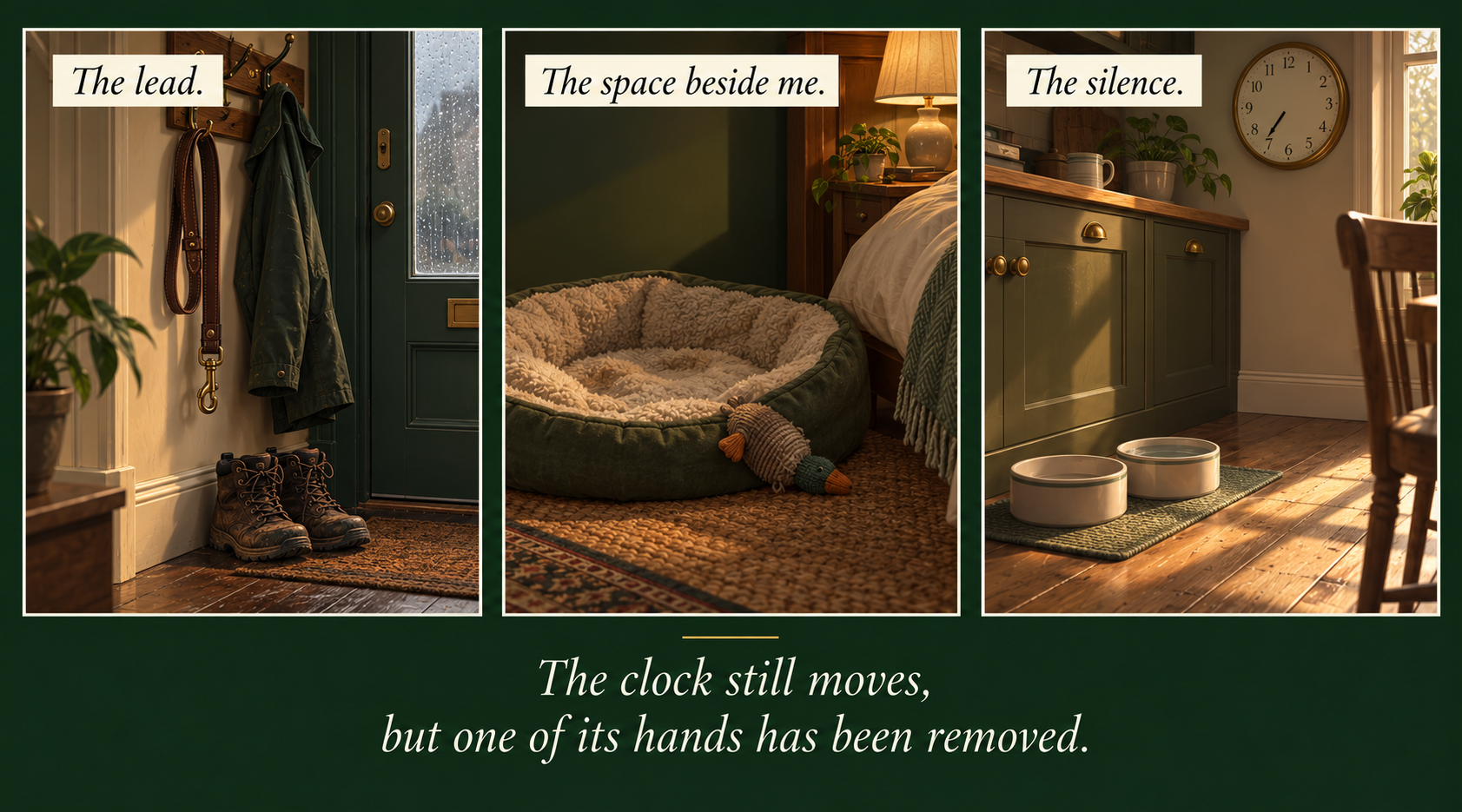
For a long time, I could barely say her name. It took close to two years before the grief loosened its grip enough for ordinary speech. Even then, it did not leave so much as change shape. It stopped being a wave that knocked me flat and became something I could carry without always looking like I was carrying it. There are still days when some small remnant of her returns with unreasonable power: the remembered sound of her feet, the absent pressure beside me, the sight of a lead hanging in a hallway, the particular silence of a house no longer being watched by someone who loved you without language.
A Loss Without Permission
The difficulty with pet grief is not only that the animal dies. It is that the world so often fails to make room for the scale of the loss. Human death, however devastating, arrives with a structure. There are rituals, condolences, leave policies if you are fortunate, funeral clothes, sympathy cards, casseroles, flowers, awkward but recognisable sentences. People may not know what to say, but they usually know that something must be said.
When a pet dies, the rituals are often private unless you make them yourself. There may be ashes, a paw print, a collar folded into a drawer, a favourite blanket you cannot wash and cannot keep looking at. The bowl remains on the floor with a terrible simplicity. The bed in the corner becomes an accusation. The house has not merely lost a creature; it has lost a pattern. Nobody wakes you at the same hour. Nobody follows you into the kitchen. Nobody arranges the day around hunger, weather, medication, walks, comfort, mischief, companionship. The clock still moves, but one of its hands has been removed.
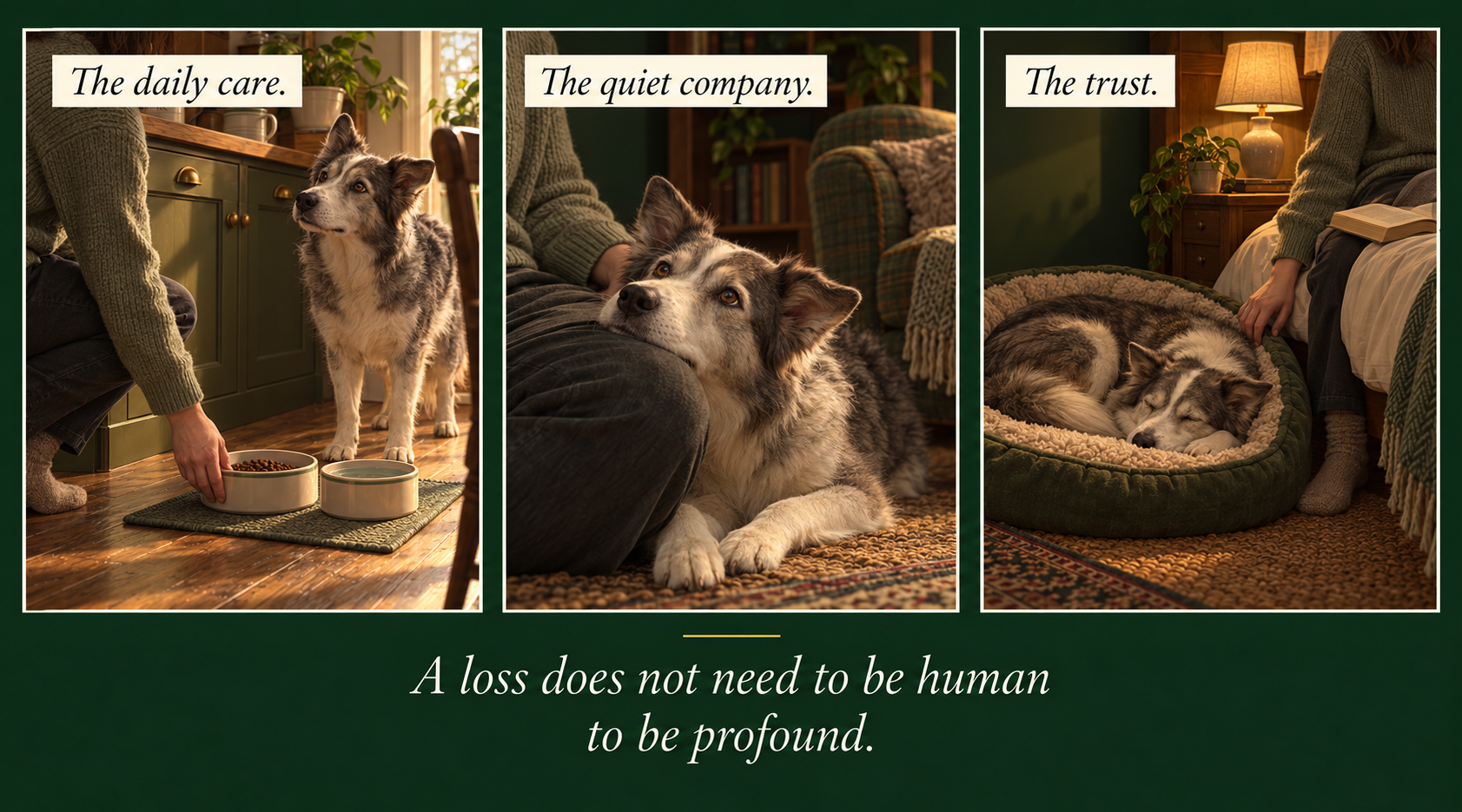
This is why the phrase “just a pet” is not only cruel, but inaccurate. A pet is rarely one thing. A dog may be child, friend, witness, routine, protector, dependent, comic relief, reason to leave the house, reason to come home, warm body at the edge of sleep. A cat may be household monarch, quiet companion, irritant, comfort, shadow, private language. Animals enter the most repetitive parts of life, and repetition is where attachment deepens. The relationship is made not only of grand affection, but of thousands of unrecorded gestures: filling the water bowl, opening the door, checking breathing in sleep, cutting tablets in half, wiping paws, learning the difference between one whine and another, making bargains with rain.
People who have never loved an animal in that way often misread the grief as indulgence, as if it were a softer, more decorative form of sorrow that ought to be kept in proportion. Those who have loved an animal deeply may still feel compelled to apologise for the scale of their loss, as though intensity itself were a kind of social error. That quiet shame becomes part of the wound. It alters how you speak, how much you reveal, how quickly you retreat. You begin to edit your own bereavement in real time, trimming it into something more palatable. You hear yourself adding disclaimers—“I know she was only a dog”—before anyone else has the chance to question you, pre-emptively reducing the life you are trying to honour. Conversations become exercises in calibration: how much truth can this person hold, how much must be softened or omitted? Over time, you learn the subtle distinctions between those who will sit with the full weight of what you have lost and those who require you to make it smaller, tidier, easier to absorb. In that process, the grief is not only endured but managed, contained, and, in some quiet way, made lonelier.
The Body Knows the Bond
The science does not cheapen this. If anything, it confirms what bereaved pet owners already know in the body. The human-animal bond is not an ornamental attachment invented by lonely people, although loneliness can make it more vital. Research into dogs and humans has shown that mutual gaze can affect oxytocin, one of the hormones involved in social bonding and affiliation. This does not mean love can be reduced to chemistry. It means that the body participates in the relationship. The dog looking back at you from the kitchen floor is not a decorative presence; she is part of a biological, emotional and behavioural loop.
More recent grief research has begun to catch up with the lived reality. A 2026 UK study published in PLOS One found that among people who had experienced both the death of a beloved pet and the death of a human, a notable proportion chose the pet’s death as their most distressing bereavement. The same study found that a minority of pet-bereaved people met criteria for probable prolonged grief disorder, with symptoms manifesting in ways comparable to grief after human loss. This is uncomfortable for a culture still invested in keeping species boundaries neat. It should not be. A loss does not need to be human to be profound.
For many of us, pets occupy something close to a child-shaped place in the heart, even when we understand perfectly well that they are not human children. They are dependent on us. We feed them, soothe them, read their bodies, manage their pain, make decisions on their behalf, and in many cases decide when suffering has become too much. That last responsibility can leave a terrible residue. The mercy of euthanasia, when it is needed, does not erase the torment of authorising an ending. Love becomes a signature on a consent form. Afterwards, even when the decision was right, guilt moves into the empty space and starts rearranging the furniture.
There is a particular cruelty in the arithmetic of pet ownership. We invite animals into our lives knowing, at least abstractly, that we are likely to outlive them. If we are lucky enough to love many animals across a lifetime, we are also likely to bury them repeatedly. We become, again and again, the surviving parent. In human life, burying a child is treated as a rupture in the natural order. With pets, that rupture is built into the contract from the beginning, and we are expected to keep signing it because the years before the loss are worth the ending. They are. That does not make the ending small.
Why It Can Hurt More Than Human Grief
Saying that pet loss can hurt more than human grief does not dishonour human relationships. It tells the truth about how grief works. My father’s death came after years of anticipatory mourning. I had imagined it before it happened, not willingly, but repeatedly. The mind, under enough threat, begins to rehearse. It starts to live in two times at once: the person still here, the person already being lost. When the death finally comes, the shock remains, but it lands on ground that has been trembling for years.
My dog’s death was different. She was part of the present tense. Her life was fused with the day’s smallest mechanics. She did not belong to occasional memory, family history or adult obligation; she belonged to waking, sleeping, eating, leaving, returning, surviving. Losing her did not only remove someone I loved. It removed the creature around whom my nervous system had quietly organised itself.
She was also the first soul who ever made me feel truly safe, accepted and loved without condition. That kind of experience resists neat description. It is not something easily translated into language, because it exists beneath it. The bond did not depend on shared words or even shared species; it was something quieter and more absolute, a recognition that settled into the body and stayed there. In ways I only understood after she was gone, she held me together. I had known dark periods, long stretches of instability and fear, and she met all of it without judgement or retreat. She kept me grounded when my thoughts turned against me, kept me moving when stillness became dangerous, and gave me a reason to continue when reasons felt scarce.
Living with complex trauma since my teenage years, I had encountered many forms of help, some useful, some not, but nothing and no one reached me in quite the way she did. She gave me more than routine. She gave me purpose, a structure to return to, a presence that made survival feel possible rather than theoretical. It may sound excessive to say she saved my life, but it is also the most accurate language I have. She did it quietly, repeatedly, without instruction or expectation, simply by being there.
That is one reason pet grief can feel so physically disabling. The loss is not confined to thought. It alters the body’s routines. Sleep changes. Appetite changes. The urge to get up changes. A person who could manage a parent’s funeral may find themselves unable to pick up a dog bowl. This is not hypocrisy, and it is not evidence that the parent was loved less. It is evidence that different attachments occupy different rooms in the self.
There are also social and economic dimensions that are rarely acknowledged. A person with secure employment, savings and understanding colleagues may be able to take a few days, pay for cremation, sit in their grief, and build some sort of ritual. Someone in insecure work may have to turn up the next morning and smile at customers. Someone already unwell, lonely, traumatised or financially precarious may lose not only a beloved animal but their daily stabiliser. For a person who has been homeless, isolated, chronically ill, or repeatedly let down by human systems, an animal’s devotion can carry more than companionship. It can become proof of continuity. It can make a room feel inhabited, a day survivable, a damaged life less abandoned.
This is where some outsiders become impatient. They hear “my dog was my soulmate” and imagine exaggeration. They do not see the years behind the sentence. They do not see the animal who lay beside someone through panic attacks, illness, hunger, addiction, recovery, depression, divorce, bad housing, chemotherapy, grief, poverty, or the blank afternoons when nobody called. They do not see the creature who asked for nothing except care and gave, in return, a form of presence so steady it began to feel like ground.
The Rituals We Have to Invent
Grief needs expression. It does not always need spectacle, but it needs somewhere to go. Human beings have always made rituals because the mind struggles to process absence without form. We gather, speak names, light candles, lower coffins, scatter ashes, keep anniversaries, wear black, sit shiva, hold wakes, tell stories, mark time. Ritual does not solve grief. It gives grief a vessel.
Pet loss is often denied that vessel. There may be no funeral unless we create one. No public gathering unless we risk embarrassment by inviting people. No obituary, no official pause, no recognised status as bereaved. The mourner is left to improvise, and improvisation can feel childish when the grief is enormous. Yet making ritual for an animal is not childish. It may be one of the most adult things a grieving person can do: to refuse the culture’s smallness and give the relationship its proper dignity.
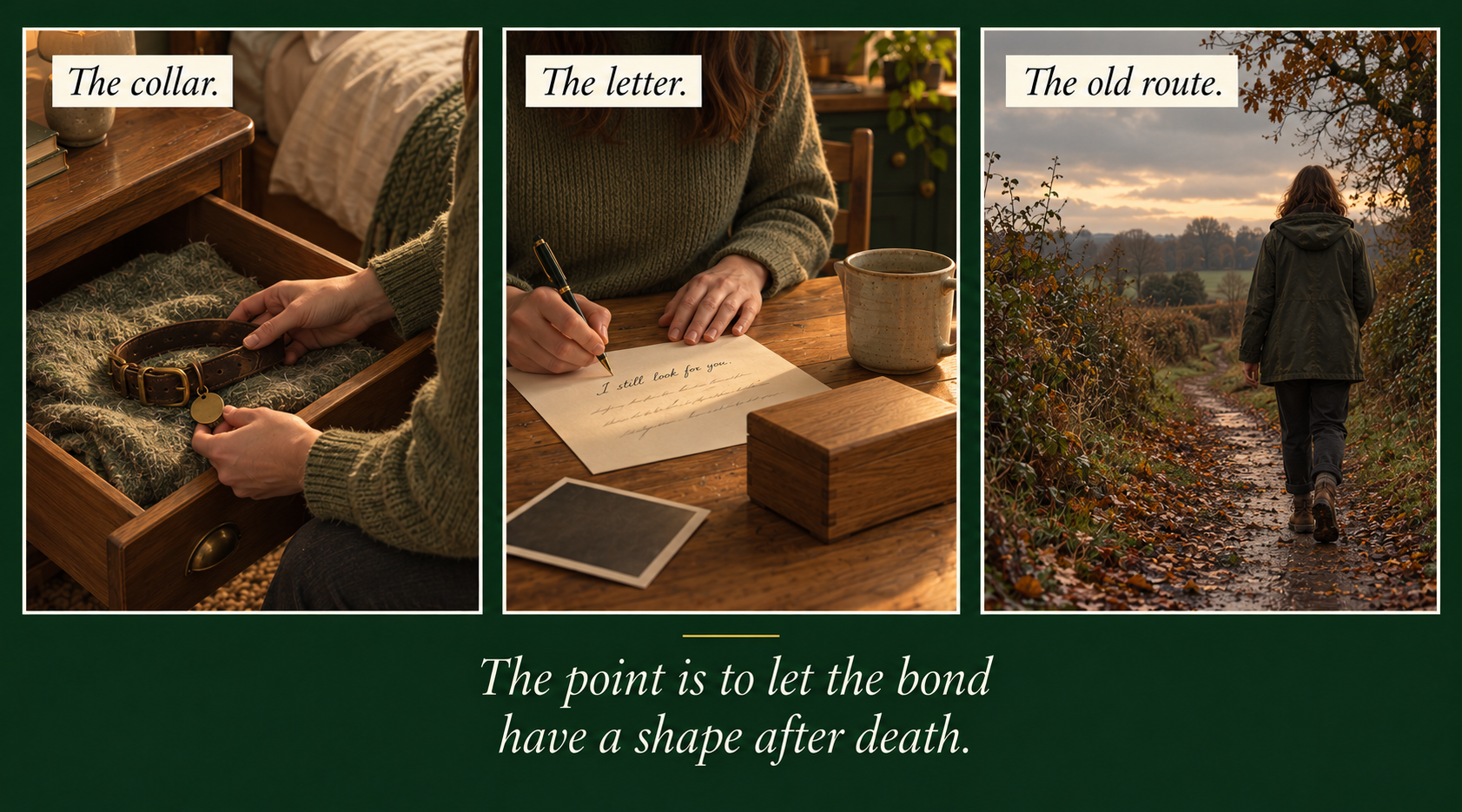
A memorial does not need to be elaborate. It can be a walk taken at the old hour, a letter placed with ashes, a plant in the garden, a framed photograph, a donation made in their name, a few friends invited to say what they remember. It can be speaking aloud to them for a while after they have gone, because silence is sometimes too abrupt a demand. It can be keeping the collar until you are ready, and then keeping it still because readiness changes nothing about love. The point is not to perform grief correctly. The point is to let the bond have a shape after death.
Children often understand this better than adults. They ask where the animal has gone, whether they were frightened, whether they knew they were loved. Adults, anxious to protect or distract, sometimes reach for evasions. Yet clear, tender truth usually serves grief better than soft confusion. Animals teach many children their first lessons in care, bodily vulnerability and mortality. They deserve language sturdy enough to hold the facts and gentle enough to protect the child standing inside them.
Surviving the Aftermath
There is no single sensible way through pet grief. Anyone offering a timetable has misunderstood the terrain. Some people need to talk constantly; others become mute. Some need another animal quickly because the house is unbearable without life in it; others cannot imagine ever opening that door again. Some people feel relief after a long illness and then shame at the relief. Some feel rage at the vet, themselves, God, biology, money, time. Guilt is especially common, because pet ownership is full of decisions made with incomplete information. You did not know soon enough. You waited too long. You acted too early. You missed a sign. You saw the sign and still could not save them.
Grief is fluent in accusations. It will use love as evidence against you if you let it. The answer is not to argue yourself into calm, because grief rarely responds to legal reasoning. The answer is to return, repeatedly and with discipline, to the whole life rather than the final scene. One death, however awful, does not get to become the only record. There were years of feeding, shelter, play, care, patience, irritation, laughter, warmth, loyalty and ordinary devotion. The ending matters. It does not own the story.
Support matters, too, and it needs to be chosen carefully. Speak to people who understand pet loss without requiring translation. There are UK pet bereavement services, including Blue Cross Pet Loss Support, and veterinary charities such as PDSA and the RSPCA now offer guidance that treats this grief as real rather than sentimental excess. A good GP or counsellor should also take seriously grief that has made daily functioning impossible. If, after many months, grief remains so intense that you cannot return to ordinary activities, or if it brings suicidal thoughts, professional support is not an overreaction. It is care. The dead do not need you to prove love by refusing help.
There is also value in lowering the threshold for practical survival. Eat badly before you do not eat. Sleep with the light on if darkness makes the room too empty. Move the bed, bowl and toys when you can, not when someone else thinks you should. Walk the route if it comforts you; avoid it if it breaks you. Tell your workplace plainly if you are not functioning. Some people will disappoint you. A few may surprise you. Let the surprising ones in.
For a while, the future may feel like betrayal. The idea of laughing, travelling, loving another animal, or having a day in which you do not think of them first may seem indecent. This is one of grief’s cruellest misunderstandings. Continuing is not replacement. A new animal, if one comes, does not occupy the old animal’s place. The heart is not a rented room with one tenant at a time. It is more like land altered by every grave and every garden. Nothing grows in exactly the same place twice, but the ground remembers.
A Love With No Lesser Name
I no longer believe I need to apologise for the fact that losing my dog broke me. I loved my father. I love him still. His death broke my heart in the way the death of a parent does: deeply, historically, with sorrow that reached backwards through childhood and forwards into all the moments he would not see. My dog’s death broke something more immediate and animal in me. It took away a daily presence, a private language, a creature who had made my life feel held at the level of breath and routine.
Those griefs do not compete. They belong to different chambers. One does not cancel the other, and neither needs to be made smaller to protect the dignity of the dead. Love is not a court of law. It does not arrange itself according to cultural expectation, genetic proximity, or what other people can comfortably understand.
If you are grieving a pet now, and the force of it has embarrassed or frightened you, there may be some relief in knowing that you are not strange for being undone. You are responding to the loss of a relationship that lived in your days, your body, your home, your habits and your sense of being accompanied. That kind of love leaves evidence everywhere. Of course its absence does the same.
In time, the grief may become less sharp. It may stop arriving every morning before thought. You may find yourself able to say their name, then tell a story, then smile before crying, then cry without being ruined for the day. Hope does not always announce itself as happiness. Sometimes it is only the first morning you open the curtains because the room has been dark too long. Sometimes it is washing the blanket. Sometimes it is keeping the blanket and no longer hating yourself for needing it.
Some animals are not like family. They are family. When they leave, the grief is not lesser because there is no formal place to put it. It is grief with fur still caught in the fibres of your coat, grief with a bowl in the kitchen and a shape missing from the bed, grief that knows the sound of a name you cannot yet say. Let it be as large as it is. Let it take the time it takes. The love was real, and the wound is only another form of proof.
Thank you for reading.
DOWNLOAD OUR SHORT GUIDE ON GRIEVING THE LOSS OF A PET HERE
Support and further reading
For readers living with the loss of an animal, the following organisations offer dedicated support and guidance on bereavement.
Blue Cross — Pet Loss Support
Dedicated emotional support for people grieving an animal, with options to speak to someone by telephone or make contact by email.
PDSA — Coping with the Grief and Loss of a Pet
Guidance on the emotional and physical effects of bereavement, anticipatory grief, guilt following euthanasia, supporting children and remembering a beloved companion.
RSPCA — Pet Bereavement Toolkit
Information and practical guidance on coping with pet loss, approaching end-of-life decisions and supporting others through bereavement, alongside accounts from people who have experienced it.
Cruse Bereavement Support — Understanding Grief
General bereavement resources exploring the experience of grief and ways of managing its effects. These materials address bereavement more broadly; readers seeking dedicated pet-loss support can contact Blue Cross.