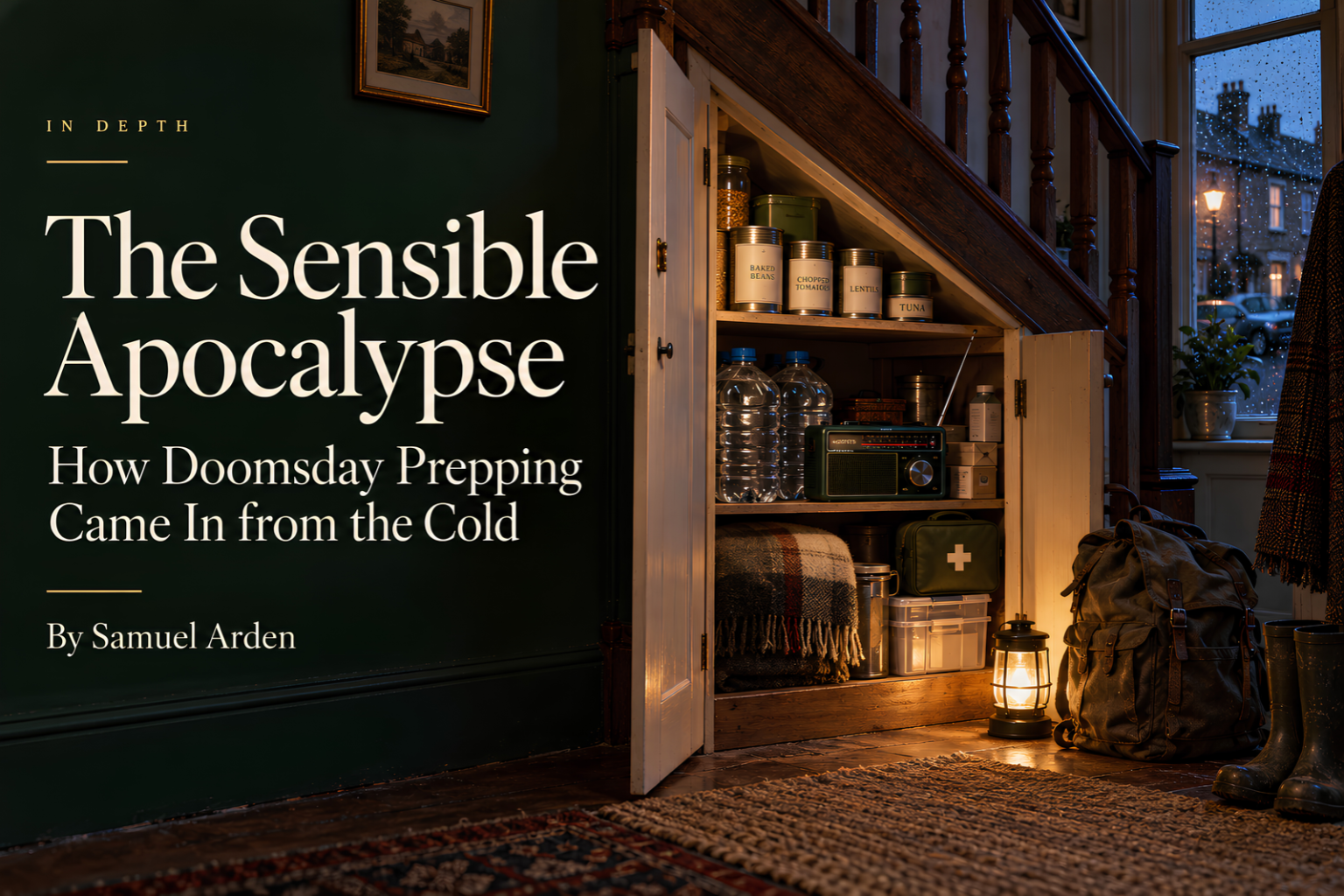
IN DEPTH
The Sensible Apocalypse: How Doomsday Prepping Came In from the Cold
By Samuel Arden
For decades the doomsday prepper was a figure of fun, a man in a bunker with a ham radio and a grudge. Now governments are issuing their own lists of what to keep beneath the stairs, and a quieter, more domestic kind of readiness is taking hold among people who simply want to sleep at night. Samuel Arden, who began stocking a cupboard during a season of dread, asks whether preparing for the worst is a symptom of our anxious age or one of the more intelligent answers to it.
The Cupboard Under the Stairs
It began, as these things often do, with a supermarket and a faint sense of embarrassment. A few winters ago, during a run of months when the news seemed to arrive in a single unbroken register of alarm, I found myself in the tinned aisle of a shop on the edge of town, loading a trolley with chickpeas, sardines, long-life milk and a quantity of soup no single household could plausibly justify. At the till I made a joke about a long winter, the cashier laughed politely, and I drove home through the flat Suffolk dark feeling slightly ridiculous and, somewhere beneath the ridiculousness, steadier than I had felt in weeks.
The tins went into the cupboard under the stairs, behind the hoover and a box of Christmas lights, where they sat in rows I would occasionally open the door simply to look at. I did not expect the world to end. What I wanted, I think, was a small physical reply to the question the headlines kept posing and never resolving, which was what, exactly, I would do. A few dozen tins were no answer at all to war in Europe or a destabilising climate, yet they had the unexpected virtue of being finite, countable and mine. Over the years that followed, the cupboard grew into a packed rucksack by the front door, a shelf of survival manuals, a properly rotated store and weekends spent learning to light fires in the rain, and somewhere along the way the anxiety that had sent me down that aisle loosened its grip. This essay is an attempt to understand why, and to ask whether a pursuit once dismissed as the province of cranks has become one of the saner responses to an age whose emergencies arrive faster than anyone can digest them.
From Bunker to Brochure
For most of the past half-century the prepper occupied a fixed place in the cultural imagination, somewhere between the eccentric uncle and the subject of a late-night documentary. American television made a franchise of him from 2011 onwards with Doomsday Preppers, which lingered over gas masks, buried shipping containers and basement armouries with a mixture of fascination and barely suppressed mockery. In Britain the figure carried an extra residue of Cold War absurdity, since the government's own Protect and Survive pamphlets of 1980, with their advice to shelter beneath doors propped against an inner wall, had come to stand for the futility of preparing at all. To prepare, in this framing, was to confess either paranoia or a secret appetite for catastrophe, and the joke rested on a comfortable assumption that sensible people need not bother, because the state, the supermarket and the grid would always be there.
That assumption has been quietly withdrawn. Sweden, which first posted households a booklet called Om kriget kommer ("If the War Comes") in 1943, revived the practice in 2018 and in 2024 sent a new edition of In Case of Crisis or War to around five million homes. In March 2025 the European Commission's first Preparedness Union Strategy urged the EU's 450 million citizens to keep enough essential supplies for 72 hours, with the crisis commissioner, Hadja Lahbib, describing readiness as a "new European way of life". This October the UK followed with its own Be Ready campaign, asking households to keep three days of water, food, light, warmth, cash and medication, while ministers took pains to say they wanted the public "alert but not alarmed".
The irony is that the eccentrics were, on the evidence, rather less unhinged than their caricature. When the University of Kent sociologist Michael Mills studied American preppers for the Journal of Risk Research in 2018, he found that most did not anticipate civilisational collapse; they expected short- or medium-term disruption, believed society would recover, and were often acting on official guidance. The prepper was usually just early, and what has happened since looks less like a conversion than a catching-up, with governments arriving by policy at the cupboard under the stairs that a minority had reached by temperament.
A Short Catalogue of Endings
The word doomsday flatters our fears by making them cinematic, when the risks that occupy the people paid to think about them are mostly duller, likelier and, for that reason, more worth preparing for. The government's 2026 guide to the National Risk Register counts 87 standalone risks and eight linked scenarios, and reading it is a curious experience, at once alarming and oddly reassuring in its bureaucratic calm.
The most exotic entry is severe space weather. In September 1859 the astronomer Richard Carrington watched a flare of white light erupt above a cluster of sunspots; within a day aurorae had lit skies around the world and telegraph lines faltered, their operators reporting shocks and sparks. A storm of that scale today would interfere with GPS, satellites, mobile networks and parts of the power grid, and the storm of May 2024, the first to reach the top G5 rating since 2003, offered a beautiful and largely harmless preview as the Northern Lights spread across British skies. In March 2026 the National Audit Office concluded that the UK was not yet fully prepared, noting that warning of such an event may range from none at all to 96 hours.
Flooding is the home-grown emergency. Around 6.3 million properties in England sit in areas at risk from one or more sources, and the register's reasonable worst case for river flooding imagines a fortnight-long event in a large city, with weeks of lost electricity and telecoms. A national power outage is ranked as low in likelihood but catastrophic in effect, a judgement sharpened by the April 2025 blackout across Spain and Portugal, when a cascading failure halted trains, darkened traffic lights and silenced card machines within minutes. Cyber attack is the likeliest route to that kind of paralysis: the National Cyber Security Centre handled 204 nationally significant incidents in the year to August 2025, more than double the previous year's 89, and the register now includes attacks on water and data infrastructure. Behind all of these sits the risk people find hardest to say aloud, with the guide observing that Britain is "likely to face indirect and potentially direct confrontation with adversaries".
What unites these scenarios, beyond the strangeness of reading them in a government PDF, is how unglamorous their consequences would be for most households. The realistic emergency involves no marauding gangs, only cold radiators, dead phones, shuttered cash machines, a slowly warming fridge and the long, disorienting wait for information. Preparation, seen this way, is a matter of getting through the first 72 hours of an ordinary catastrophe with dignity, which happens to be precisely the threshold the government has chosen.
What the Tins Are Really For
Anxiety feeds on formlessness. A threat that is global, ambient and endlessly refreshed on a phone screen offers no edge to grip, and there is some evidence that the habit of feeding on it carries a cost of its own: a 2024 study of 800 students in Iran and the United States, published in Computers in Human Behavior Reports, found that compulsive consumption of bad news was associated with higher existential anxiety, although, being correlational, it could not establish which came first. The NHS's self-help guidance for generalised anxiety puts the matter in homelier terms, advising people not to focus on the things they cannot change.
Prepping, at its best, performs a kind of translation on that advice. It takes the unanswerable (will there be a war?) and renders it as a series of answerable tasks (is there water for three days, where is the stopcock, who on the street lives alone), each with a beginning, an end and a tangible result. That explains why my cupboard felt calming long before it held anything genuinely useful: attention had moved from a scrolling feed of other people's disasters to a set of small, completable jobs within my own walls, which is the oldest consolation of any craft.
It would be dishonest, though, to present the activity as purely therapeutic. Research by Nina Smith and Susan Thomas in Frontiers in Psychology in 2021 found that prepping beliefs and behaviour during the pandemic were associated with anxiety, stress and intolerance of uncertainty, and that stockpiling was driven more by watching others stockpile than by any actual risk of infection. Prepping can soothe anxiety, then, but it can just as easily become one of its expressions, a ritual of checking and acquiring that never arrives at enough. The difference lies largely in whether the activity has a horizon, a point at which the job is done and ordinary life resumes. Anyone whose worry persists for months, disturbs sleep or begins to shrink their days should know that NICE recommends structured, evidence-based help for generalised anxiety, from guided self-help grounded in cognitive behavioural therapy to psychoeducational groups, and that adults in England can refer themselves to NHS Talking Therapies without first seeing a GP. A well-stocked cupboard is a fine thing to own, but it is no substitute for treatment.
The Anatomy of Readiness
My preparations grew in layers, and the order turns out to matter, since each stage teaches something the next relies upon. The foundation is the three-day household supply, which is now, conveniently, the state's own recommendation: three litres of drinking water per person per day, with more for washing and cooking; food that needs neither fridge nor hob and that you would actually choose to eat; a torch with spare batteries, or a wind-up model, in preference to candles; a battery or wind-up radio with local frequencies written down; a charged power bank; coins and small notes for when card readers fail; a first aid kit; essential medication, with repeat prescriptions ordered in good time; hygiene supplies; warm clothing and blankets; and printed copies of key documents and phone numbers. Households with babies will need ready-to-feed formula and nappies, pets need their own food and water, and anyone who depends on powered medical equipment should join the free Priority Services Register run by energy companies. The guidance suggests building the supply gradually, an item or two with each shop, and checking it every six months, which is the moment, I have found, when a store stops being a purchase and becomes a practice.
The second layer was the bug-out bag, a term borrowed from American military slang for what British emergency planners more soberly call a grab bag: a rucksack packed in advance for the occasion when you must leave rather than shelter, because of flood, fire or a gas leak. Mine holds a filter water bottle, a few days of high-energy food, a foil blanket, a waterproof and spare layers, a head torch, a compact first aid kit, a multi-tool, a charger and cable, copies of documents in a sealed pouch, cash, a paper map of the county and a written list of numbers that does not depend on a phone battery. Its weight is part of its discipline, since everything that goes in must justify itself on your back.
Then came the books, which were less a phase than an education. John "Lofty" Wiseman's SAS Survival Handbook and Ray Mears's Essential Bushcraft sit beside the first aid manual published jointly by St John Ambulance, St Andrew's First Aid and the British Red Cross, and the last has proved by far the most useful, because the skills most likely to matter in an emergency are the ones that matter on an ordinary Tuesday. The deeper store followed: several weeks of staples kept on a first-in, first-out rotation so that nothing expires unnoticed, sealed water containers, purification tablets, a camping stove reserved strictly for outdoor use given the danger of carbon monoxide, a solar charger and a battery-powered carbon monoxide alarm.
Finally came the training, which converted possession into competence: an accredited first aid course, a weekend of bushcraft spent coaxing fire from damp tinder, and the slow, absorbing pleasure of navigating with map and compass across heathland where the phone signal gives out. Foraging is where enthusiasm most needs restraint, since misidentified mushrooms and plants remain a recurring cause of poisoning, and it should be learned from qualified instructors rather than an app.
Where Readiness Curdles
There is, however, a version of prepping that deserves the old mockery, and its forms are worth naming plainly. The first is economic. Readiness costs money and space, and the three-day kit that is a minor errand for a homeowner with a garage becomes a real burden for a family in a one-bedroom flat whose budget is spoken for by the twentieth of the month, so that the households least able to absorb an emergency are often the least able to prepare for one. At the opposite pole sits the much-reported market in luxury bunkers and remote bolt-holes for the very rich, a privatised apocalypse that treats survival as a premium product and everyone else's misfortune as scenery. Between the two lies the treadmill, the hobby that turns into a shopping habit with a theme, in which each new gadget promises the security its predecessor failed to supply.
The second danger is social. The empty shelves of spring 2020 were a lesson in how individual prudence, multiplied, becomes collective harm, and the finding that stockpiling spreads by imitation should give every enthusiast pause. A store assembled slowly and in advance is resilience; one assembled in a panic, at the moment of crisis, is simply somebody else's shortage.
The third, and the most corrosive, is the fantasy of solitude, the lone household behind a barricaded door. Disaster researchers have long observed that people in emergencies tend to help rather than prey upon one another, a pattern Rebecca Solnit documented at length in A Paradise Built in Hell, and the government's own advice, which asks neighbours to swap numbers and talk through who might struggle in a power cut, is closer to the reality than any fortress. The WHO, writing on the mental health toll of climate disasters, likewise urges community-based approaches to reducing vulnerability. The neighbour who depends on an electric stairlift belongs in a sensible plan as surely as the water in the cupboard, and the measure of good prepping may simply be whether it leaves you more suspicious of the people around you or more useful to them.
A Lamp Lit Early
The cupboard under the stairs is fuller now, and duller, which is how I know it is working. Twice a year I open it with a notebook, check the dates, move the older tins to the kitchen and replace them, test the torch and the radio, and close the door on something that no longer needs to be looked at to be believed in. The anxiety that first sent me down the tinned aisle has not been abolished, since the world has declined to oblige by becoming safer, but it has been given somewhere to go, and in the going it has turned into something closer to attentiveness: to weather and water levels, to what my own hands can do, to the people on my street, and to the quiet infrastructure of power and supply that most of us notice only at the moment it fails.
If prepping is to become the hobby of an anxious age, its best version is modest, sociable and finite. It begins with three days, because that is what the people who model these risks judge most useful; it adds a skill that would help someone else, first aid above all; it involves talking to the neighbours before there is any need to; and it knows when to stop, so that the hobby serves a life instead of replacing one. None of this will avert a solar storm or a war. What it offers is a change of position, from spectator of catastrophe to participant in one's own resilience, and that small, practical shift may be among the sanest things a person can do with dread, rather like lighting a lamp early, while there is still daylight enough to find the matches.
Sources
HM Government, A Guide to the 2026 National Risk Register
ITV News, What items are on the 'Be Ready' checklist (23 Oct 2026), and Sheffield Star summary of the government guidance
National Audit Office, Government has more to do to boost the UK's resilience to severe space weather (20 Mar 2026)
Science Museum, The Carrington event and the May 2024 storm
NCSC, Annual Review 2025: incident management
ITV News, EU tells public to stockpile 72 hours of supplies (27 Mar 2025)
In Case of Crisis or War (overview of the Swedish booklet's history)
University of Kent, Mills (2018), Journal of Risk Research, on prepping and risk anxiety
Smith & Thomas (2021), Doomsday Prepping During the COVID-19 Pandemic, Frontiers in Psychology
BPS Research Digest, Shabahang et al. (2024) on doomscrolling and existential anxiety, Computers in Human Behavior Reports
NHS, Generalised anxiety disorder: self-help
NICE, CG113: Generalised anxiety disorder and panic disorder in adults
WHO, Why mental health is a priority for action on climate change (3 Jun 2022)
From general knowledge, not checked against a source this session: Protect and Survive (1980), Doomsday Preppers (2011–14), the April 2025 Iberian blackout, and Solnit's A Paradise Built in Hell (2009).