WHIPS, WELLIES & OTHER COUNTRY PURSUITS
Episode One · By Ivy Thorne
No One Imagines the Countryside Like This
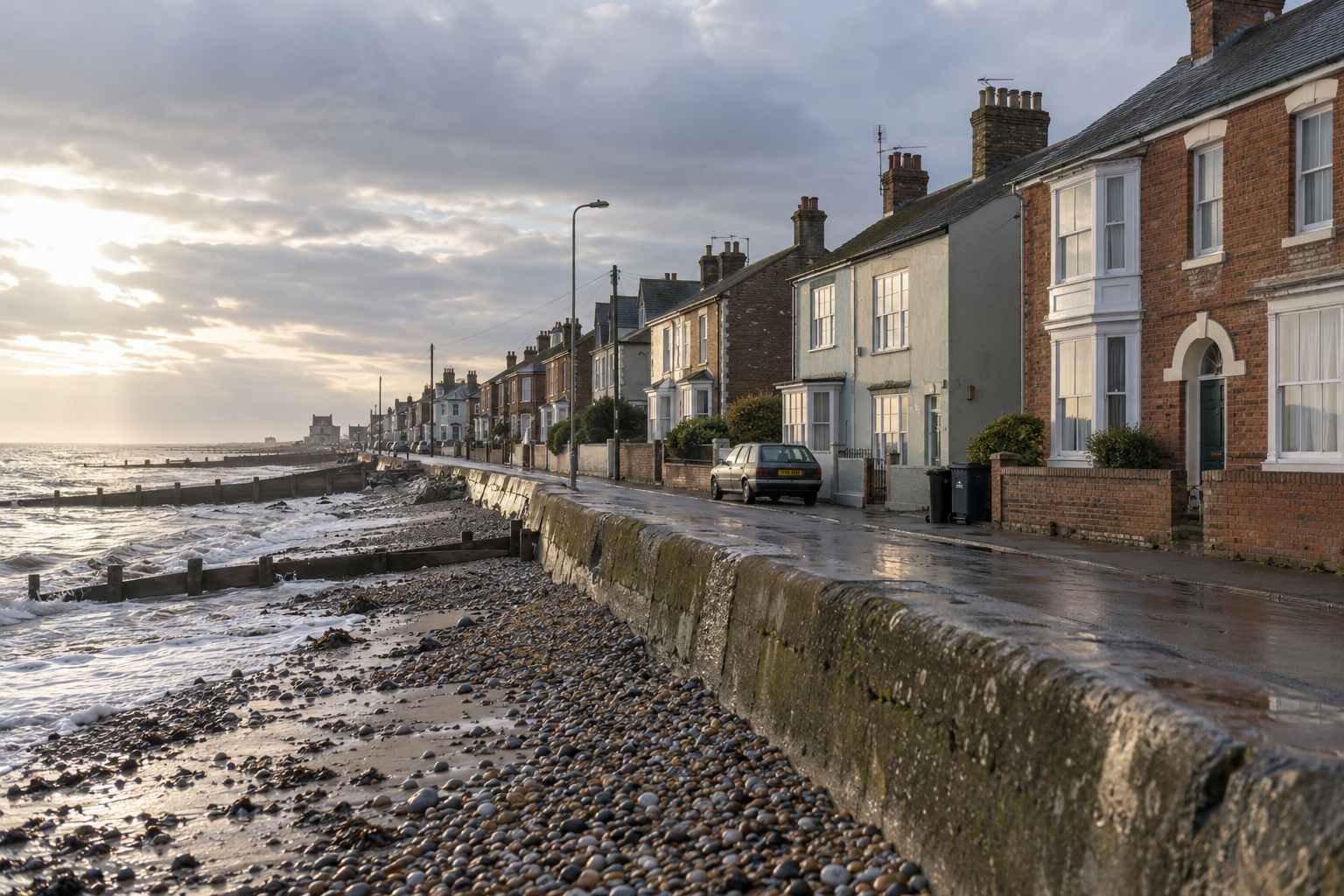
The town sat in that peculiar Suffolk arrangement between exposure and enclosure: sea on one side, green country rolling away behind it, rivers cupping the edges as though the place had been half-designed to drift off if left unattended. It was not the sort of seaside town that advertised itself with vulgar confidence. There was no gaudy promenade, no theatrical decay performed for visitors, nothing with quite enough self-belief to call itself glamorous. It was medium-sized, self-contained, and English in the most evasive sense: a stony beach with patches of sand, tidy streets that could look either respectable or depressed depending on the weather, and a surrounding landscape so changeable in mood that it often felt less like geography than collusion.
The weather there had an almost indecent facility for commentary. With water pressing in from three directions, the town seemed to generate its own atmosphere according to need. The sea could flatten into pewter or glitter with the kind of brightness that made unhappiness feel briefly decorative, while inland the fields unrolled in long green breaths, all softness of contour and hidden severity. The air moved between salt, mud, cut grass, rain and diesel depending on the hour and your luck. If you were melancholy, there was a walk that would indulge you; if you were furious, there was a sky for that; and if your life had taken a turn you would have hesitated to describe as wise, the town would usually provide a light in which it looked almost narratively inevitable.
That was the landscape in which I became a dominatrix.
I did not drift towards the work out of boredom, decadence or some metropolitan ennui. I was at home in Suffolk, alone more often than I wanted to be, trying to keep hold of a house I had spent months making liveable and had no intention of surrendering. By day I worked in an admin role at the local council, which paid in the modest, faintly reproachful manner of most public-sector salaries and was never going to carry a mortgage and a life on its own. My ex had been violent, and I had sent him packing. That sounds brisker than it felt, but he has already taken up more than enough room in real life and I do not intend to grant him much here. In practice it meant the usual aftermath: financial strain, administrative tedium, a nervous system too well trained in bracing, and the cold, unromantic realisation that survival often arrives disguised as paperwork, a joke I appreciated rather less for spending my working days buried in the stuff. The bills remained, as did the mortgage, the dog and, irritatingly, my pride. Moving was not an option, and collapse was less appealing still.
There are moments in a woman's life when necessity stops being abstract and becomes architectural: the roof, the food, the numbers, the monthly insult of everything costing more than it morally ought to. I was not looking for adventure; I was looking for leverage.
I had tried escorting years earlier, and that mattered, because it meant the thought did not arrive as some lurid fantasy imported from nowhere but as precedent. The money had been undeniably good, particularly for a young woman in 2010. Living alone was expensive, and a dog with a complicated health condition, which insurance had no intention of treating with moral seriousness, was more expensive still. Survival tends to be vulgar enough to require numbers. I understood the financial logic of sex work perfectly well; what I did not like was its bodily logic. Having a stranger inside me felt like a steep surcharge on the transaction, even at two hundred and fifty pounds an hour.
So, faced with keeping the house afloat on my own, escorting was the obvious option to revisit, at least on paper. But memory has a way of correcting financial logic. I knew what escorting paid and I knew what it extracted, and while I could return to that world if I had to, I was no longer convinced I wanted to pay its particular price.
Around the time my financial woes had become all-consuming, I had developed a fixation with Secret Diary of a Call Girl, which I watched at home with the concentration of a woman taking notes from enemy territory. One evening, alone, tired, financially cornered and in no mood for moral delicacy, I watched the episode in which Belle attempts to be a dominatrix for a regular client. What interested me was not that it went beautifully for her, because it did not, and that was precisely the useful part. The role did not fit her cleanly; one could feel the effort where there ought to have been instinct. And I remember thinking, with a clarity indecent enough to feel exciting, that although it was not quite right for Belle, it might be right for me. Given that I had already tried escorting, the move did not feel especially radical. It felt less like a leap than a correction.
Escorting had asked for a version of femininity I could perform but never especially admired: warmth on demand, a kind of managed nearness, the careful simulation of ease. What I saw in dominatrix work was something cleaner, with less barter over intimacy and more command over terms. If I was going back into sex work out of necessity, I wanted a form of it that suited my temperament: more distance, more structure, less counterfeit tenderness, and a sharper distribution of power. It was not that the work suddenly seemed glamorous. It was that it seemed more honest about what was being bought.
There existed a corner of the market in which men would pay not for the simulation of warmth but for its deliberate withdrawal, and would often pay more to be handled without tenderness. I had assumed, as many people do, that sex work priced intimacy, when one of its more lucrative niches priced its refusal. Contempt, it turned out, commanded a better rate than affection, which struck me as both revealing and, in its own way, efficient.
If you are expecting Belle de Jour with a Suffolk postcode, then, you will have to adjust your imagination. Belle, in the popular mind, glides; she appears to have been edited, and even her compromises arrive dressed for dinner. There would be no black cabs ferrying me between appointments, no lacquered apartments, no metropolitan glow flattering the transaction into something art-directed and chic, and nobody photographing my stockings in tasteful shadow while I moved through London like a controlled hallucination. This was not sleek vice in the city but chaos in the country: salt on the air, patchy signal, unreliable directions, and me trying to project the sort of composed, high-end authority the setting did very little to support.
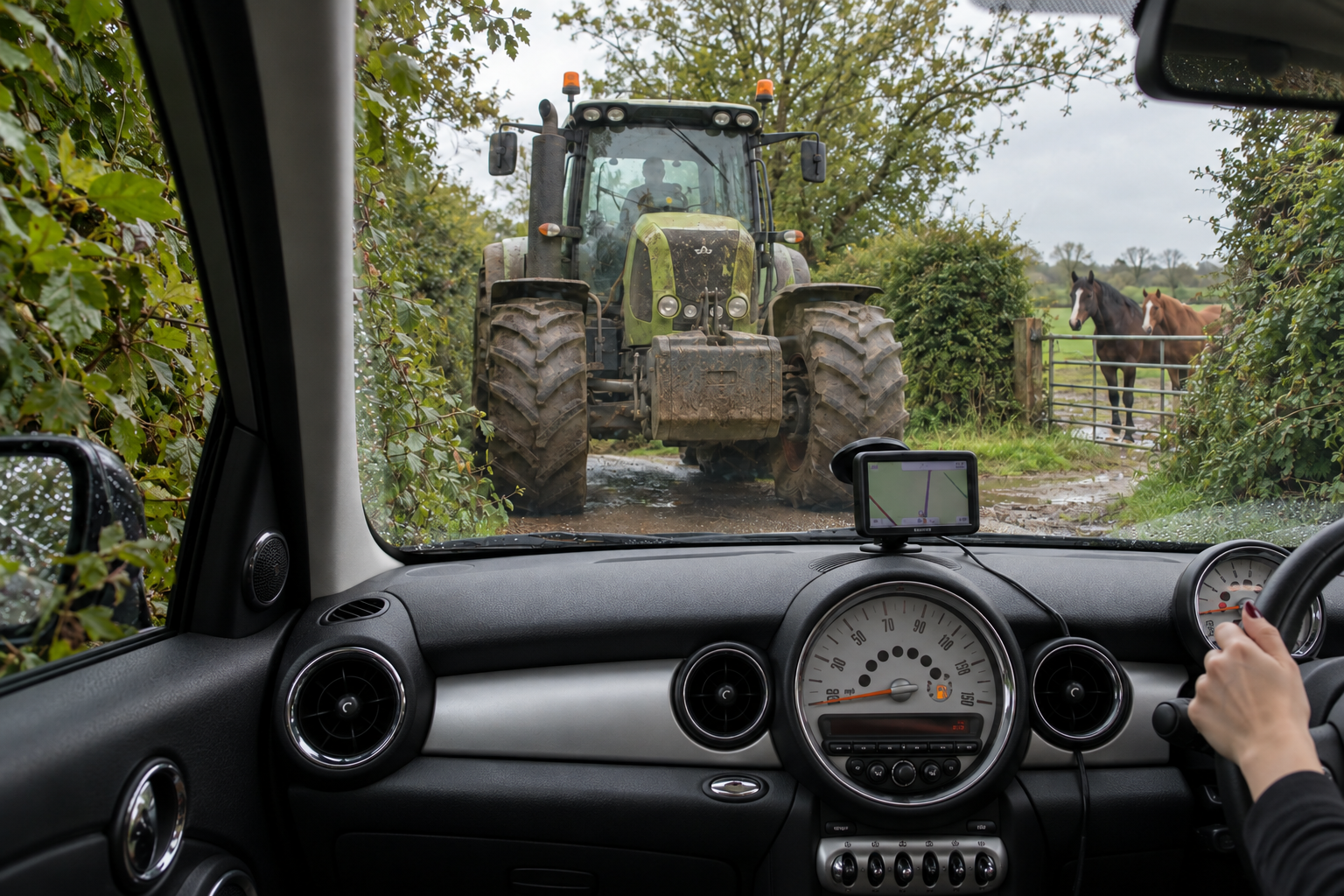
I would soon learn what that meant in practice: trundling down country roads in a car that had no business participating in anyone's erotic fantasy, peering through the windscreen for house names and swearing ferociously at the sat-nav, while trying to look like a woman of decisive appetites and curated menace. It is difficult to feel like a polished instrument of male undoing when a tractor has just forced you into a hedge, and harder still after reversing past a field of judgemental horses and arriving with one shoe full of gravel. London vice, at least in the imagination, benefits from infrastructure. Suffolk merely offered weather and a series of passive-aggressive lanes.
People hear the word dominatrix and reach automatically for an urban vocabulary of black gloss, polished cruelty and studied decadence. They do not imagine hedgerows, or estuary light, or a county that appears to shut both commercially and emotionally at the same hour as its tea rooms. But the countryside does not lack appetite; it simply trains appetite to dress modestly, speak less, and arrive by a less conspicuous route.
My route into the work was not especially romantic, but it was practical, and practicality is often accused of lacking glamour by people who have never had to rely on it. In reality it can be intensely clarifying. I was not only under pressure; I was becoming alert in a new way, sharpened by necessity and irritated into invention. There is a particular energy that comes over a woman when she realises she may yet turn misfortune into strategy, and strategy into money. It is not quite hope. It is cleverer than hope, and usually better dressed.
What appealed to me was not merely the money, though I had no intention of pretending the money was incidental. It was the altered emotional geometry of the thing. BDSM, at least in the form I was beginning to understand it, was structured, theatrical, and in certain respects more candid. Everyone entered the room under a declared fiction, and that fiction could be managed: roles were assigned, and tone, boundaries and performance all mattered. It seemed to me, even then, that many men were not paying for excess so much as clarity, a frame in which their private disorder could be arranged into something coherent for an hour. The authority, the distance, and the possibility that male desire might be made to organise itself around my terms rather than the other way round all interested me at once.
Financially, certainly. But not only financially.
I did not yet know how much of that would prove true. I only knew that this deliciously dark world had captured my attention, particularly as a study in leverage: what men would reveal when they paid to be directed; what forms of masculinity loosened or collapsed under female authority; what happened when the person expected to counterfeit softness simply declined.
So I began, as I often do, with construction.
I wrote lists, not of fantasies but of attributes. What made me feel powerful rather than merely looked at? What kind of clothing altered my posture? What visual language suggested control without tipping into parody, and what kind of woman did men believe quickly, as opposed to the kind they felt entitled to challenge? I understood instinctively that the role would have to be built from the outside in until it could be inhabited from within. I was young, but not so young as to think authority descended like a blessing. It had to be designed.
I researched aesthetics with a seriousness that would have been admirable in another profession and absurd in almost any other context. There is a precise point at which a woman stops dressing attractively and starts dressing as a proposition, and I was looking for the narrower point beyond it, where attractiveness sharpened into command. I wanted lines that made me stand differently, fabrics that imposed a certain economy of movement, and details that signalled severity without collapsing into costume-shop vulgarity. The aim was not to look cartoonishly dominant. The aim was to look like a woman for whom dominance was simply the most efficient form of social organisation.
But clothing alone was never going to be enough; the image had to be held up by method. I had watched hours of BDSM porn with the kind of attention other people reserve for scripture, and it had shown me where glamour stopped and specialism began. If even Belle, in all her polished city cleverness, could not simply drift into the role fully formed, neither could I. I did what sensible women with unsuitable career ideas occasionally do when they have reached their limit for online learning: I found someone who already knew the trade.
She was an established dominatrix with a functioning business and the sort of self-command that immediately improved a room. I contacted her, asked questions, and eventually arranged to shadow one of her regular appointments, which is how I came to be standing in her doorway one evening, trying to look like a woman who had seen everything and suspecting that I looked, above all, like a woman who worked for the council.
She was tall and slim, with a waist cinched so decisively it seemed to have been negotiated, and beneath it a slight, unrepentant softness, the faint mum tum of a woman who had long since stopped auditioning for anyone's approval. Her black hair was cut short around big blue eyes that took an inventory of you before you had finished saying hello. She wore a black leather bra with a matching skirt, fishnets, and red stilettos that announced her arrival a beat before she did. Her lips were small and thin, which on another face might have read as meanness; on hers they looked like policy. Hers was the face of cruelty as caricature imagines it, except that she had so plainly stepped into the role rather than been born to it, and that difference was the whole of her authority. Her perfume was sweet, but with an edge I could never quite place, and beneath it her skin smelled of cocoa butter, which struck me as the most disarming detail of all: the scent of a woman who moisturised diligently before going to work on a man's dignity.
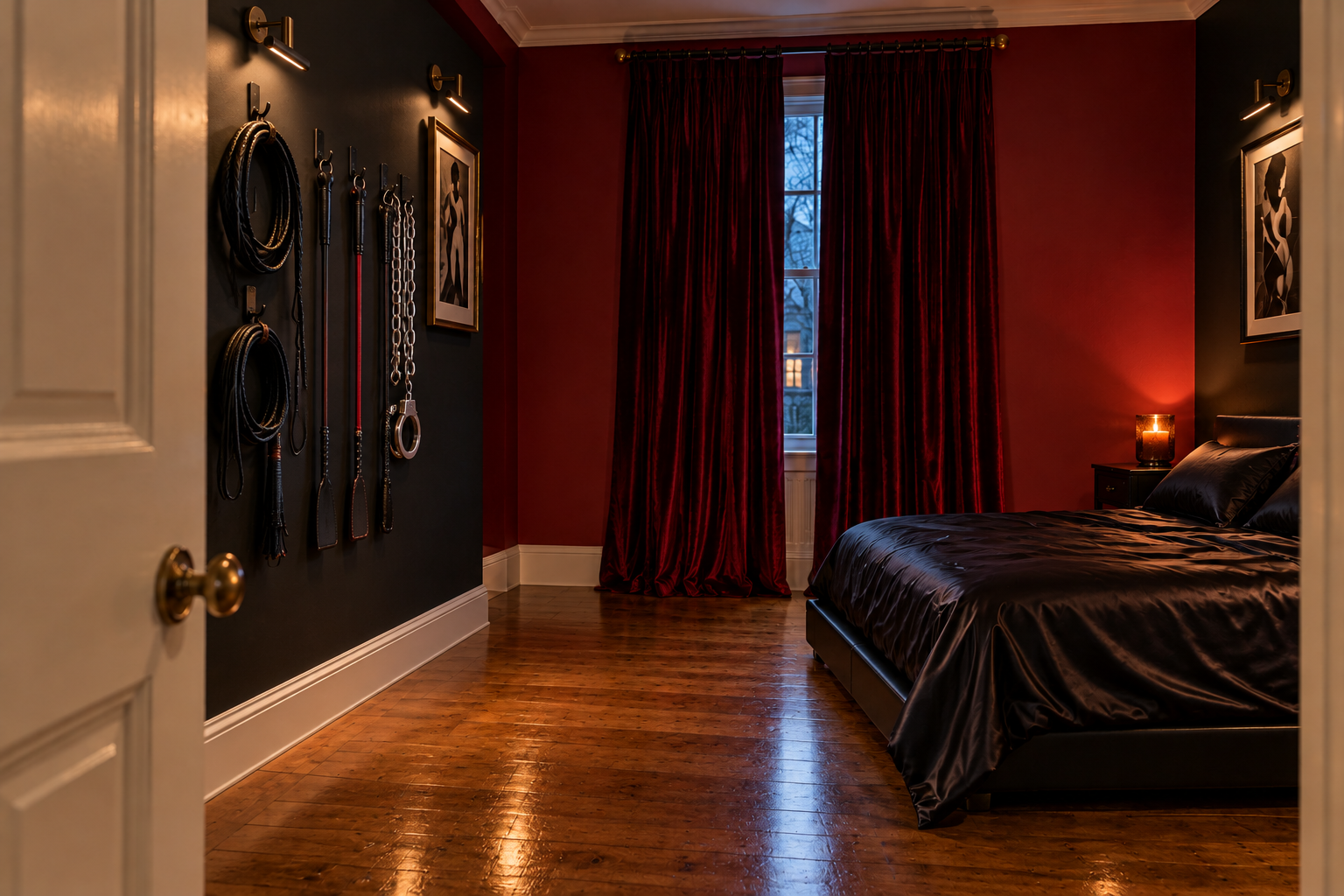
The room was a study in conviction. Hard wooden floors carried every footstep like an announcement. Two walls were painted black and two a deep, unapologetic red, as though the decorator had considered subtlety and rejected it on principle. Along one wall hung her armoury, whips and chains among tools and devices whose purposes I could only partly guess, each displayed with the pride and care other women reserve for heirloom china. The bed lay under silk sheets, velour curtains fell in a grand, operatic swing, and ornate Art Deco frames around the walls displayed scenes of discipline through the centuries, as though the whole history of the practice had been invited in to supervise. Over all of it hung the scent of spiced apple, which was faintly ridiculous and wholly right, like being dominated inside a very expensive Christmas candle.
What impressed me once the session began was not the theatricality, though there was plenty of theatre in it, but the management: pace, tone, image, distance and calibration, each adjusted with the unhurried care of a sound engineer at a mixing desk. The work required reading as much as nerve, and she seemed to understand her client's psychology slightly ahead of him, which is a useful position from which to govern anyone.
The man himself was revealing precisely because he was not especially unusual. He arrived in jeans and a plain white T-shirt, carrying a holdall-style gym bag, like someone dropping in on his way back from five-a-side. His excitement had less to do with novelty than with submission to a frame someone else had made for him, and what was telling was how quickly he surrendered to sequence, to ritual, to controlled diminishment. This was one of my earliest useful lessons. Men often described themselves in the language of appetite and extremity, but many of them were not seeking danger in any grand romantic sense, and danger is a more glamorous word than most people deserve. What they wanted was relief: from self-presentation, from decision-making, from whatever burden of authority or normality they had spent the day carrying like a badly tailored suit.
Partway through, she stepped back and handed the room to me.
I remember the lurch in my stomach and the brief, fierce wish to be anywhere else, even back at the council reconciling something harmless. Then I did the only thing available to me. I took the woman I usually was, folded her up small, and stuffed her somewhere deep down inside where she could not interfere, and in her place I put on the persona as one puts on a dress: stiff at first along the seams, cut for a bolder woman than the one stepping into it. What astonished me was how quickly it settled. I had braced for awkwardness, for the sense of wearing a silhouette that did not belong to me, but the dress fitted, then it moved with me, and within minutes I had forgotten I was wearing it at all. I did not have to labour to become convincing. I merely had to stop wasting energy on forms of softness I had never found especially sacred, and once I had started, I discovered, rather alarmingly, that I could not stop.
I understood the grammar of the encounter almost at once: where pressure became theatre, where theatre became anticipation, and how shame, pleasure, relief and display could sit beside one another in the same expression without cancelling each other out. What I felt was more unsettling than nerves and, in its way, far more useful. It was fluency. The role did not feel alien so much as available, and part of me wondered why I had ever hesitated at all.
As I stood over him, I remember the almost dizzying force of the contrast. Here was this entirely ordinary man laid out beneath me, no longer protected by whatever version of himself he wore in daylight, stripped back to hunger, surrender and want. I paused just long enough to look at him properly, at the tension in his body, his erection, the expectancy in his face and the way pleasure and pain had begun to blur, and I felt the power in me gather into something darker and more intoxicating. For those few suspended moments I was a Goddess: watched, worshipped, deferred to and waited on, the entire atmosphere of the room arranged around whatever I might do next.
What startled me most was not his intensity but my own. The room felt charged, feverish, almost airless with anticipation, and every pause mattered and every gesture landed: a flick of the wrist, the drag of a feather, the press of my stiletto heel into his testicles, the deliberate withholding of relief. All of it seemed to speak in a language I had somehow always known without ever being taught. It was not simply that he wanted more. It was that I loved, immediately and without apology, the atmosphere his wanting created, and when it was over, and the dress came off, I found the woman I had stuffed down inside was no longer quite the same size.
Here, perhaps, is the least glamorous truth about entering any strange profession: at a certain point the mystery gives way to technique. Once you understand the principles, the thing ceases to be exotic and begins to look like work; specialised work, certainly, with its own risks, absurdities and moral weather, but work all the same. That was one of the reasons I took to it. The role had style, but it also had structure, and I have always preferred structure to fantasy. Fantasy is for clients. Structure is for women trying to survive.
And survival, by then, had several moving parts. From nine to five I sat at a desk at the local council, processing forms and answering emails in the approved register of polite municipal regret. In the evenings I calculated money with the grim devotion of a woman saying the rosary, and in whatever hours remained I was arranging one self around another and trying not to let the seams show. There are periods in life when identity is less a stable inner truth than a series of practical negotiations conducted under pressure, and this was one of mine. I was not simply becoming a dominatrix. I was constructing the kind of woman the market would pay to believe in: composed, controlled, sharper than she looked, colder than she sounded, and entirely unpersuaded by male confusion. That she would also need to be back at her desk by nine the next morning, filing with a straight face, was a detail the market did not need to know.
The setting made all of this faintly absurd, which, to my surprise, only improved it. Rural Suffolk does not naturally flatter female spectacle. It meets ambition with a damp, watchful reserve, as though anything too vivid ought to apologise for itself before being allowed indoors. Respectability there is not innocence but choreography, a highly trained regional performance in which everything is seen and almost nothing is said. People do not fail to notice; they simply cultivate an exquisite instinct for looking a fraction to the left of whatever would be inconvenient to acknowledge. That, too, proved useful. In places built on omission, everyone is hiding something and almost nobody wants the arrangement dragged out into the open. The county's notion of decency was not ignorance. It was curation.
Which is perhaps why the work belonged there more naturally than an outsider might suppose. What I was dealing in was not simple transgression but secrecy with structure: a private theatre in which men could become smaller, stranger, dirtier, or simply more truthful about themselves than their daylight lives permitted. The town understood concealment intimately, as anyone who has worked in local government could tell you. It merely preferred it tastefully managed, lightly euphemised, and hidden behind better curtains.
Once I decided to do it properly, I became meticulous. The online profile was not thrown together in a panic; I built it with the care of someone constructing both an advertisement and an alibi. The photographs had to suggest authority without tipping into farce, and the wording had to be precise enough to deter the wrong men and alluring enough to catch the right ones. I learned quickly that ambiguity was expensive. Leave a sentence open and some man, somewhere, would drive a fantasy through it like a stolen car. So I tightened everything: what was on offer and what was not, what I understood, and what I would not be pretending to understand.
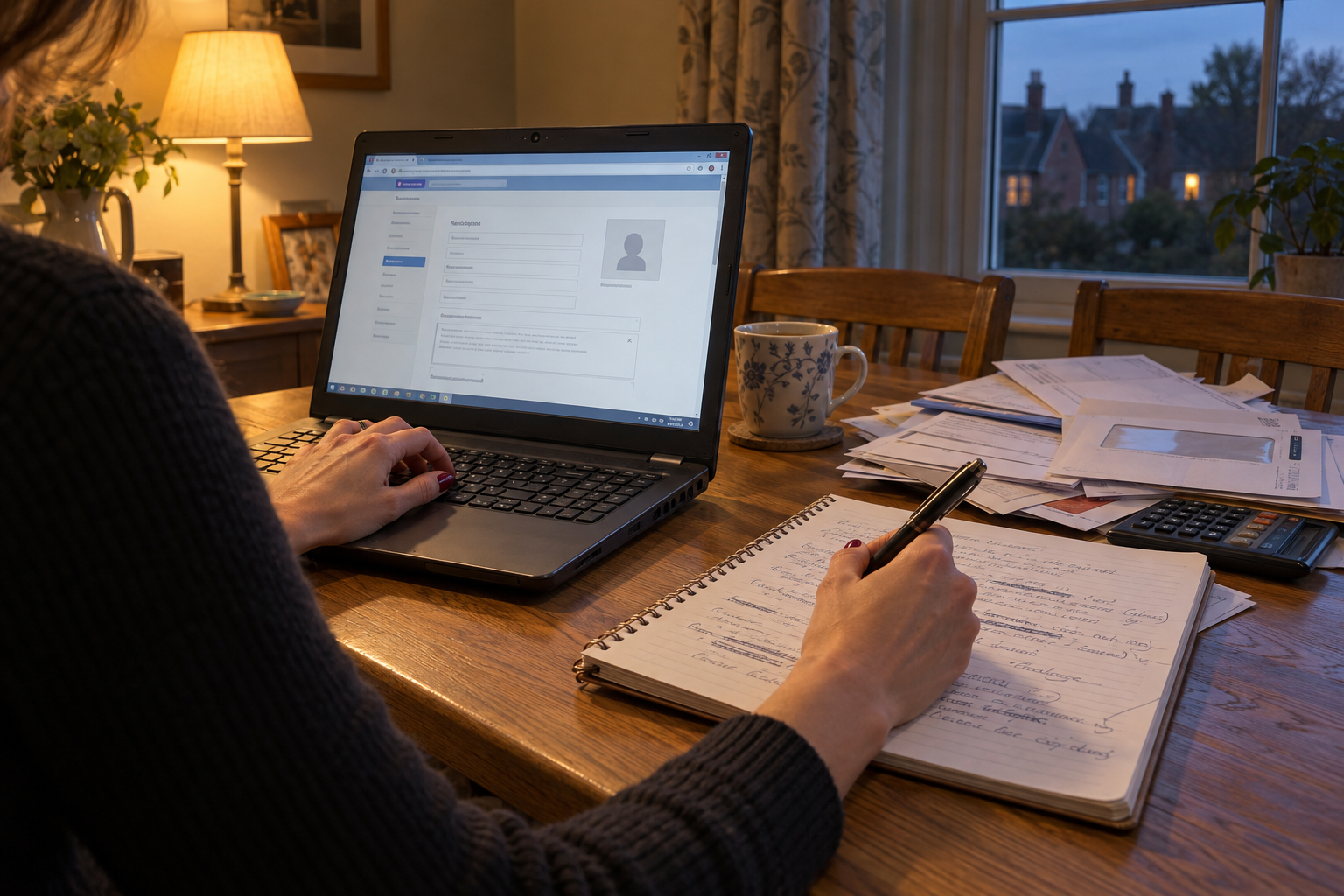
Some men ruled themselves out immediately. They were too pushy, too confused, too entitled, too convinced that a dominatrix was merely a decorative prelude to the much more conventional access they had no intention of paying for correctly. Those men were useful only insofar as they clarified the language, and every wrong enquiry helped me refine the profile, firm up the boundaries and make the proposition more legible. By the time I was finished, the page did not simply describe a service. It described a woman more severe, more self-possessed and more professionally assured than I yet felt in my ordinary life, which was, of course, the point. I was not documenting myself. I was creating someone sellable.
And yet she was not wholly fictive. Exaggerated, yes, and stylised, but not false. She was colder than I usually allowed myself to be by day, less interested in reassurance, more exacting, and far less willing to apologise for having standards. Building her had begun to alter the temperature of my thinking, and even before the first client of my own, the exercise had become strangely animating. I felt more deliberate in my own skin, as though some part of me had been waiting, with mounting impatience, for a more interesting use of my energy and talents.
And then there was the waiting.
It is one of the less explored parts of any life built partly through a screen: that brief and peculiarly charged silence after you have arranged your face, honed your language and made yourself available to a market, and now have no choice but to discover whether the market agrees. The page sat there looking back at me with its own small electronic indifference. Outside, the town remained exactly as it had been an hour earlier, the sea air coming in off the coast, the gulls behaving as though nothing morally interesting had ever happened within ten miles of them, the green hinterland minding its own business, and respectable Suffolk carrying on with its usual performance of having no inner life worth mentioning.
Then the messages started.
Not dramatically at first, and then seemingly all at once: a ding, then another, then another in such quick succession that the sound lost its polite digital neatness and became something closer to intrusion. They came from nearby and from further out, from North Norfolk, Cambridge and London, from men young enough to be reckless and men old enough to have spent decades refining the appearance of self-control. Eighteen to seventy, roughly speaking, which felt less like a demographic than an argument. It was not the trickle of fringe interest one might expect in a quiet coastal town but something closer to a roll call, a hidden network announcing itself the moment it found the right phrasing, and I noted with some satisfaction how many of its members lived in places that liked to imagine themselves above this sort of thing.
At first the sheer speed of it made something in me tense. Every ping landed with the bright little shock of interruption, and for a few moments I sat there watching the screen light and relight, my thoughts racing ahead into the lives behind the messages. Who were they when they were not doing this? What had they been carrying all day beneath their respectable surfaces, in offices and marriages, in polished shoes and decent jumpers and carefully moderated voices? How quickly would composure give way once a private door had opened? The sensation was not fear exactly but charged uncertainty, that brief electric interval in which nerves and anticipation are still pretending to be different things.
The anxiety did not last. What replaced it was keener, stranger and far more exhilarating, and I realised with a kind of inward jolt that I was thrilled: not abstractly pleased, nor merely reassured that the advert had worked, but properly, physically electrified by the force of their wanting. The messages kept coming, eager and clumsy and hungry, some almost comically direct, others wrapped in a thin veneer of politeness that barely disguised the urgency underneath, and with each one I felt less intimidated and more alive. There was something heady in watching desire arrive in real time, each message with its own texture of appetite, its own rhythm of need, its own small collapse of male composure. They were not browsing. They were biting. And the more insistently they came, the more I felt it, excited, aroused and quickened by the sudden knowledge that I had found the seam where secrecy, money, fantasy and hunger all met.
Until then, this had still been hypothetical, a persona and a strategy, a line of work assembled from necessity, nerve and observation. Those messages gave it weight, making visible what the county had been concealing in plain sight. The men were not random, and neither the desire nor the desperation was rare; the market had been there all along, waiting for someone to name it correctly. Rural life had not prevented passion but shaped it into something more furtive, more ceremonial, and in many cases far more revealing. The countryside had not suppressed its appetite. It had taught it manners.
I sat there listening to the phone keep sounding off, the profile I had polished so carefully now doing exactly what I had built it to do, and realised that whatever this was going to become, it had already ceased to be a curiosity. Somewhere beyond the screen, men were rearranging their evenings, composing enquiries, calculating mileage, rehearsing nerve and practising lies and excuses. Suffolk's sordid private life, having been addressed in the proper tone, was beginning to answer back.
Most of those first messages have since blurred into one long, breathless paragraph of want, but one has not.
It came from an older gentleman, and it read less like an enquiry than a proposal drawn up by a man who had given the matter years of careful thought. He wished to travel down to me for a three-hour booking. On arrival he would change into a leather maid's outfit and a wig, and he would clean my house from top to bottom while I berated him, hurt him and humiliated him, and if he was good, and only if he was good, I might permit him to rub my feet at the end. As a further courtesy, he offered his services as a servant at any party I cared to host, where my friends and I could put him to use and make fun of him as the evening required. He wanted nothing physical from me whatsoever, not a kiss nor a touch nor a glimpse of anything beneath the hem. What he wanted was entirely of the mind: to be made small, to be scolded and stung and laughed at, and to leave my house cleaner than he had found it. It was, I reflected, the most honest job description I had read in years, and considerably more appealing than anything that had crossed my desk at the council.
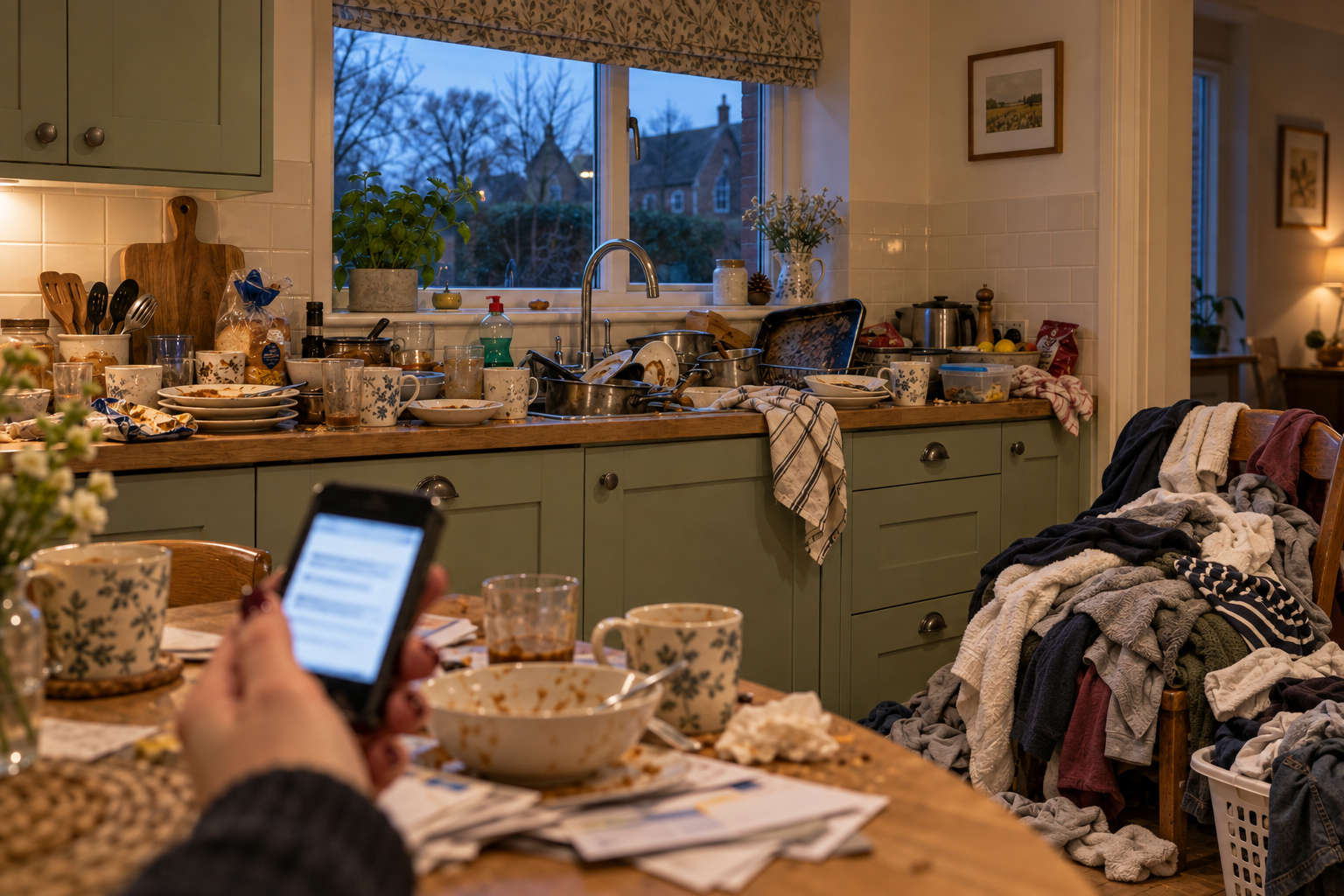
I looked up from the screen, and the house looked back. The home I had fought so hard to keep had spent the past few weeks quietly going feral around me while my life, as it felt then, burned. I had been living at the bottom of a depression pit of my own digging, and the mess had accumulated with the slow inevitability of sediment: plates colonising the counters, laundry achieving its own geology, every surface bearing some mutely accusing piece of evidence that I had stopped coping some time ago and had been too tired to announce it. Into all of this, a stranger was proposing to arrive in a wig and restore order, and to pay for the privilege of being abused while he did it. It was preposterous and faintly obscene, and it was also, by some distance, the most practical offer I had received all year.
I read it again and glanced at the sink. Somewhere at the back of my mind a far more dangerous thought had begun to assemble itself, one involving my friends, a party, and a grown man in a leather maid's outfit carrying a tray of drinks through my living room, and before I had quite decided what kind of woman I was about to become, I found that I was already typing my reply.
Suffolk had spoken. Now it was my turn.