Rest Is Not Laziness: Recovery After Emotional Overload
By Beatrice Wren
Emotional overload is not only a feeling. It is what happens when the body has been forced to carry too much for too long, and finally begins to refuse the arrangement. Real recovery is not a quick patch, but a return to the physical, emotional and spiritual conditions required to live without constantly breaking yourself to survive.
When the Body Stops Negotiating
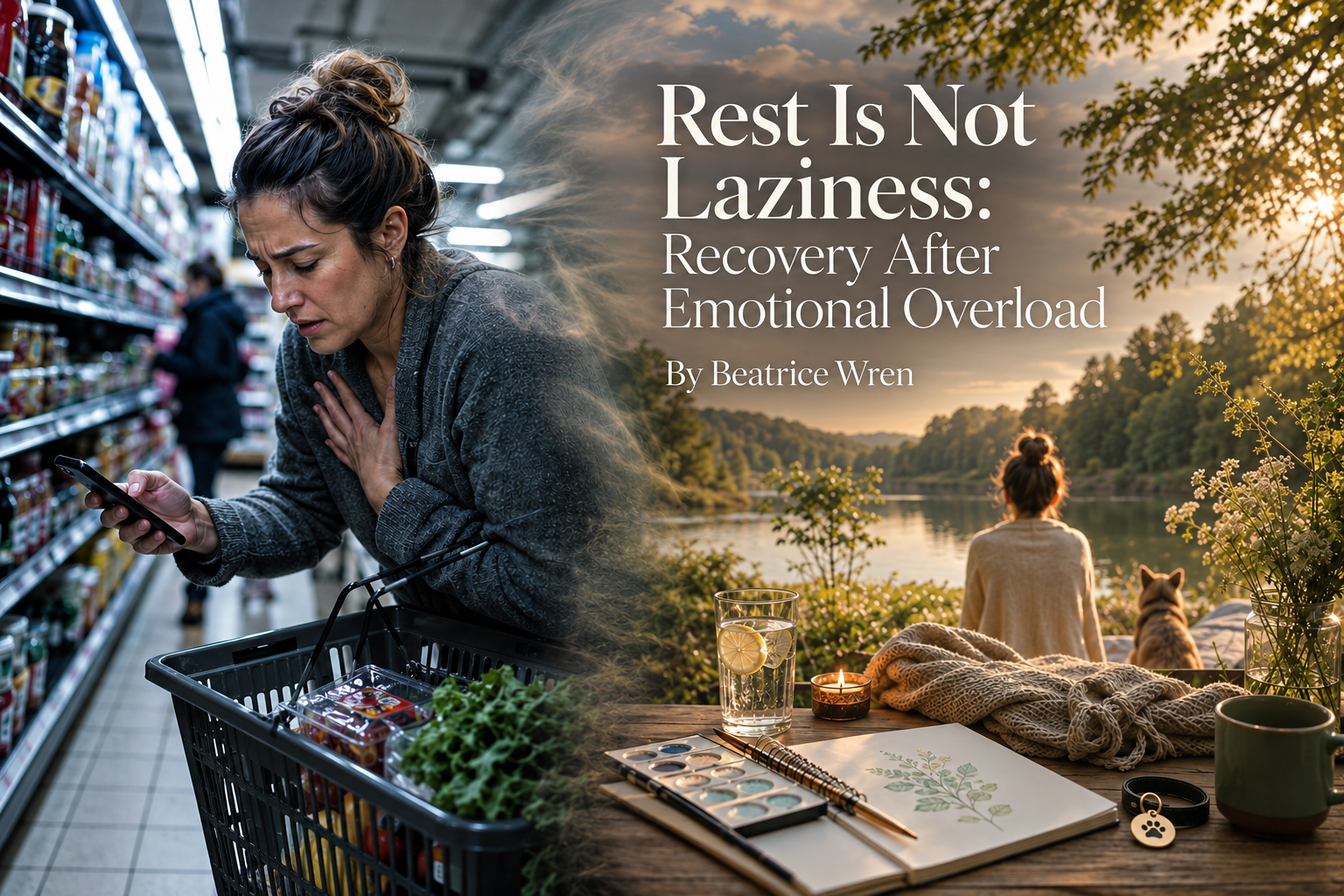
I was in a supermarket when my body made its case against the life I had been trying to live. Nothing dramatic had happened in the aisle. There was no raised voice, no sudden accident, no visible emergency to explain why the floor seemed to tilt and the strip lights had become hostile. I was holding a basket, surrounded by the harmless abundance of ordinary things, when my heart began to hammer as though I had been cornered. My mouth dried. My hands turned untrustworthy. The shelves blurred at the edges. I had been anticipating a message from someone whose attention had come to feel like both hope and punishment, and my nervous system, tired of being reasoned with, treated the possibility of a text as danger.
That panic attack did not arrive out of nowhere. It had been assembled over years: wrong jobs, wrong rooms, wrong people, too much loyalty directed towards places where it was not returned, too many private humiliations digested in the name of being kind, useful, mature, forgiving. I had spent a long time being too much to too many, and too little to myself. I had not taken a proper holiday in a decade. I had kept working, caring, smoothing, answering, surviving. I had treated my own limits as inconvenient weather.
By the time I broke, my life had already become unrecognisable. I had been made homeless. My boyfriend had cheated on me, and then his mother had threatened to hurt herself if I told anyone. My dog, whom I loved with the ferocity other people reserve for blood, became suddenly ill and died in my arms. I had lost my father, my grandparents, my home, and then found myself grieving people who were still alive because the relationships had vanished without even the courtesy of a conversation. A best friend of fifteen years, someone I had supported through their own difficulties and for whose children in care I had even become a registered carer, turned away without explanation when I finally needed support myself.
There are betrayals that hurt because they are sudden, and there are betrayals that reveal the shape of an old arrangement. As a disabled person, being cut off by people who had already failed to make room for my needs felt less like abandonment than exposure. I saw, with a clarity that was almost indecent, how much of my life had depended on my ability to absorb pain quietly. The supermarket panic attack was not an overreaction to a message. It was the moment the body refused to keep pretending that emotional labour does not have a physical cost.
Emotional Overload Is Physical Overload
Rest after emotional overload should be taken as seriously as rest after physical strain, and sometimes more seriously. A person who has run too far or lifted too much is not accused of laziness for needing to stop. Their exhaustion is granted a cause, a logic, a place in the body. Emotional exhaustion is expected to defend itself because so much of its labour is invisible: anticipation, suppression, grief, dread, social performance, caretaking, financial fear, the effort of remaining civil in rooms where something in you is being diminished.
British health guidance is admirably blunt where culture is evasive. Stress can affect the body as well as the mind: headaches, dizziness, muscle tension, stomach problems, chest pain, faster heartbeat, sleep changes, appetite disruption, poor concentration, irritability, avoidance, and overwhelm. Panic attacks can bring a racing heart, nausea, breathlessness, trembling, dizziness, dread, numbness, and the frightening sense of being detached from oneself. Heart palpitations may have many causes, including stress, anxiety and lack of sleep, though chest pain, persistent palpitations, severe weight loss, prolonged insomnia, or any symptom that feels dangerous should be taken to a clinician rather than folded neatly into a wellness narrative.
The point is not to turn every ache into a metaphor. The point is to stop treating the emotionally overloaded body as an unreliable narrator. When someone has been living on alarm, the body does not distinguish politely between grief, work, betrayal, caregiving, disability, poverty, loneliness, sensory strain and fear. It responds to demand. The Health and Safety Executive defines stress as an adverse reaction to excessive pressures or demands, which is a plain sentence with devastating reach. The demand may come from a workplace, but it may also come from a family system, a friendship that has become extraction, an unsafe home, illness, debt, bereavement, or the long performance of being fine because other people find your distress inconvenient.
This is why the warning signs often appear late. By the time the body starts making itself impossible to ignore, the crisis has usually passed beyond the stage of a quiet evening and a cup of tea. Anxiety attacks, sleepless nights, restless days, palpitations, weight loss, loss of appetite, shame, guilt, numbness, loss of desire, and the sensation of living on autopilot are not little administrative errors in the self. They are evidence of a system that has been pushed past its tolerances. A quick patch may delay the collapse, but it will not change the conditions that keep producing it.
The Cruel Prestige of Coping
One reason emotional overload becomes dangerous is that many of us are rewarded for the very habits that eventually make us ill. We are praised for being strong, reliable, low-maintenance, forgiving, resilient, hardworking, emotionally intelligent. We learn to read a room before reading our own bodies. We keep the peace, remember the birthdays, absorb the awkwardness, manage the moods, anticipate the needs, soften the blow, make ourselves useful enough to be kept. In families, friendships and workplaces, the person who over-functions often becomes invisible as a person and invaluable as a service.
This is especially true for those whose needs are already treated as excessive: disabled people, chronically ill people, carers, women, low-paid workers, people in precarious housing, people whose lives leave little margin for repair. Wellness culture often speaks as though rest is a private decision made in a beautifully lit room. For many, rest is tangled with money, work, access, safety, childcare, medical support, housing and the politics of whose exhaustion is believed. It is absurd to tell someone to choose calm while leaving untouched the conditions that keep charging their nervous system interest.
Even where choice exists, guilt can make it unusable. The first boundaries I set did not feel like liberation. They frightened me. My body had been trained to survive by appeasing, explaining, tolerating and returning. Saying no felt dangerous before it felt peaceful. Walking away from friendships I had spent years trying to maintain felt at first like failure, then grief, then air. I had to learn that the people who benefited from my lack of boundaries were not reliable judges of whether those boundaries were fair.
This is where emotional overload becomes more than tiredness. It becomes a reckoning with the life that demanded so much depletion in the first place. The question is not simply, “How do I feel better?” It is sharper, less decorative, and harder to evade: “What keeps making me unwell, and why have I been calling it love, duty, ambition, loyalty or survival?”
The Hard Reset
A proper reset is rarely glamorous. It does not always look like a retreat, a spa day, a white robe, a journal, a softened morning. Those things may help, and I will defend beauty wherever it can be found, but the deeper reset begins when demand is lowered enough for the body to believe something has changed. Sleep has to stop being treated as the thing left over after everyone else has been served. Food has to become steady and kind, particularly when stress has stolen appetite or made eating feel like another task. Hydration matters more than it sounds, and for some bodies, especially where illness, medication, sweating, crying, poor appetite or disability complicates ordinary cues, electrolytes can be part of returning to basic physical steadiness.
Movement also has to change its meaning. I could not punish my way back into health. Exercise, when it helped, had to become a form of return rather than conquest: nature walks, stretching, swimming in cold water, moving because the body deserved circulation and air, not because it had failed some aesthetic test. Creativity mattered too. Music and art gave the mind a room that was not built out of memory, analysis or dread. Peace and quiet became medicine. So did friendship, but only the kind that did not require performance. So did solitude, when solitude meant safety rather than exile.
Recovery was trial, error and repetition. Some adjustments sounded too small to matter until I discovered how much they mattered: a fan at night, white noise, an eye mask, a support pillow, a hot bath, fresh air, fewer decisions, fewer screens, fewer people with immediate access to me. Other remedies failed or worked only sometimes. A walk could save a morning and feel impossible by evening. A boundary could unsettle my nervous system before it settled my life. Progress could be undone in minutes by the wrong room, the wrong message, the wrong person pulling me back into an old role.
Eventually, the evidence became too consistent to ignore. If contact with certain people left me shaking, sleeping badly, losing appetite, or feeling as though all the air had been taken from the day, then my body was not being petty. It was telling the truth faster than my mind could make excuses. Real healing required more than rest; it required removal. I had to stop returning to arrangements that made recovery impossible and then blaming myself for not recovering quickly enough.
Building a Life That Does Not Cost So Much
Recovery is often mis-sold as a return to the person you were before collapse. That can be a dangerous ambition if the person you were had survived by disappearing. The old self may have been capable, impressive, generous and beloved, but she may also have been sleeping badly, eating badly, working in the wrong places, giving too much to the wrong people, and mistaking endurance for virtue. To recover properly, I had to stop asking how quickly I could get back to normal and start asking why normal had cost me so much.
A safer life is not always dramatic from the outside. It may look like protected sleep, simpler food, better hydration, gentler movement, clearer work hours, fewer explanations, more honest friendships, medical support when needed, therapy where possible, creativity without productivity attached, and time in nature treated as a necessity rather than an indulgence. It may look like wild swimming, music, art, warm water, clean sheets, laughter, animals, silence, sunlight, or a day at a spa when the body needs to be reminded that pleasure is not a suspicious use of time. These are not ornaments placed on top of healing. They are part of the ecology that makes healing sustainable.
The social world will not always approve. Some people prefer the version of you that could be reached, used, forgiven and resumed without consequence. Some will call your boundaries cold because they were warmed by your overextension. Some will notice your absence only as an inconvenience. This knowledge is not comforting, but it is clarifying. You learn who loved you and who loved the labour you performed. You learn which rooms your body enters softly and which ones make it brace before anyone has spoken.
There is hope in that knowledge, though it is not the sentimental kind. It is the hope of appetite returning: hunger, interest, humour, music, the ability to read a few pages, the wish to cook, the pleasure of weather, the sudden lightness of a weekend not arranged around dread. It is the hope of no longer needing catastrophe to authorise rest. It is the hope of building a world in which your body does not have to become unwell in order to be heard.
Rest is not laziness. Laziness is a moral accusation, usually made with too little curiosity. Rest is repair, regulation, grief work, boundary work and physical maintenance. It is how the body returns from a life that asked too much and listened too little. By the time the signs appear, the body has often been asking for mercy for a long while. The task is to listen before refusal becomes collapse, to bend before we break, and to build a life that no longer requires us to spend ourselves so completely just to remain inside it.