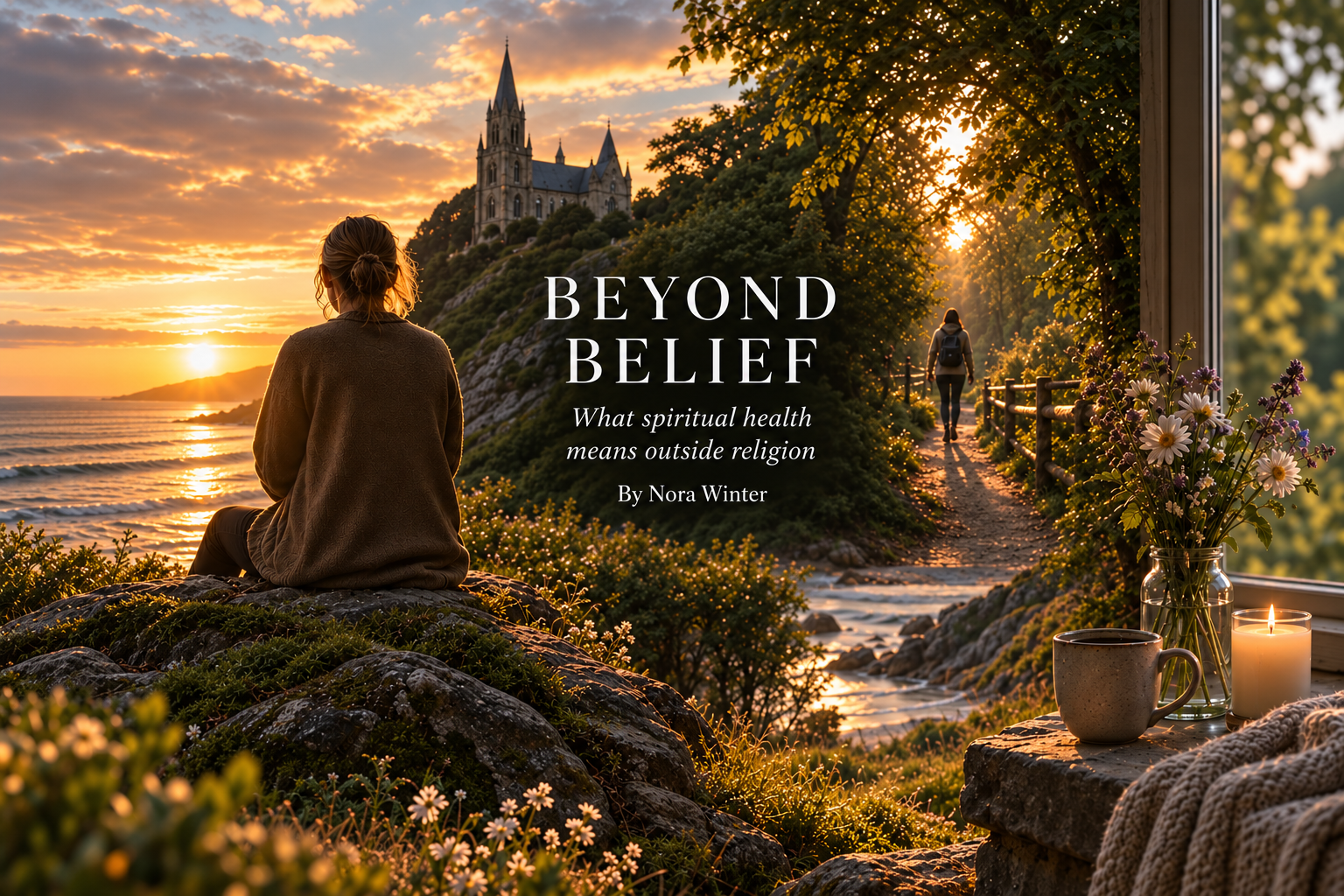
BEYOND BELIEF
What Spiritual Health Means Outside Religion
By Nora Winter
There are many ways to be unwell in public, and modern culture has become fluent in almost all of them. We know how to discuss stress, burnout, anxiety, hormones, sleep debt, attention fatigue. We know how to count steps, optimise routines, regulate blood sugar, reduce inflammation, and curate an increasingly elaborate architecture of self-maintenance. Yet there remains a quieter form of depletion for which many people have no stable language at all. They do not feel simply tired, or sad, or clinically unwell. They feel thinned out. Unmoored. Curiously untouched by their own lives.
For some, religion once provided a structure in which such feelings could be interpreted: a vocabulary of devotion, trial, estrangement, reverence, moral struggle, transcendence. But many now live outside formal faith, whether by conviction, inheritance, distance, or disillusionment. They may not believe in God. They may not belong to a church, mosque, temple, or synagogue. They may never have done so. And yet the underlying human experiences that religion once helped to contain have not disappeared simply because belief has become more contested, more private, or less institutionally central. The need for meaning survives the decline of certainty. So does the need for reverence, orientation, inner coherence, and some felt relationship to a life larger than appetite, output, and administration.
It is worth remembering that religion was never only a matter of belief in the abstract. Historically, it structured ordinary time. It gave many people a sanctuary within the week: a place to gather, reflect, sing, confess, mourn, contemplate, and place one’s private troubles within a larger moral or cosmic frame. Sunday church, for example, was not merely a theological appointment. For countless people it was a focal point, a rhythm, a pause in which the week was briefly reorganised around stillness, ritual, and shared attention. Even those whose faith was uncertain could experience these spaces as a form of containment. They offered texture, cadence, and a regular return to something beyond the transactional pressures of daily life.
As these practices have fallen away for many, the disappearance has not always been replaced by an equivalent form of spiritual care. Life has become faster, noisier, more atomised, more relentlessly productive in tone. The old rituals may have loosened, but the need they once addressed has not. If anything, the need may have become harder to ignore. The body can be fed, the inbox managed, the calendar colour-coded, and still some quieter dimension of the self remains unfed. Spiritual support, whether religious or secular, contributes to overall wellness not because it makes life prettier or more fashionable, but because it helps a person feel held within it. It lends shape to experience. It offers perspective, meaning, humility, and the strange medicinal relief of remembering that one is more than one’s functions.
This is where spiritual health enters, though the term is often mishandled before it has even been properly heard. It is either made so vague as to mean almost anything, or so mystical that it seems to belong only to the initiated. In the marketplace, it is frequently reduced to a mood board: candles, moonlight, alignment, vague softness arranged around the consumer self. In more secular circles, it can prompt embarrassment, as though any reference to the spirit risks a slide into dogma, irrationalism, or aestheticised nonsense. What gets lost between these distortions is something more serious and more human: spiritual health as the condition of one’s inner life in relation to meaning, values, connection, and depth.
It is not necessary to be religious to recognise that a person can be materially functional yet existentially undernourished.
Spiritual health, outside religion, might best be understood as the quality of a person’s relationship to significance. Not success, exactly. Not happiness in its thinner, consumer-facing form. Significance. The sense that one’s life is not merely being spent, but inhabited. That one’s days are connected to some larger order of meaning, whether that order is found in art, ethics, nature, love, service, truth, beauty, ancestry, scholarship, creativity, or the disciplined attempt to live in accordance with one’s deepest values.
This is why spiritual health should not be confused with optimism. A spiritually healthy person is not necessarily cheerful, serene, or free of suffering. They may in fact be in grief, uncertainty, or profound transition. The issue is not the absence of pain but the presence of orientation. A life can hold sorrow and still possess depth. It can contain fear and still feel morally or existentially intelligible. Spiritual health has less to do with permanent peace than with a certain kind of inner groundedness: the ability to remain in relationship with what matters, even when life becomes unstable, disappointing, or cruel.
Nor is it identical to mental health, though the two affect one another constantly. Psychological wellbeing concerns cognition, mood, regulation, resilience, functioning. Spiritual wellbeing asks different, if overlapping, questions. What gives your life meaning? What do you serve, consciously or not? What do you consider sacred, even if you would never use that word? Where do you experience awe? What principles organise your choices when no one is watching? What helps you endure suffering without becoming spiritually misshapen by it? These are not decorative questions. They shape the architecture of a life.
Many contemporary people are, in this sense, spiritually under-attended not because they are shallow, but because they live inside conditions that reward fragmentation. The modern self is asked to be efficient before it is asked to be wise; visible before it is inwardly coherent; productive before it is reflective. To live well, in the prevailing idiom, is often to manage oneself persuasively: to be responsive, presentable, monetisable, emotionally literate enough for social survival, and adaptable enough to keep moving. This produces a particular kind of exhaustion. One can become highly skilled at maintaining life while gradually losing contact with the part of oneself for whom life is supposed to mean something.
The language of spirit is especially difficult in a culture suspicious of seriousness unless it can be measured or sold. We are comfortable speaking about what can be tracked: sleep scores, calorie deficits, therapy milestones, resting heart rate, productivity systems. But spiritual life resists the neat vanity of metrics. It cannot be proven by a graph. It does not yield especially well to optimisation. It involves slowness, ambiguity, encounter, moral friction, humility, surrender to realities one does not fully command. These are not popular conditions in an age built around speed, self-display, and the fantasy of total personal control.
There is also a historical dimension to this discomfort. In many secular societies, religion has not merely receded; it has become culturally complicated. For some, it evokes authority, exclusion, coercion, hypocrisy, or injury. Understandably, they want nothing to do with its language. But in discarding the institution, many have also lost access to certain human practices that religious life once sustained: ritual, communal singing, shared mourning, ethical seriousness, the marking of time, acts of reverence, regular contemplation of mortality, and the humbling recognition that life cannot be reduced to utility. What remains is often a gap more than a liberation. People are freer, in some respects, but also less held.
This raises an increasingly urgent question: what are we replacing these structures with? Too often, the answer is very little beyond work, entertainment, and the low-grade anaesthesia of digital distraction. We have surrendered many inherited rituals without building new ones capable of carrying the same psychic or spiritual weight. The result is not only freedom, but drift. A person may reject doctrine quite legitimately and still find themselves aching for rhythm, reflection, or some dedicated space in which the week stops belonging entirely to other people.
A secular life may therefore need its own forms of consecrated time. Sundays, for instance, need not belong to church in order to function as a sanctuary. They can be reserved, wholly or partly, as a kind of private Sabbath: not for self-improvement in the punitive modern sense, but for return. A few hours in which self-care is not followed by guilt. A day in which rest is not defended as laziness, and inner maintenance is not treated as indulgence but as stewardship. One might call it, only half playfully, a church of the self — though not in the narcissistic register our age tends to assume. What is meant here is not self-worship as vanity, but self-tending as reverence: bathing slowly, walking without agenda, making tea properly, cleaning one’s space, writing, praying if one prays, reading something nourishing, sitting with grief, tending plants, watching the sky change, or giving oneself over to silence without the usual compulsion to justify it.
For others, the focal point of spiritual attention may be directed less toward the self than toward the planet, or toward the more-than-human world. Reverence may take the form of watching birds from a window, learning the names of trees, planting something small, protecting a patch of soil, or picking litter from a local path. There is a spiritual dignity in these acts precisely because they pull the self out of its own enclosure. They remind a person that they belong to a wider world, that care can move outward as well as inward, and that healing is sometimes helped by participation rather than introspection alone.
This helps explain a strange contradiction of modern life: at the precise moment when people have greater permission to define life on their own terms, many feel less able to name what those terms should be. Freedom without form can become its own kind of destabilisation. Without inherited structures, individuals must compose meaning for themselves, often while exhausted, economically pressured, digitally overstimulated, and socially atomised. It is no small task. To ask a person to build an inner life under such conditions is rather like asking them to cultivate a garden on moving ground.
The socio-economic dimension here matters more than much spiritual writing admits. There is a tendency, especially in commercial wellness culture, to treat disconnection as though it were primarily a matter of personal negligence. You have lost touch with yourself, the genre implies, because you have not journalled correctly, meditated long enough, purchased the right retreat, or learned to wake with gratitude. This is not only shallow; it is frequently insulting. People are not spiritually depleted in a vacuum. They are worn down by rent, debt, grief, shift work, caregiving, precarious employment, illness, discrimination, noise, loneliness, and the cumulative indignities of being forced to live too reactively for too long.
A person working multiple jobs, caring for relatives, and trying to survive an unforgiving economy does not need a lecture on alignment. They need relief, dignity, time, and conditions under which an inner life can breathe. Material security does not guarantee spiritual health, but chronic insecurity can make it extraordinarily difficult to sustain. It narrows time, attention, and imaginative bandwidth. It keeps the nervous system poised at the level of emergency. Under such pressure, one’s world can become brutally immediate: get through the day, answer the message, pay the bill, endure the meeting, quiet the fear. The soul, to use an unfashionable but useful word, is not always destroyed by this. But it is often crowded out.
At the same time, spiritual impoverishment is not limited to hardship in any simple sense. The affluent can be spiritually starved in rooms full of beautiful objects. Status does not protect against emptiness. Success does not resolve the problem of significance. Indeed, one of the more unsettling features of contemporary life is how many people arrive at the thing they were told would satisfy them—professional legitimacy, curated homes, desirable bodies, enviable freedoms—only to discover that achievement has solved the practical question of how to live while leaving the existential question untouched. What is all this for? What kind of person have I become in acquiring it? Why, despite competence, do I feel unaddressed by my own success?
These are spiritual questions, though not exclusively religious ones.
So what, then, does spiritual health look like when it is not housed inside doctrine?
It may look like the capacity for wonder without naivety. The ability to be moved by beauty without needing to own or display it. It may look like moral seriousness without self-righteousness: living by values that cost something, rather than merely posting them. It may look like the maintenance of interior space in a culture designed to colonise attention. It may involve rituals with no formal theology behind them: walking at dawn, lighting a candle for the dead, keeping a day free from noise, reading poetry before sleep, returning regularly to sea or woodland, cooking for others with reverence rather than haste. These acts are not spiritually meaningful because they are aesthetic. They are meaningful because they train attention, remembrance, gratitude, and presence.
It may also look strikingly ordinary. Meditation is one example, not because it is fashionable, but because it interrupts the tyranny of constant reaction. Breathwork, reflective journalling, contemplative reading, singing, making art without monetising it, or taking a phone-free walk can all function as forms of secular devotion. So can volunteer work, community gardening, cooking for a neighbour, or the modest civic tenderness of litter picking. Such acts are often dismissed as wholesome in a faintly patronising register, as though their value lay only in niceness. In fact, they can be spiritually clarifying. They place a person back into relationship — with the body, with place, with others, with the quiet moral satisfaction of leaving something cleaner, gentler, or more cared for than one found it.
Nature, too, remains one of the most accessible sites of secular transcendence, though even here care is needed not to romanticise access as universal. For some, immersion in nature may mean long walks, woodland trails, sea air, wild swimming, gardening, or lying in grass under an unbroken sky. For others, especially disabled people or those living with illness, fatigue, pain, or limited mobility, the scale may be smaller but no less real: opening a window and feeling fresh air move through a room, sitting in a garden for ten minutes, tending a plant on a windowsill, following the movement of light across a wall, listening to birds from bed, resting under a blanket in a patch of sun. None of this is lesser. Spiritual care is not validated by effort or athleticism. It does not become more meaningful because it is strenuous. Sometimes the holiest available act is simply to make a little more room for breath, beauty, or calm within the limits one is actually living under.
This is worth stating plainly because modern wellness rhetoric so often smuggles in ableist assumptions about what “good” self-care looks like. Spiritual health must not be reserved for the vigorous, the mobile, the affluent, or the aesthetically privileged. A person does not need a forest retreat, a yoga platform, or a perfectly curated morning routine in order to experience connection, awe, or peace. They may find it in routine, in adaptation, in the intimacy of familiar surroundings, in the discipline of continuing to notice what is still lovely, still meaningful, still alive. There is no vulgar hierarchy by which climbing a mountain is spiritually superior to sitting quietly by an open door and letting the weather touch your face.
Spiritual health may also involve a changed relationship to time. One of the most corrosive features of modern living is the reduction of time to a series of units to be filled, managed, defended, or monetised. Spiritual life resists this flattening. It asks for forms of duration that cannot be justified in productivity terms: silence, reflection, contemplation, long conversation, grief, prayer for those who pray, and for those who do not, some honest equivalent of turning toward what exceeds the self. This is not laziness. It is not escapism. It is an attempt to rescue human experience from pure instrumentality.
It may involve community, too, even outside formal religion. One reason churches and other faith spaces mattered was not simply doctrine, but assembly. People gathered regularly around something other than commerce. They sang together, kept company with the bereaved, marked births and deaths, returned to familiar faces, and felt themselves part of a moral and temporal continuum. Secular life often offers fewer equivalents. Yet spiritual health can still be sustained communally: through choirs, reading groups, local volunteering, walking clubs, mutual aid, environmental clean-ups, art classes, seasonal rituals with friends, shared meals prepared without rush. What nourishes the spirit is not only solitude, but the experience of being meaningfully among others without having to perform a marketable version of oneself.
It is also worth resisting too narrow or respectable an idea of what spiritual curiosity must look like. For some people, the sense of connection to something beyond the ordinary arrives through conventional contemplative practices; for others, it appears through mystery itself. Watching paranormal documentaries, reading folklore, studying ancestral myths, visiting old graveyards, taking an interest in ghost stories, or even going ghost hunting can, for some, function as a serious attempt to feel the edge of the known world. One need not make grand claims about the supernatural to recognise the underlying impulse. Such practices may offer wonder, humility, play, companionship, and the comforting intuition that reality exceeds what can be immediately explained. Spiritual life is not always solemn. Sometimes it is animated by curiosity, by the thrill of the unseen, by the old human refusal to accept that the visible world is the whole of it.
The important distinction is not between conventional and unconventional forms of spiritual care, but between what deepens life and what merely distracts from it. A practice need not be traditional to be meaningful, but it should, in some way, widen attention, soften estrangement, or restore a person’s sense of participation in something larger than the closed circuit of their own pressures. That “something larger” may be God, for believers. For others, it may be the natural world, art, memory, ancestry, moral purpose, collective care, or the unanswered mystery at the edge of experience. The form matters less than the quality of encounter.
And perhaps that is the crux of the matter. Spiritual health begins where life ceases to be merely instrumental. It begins where a person refuses, however quietly, to treat themselves as a machine for output, a profile for curation, a body for management, or a mind for endless extraction. It requires some recognition that a human being has an inner life worthy of stewardship—not because it improves performance, though it may, but because the erosion of that inner life is itself a form of suffering.
To care for spiritual health outside religion, then, is not to imitate belief or borrow sacred language for decorative effect. It is to take seriously the human need for depth. It is to acknowledge that meaning does not appear automatically in the space left by disbelief; it must be cultivated, protected, and sometimes painfully rebuilt. It is to understand that one can reject dogma and still hunger for transcendence, not necessarily in the supernatural sense, but in the sense of being lifted beyond the cramped confines of ego, urgency, and private appetite. It is to recognise that a life requires more than maintenance. It requires inward shape.
The benefits of such care are not trivial, nor are they confined to the symbolic. A person whose spiritual life is attended to may find that they are less internally scattered, less hostage to the tempo of the day, less easily flattened by the mechanical churn of obligation. Spiritual practices can restore rhythm where there was only rush, coherence where there was only reaction, and meaning where there was only accumulation. They can help grief move rather than calcify. They can make solitude feel less like abandonment and more like room. They can strengthen a sense of belonging — to a place, a people, a practice, a season, a moral vision, a living world. They can also support the body indirectly, by lowering agitation, inviting rest, widening breath, and interrupting chronic overstimulation. Not because spirituality is a magic solution, but because human beings tend to fare better when life feels inhabitable from the inside.
None of this demands that the secular person pretend toward faith they do not hold. It asks for something both more modest and more demanding: honesty about the fact that the spirit, however one names it, does not thrive on efficiency alone. It needs encounter. It needs value. It needs beauty not as luxury, but as nourishment. It needs some practice of return.
Outside religion, spiritual health may have fewer ready-made forms. It may be less communal, less ceremonially reinforced, more vulnerable to drift. But it is no less real for that. If anything, it asks for greater intentionality. One must choose, and keep choosing, the things that deepen life rather than merely fill it. One must resist the seductions of speed, cynicism, and permanent distraction. One must learn how to live without worshipping productivity, consumption, or the self.
This is difficult work. It is also dignified work. And in a culture full of advice on how to improve the visible life, there may be something quietly radical in tending to the invisible one.
The secular world does not need to reproduce religion exactly in order to recover some of what religion once offered. But it may need to admit, more openly than it often does, that people still require ritual, pause, reverence, and occasions for inner repair. A society that gives no protected space to the spirit should not be surprised when so many people feel privately starved. The question is not whether everyone must return to belief. It is whether we are willing to create lives that make room for depth at all.
That room may be made on a Sunday morning kept deliberately slow. In ten minutes beside an open window. In an hour spent cleaning a neglected patch of earth. In a candle lit for someone missed. In a guided meditation. In sea air. In a library. In an allotment. In a choir. In a graveyard at dusk. In a paranormal programme that stirs the imagination toward mystery rather than mockery. In the simple refusal to treat care, wonder, and reflection as embarrassing luxuries in a world that profits from our depletion.
Perhaps that is what spiritual health outside religion finally asks of us: not certainty, but attention. Not doctrine, but devotion of some kind. Not performance, but practice. A way of living that allows the inner life to feel accompanied rather than abandoned. A way of remembering that wellness is not only about keeping the body functional and the mind manageable, but about ensuring that some quieter part of the self remains lit, responsive, and in touch with what makes life feel worth inhabiting at all.