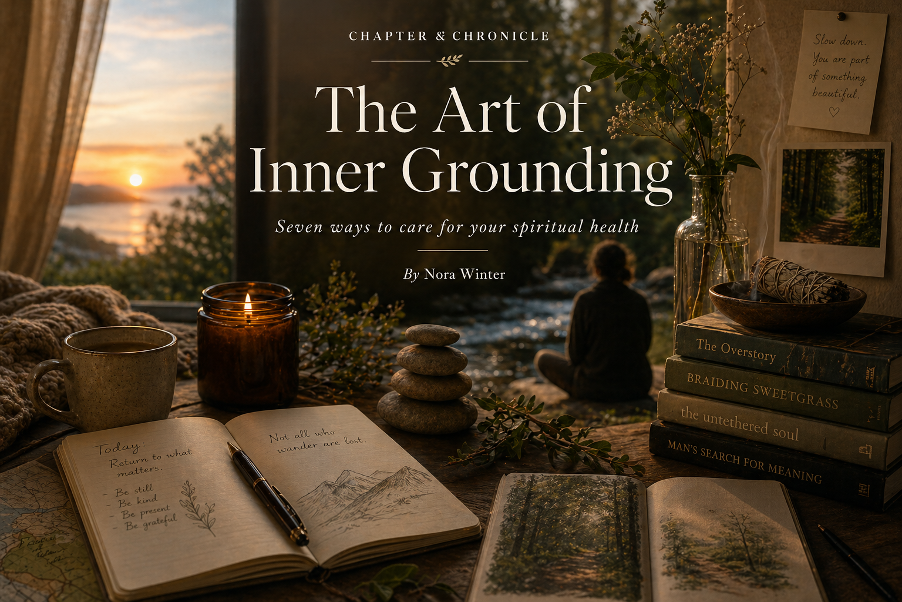
The Art of Inner Grounding
Seven ways to care for your spiritual health
By Nora Winter
There are periods in life when a person does not exactly feel broken, yet cannot honestly say they feel whole. They are getting through the week. They are answering messages, paying bills, making appointments, remembering birthdays, performing competence with reasonable success. From the outside, little appears dramatically wrong. And yet inwardly something has gone quiet in the wrong way. Not peace, but dimness. Not rest, but estrangement. The days are being managed, but not fully inhabited.
This is often described in psychological language, and sometimes rightly so. Burnout, low mood, nervous exhaustion, overstimulation, grief, isolation, decision fatigue: all may be involved. Yet there are forms of depletion that are not exhausted by these terms. Sometimes what has thinned is not only energy, but meaning. Not only mood, but connection. Not only resilience, but reverence. The inner life begins to feel neglected, as though some essential room within the self has been left closed for too long.
Spiritual health, outside religion, concerns that room.
For some, the word spiritual remains difficult: too vague for comfort, too easily commercialised, too vulnerable to cliché. It can conjure a marketplace of borrowed mysticism and expensive softness, or else the fear of drifting into piety by another name. But stripped of theatre, spiritual health is something simpler and more demanding. It is the quality of one’s relationship to meaning, depth, value, and the felt sense of belonging to something larger than private appetite and daily administration. It is the condition of the inner life when life is not being lived as pure function.
To care for it is not necessarily to become mystical, nor to imitate religious belief one does not hold. It is to resist becoming spiritually flattened by the tempo and texture of modern existence. It is to make some deliberate room for awe, attention, moral clarity, beauty, service, stillness, and forms of connection that restore scale to the self. That scale matters. Without it, life can become oppressively immediate: too much screen-light, too much utility, too much reaction, too little inward shape.
The seven practices that follow are not offered as commandments, nor as a polished fantasy of ideal living. They are not a performance of perfect balance. They are ways of reintroducing depth into ordinary life, whether one has ample time or very little, whether one is healthy or unwell, mobile or housebound, affluent or stretched to the edge of the month. Spiritual care must be real enough to survive contact with actual lives. Otherwise it is merely another aesthetic.
I. Keep Sacred Time
One of the quietest injuries modern life inflicts is the reduction of time to utility. Hours must be productive, monetised, improved, tracked, filled, defended, justified. Even leisure is often made to perform. It must count as growth, recovery, self-optimisation, enrichment, or content. This leaves very little room for time that is simply inhabited for its own sake.
Yet spiritual life has always required some form of protected duration. Historically, religion understood this. It built pauses into the week. It marked time as sacred rather than endlessly available for extraction. For many, Sunday functioned not only as a day of worship but as an interruption to ordinary tempo: a rhythm of return, assembly, reflection, and relative stillness. Even for those whose faith was uncertain, the pattern itself could be containing.
A secular life may need an equivalent. Not a perfect imitation of religious observance, but a deliberate refusal to let every hour be claimed by labour, errands, distraction, or low-level digital erosion. This might mean keeping part of a Sunday slow and unstructured. It might mean one evening a week in which no one is allowed to ask anything of you beyond the essential. It might mean an hour spent reading, walking, thinking, sitting by a window, or making food carefully rather than hurriedly. The point is not idleness for its own sake. It is the recovery of time in which the self is not being used.
For people under economic strain, caregiving pressure, or chronic fatigue, such time may be painfully scarce. This matters. Spiritual advice that ignores the material conditions of people’s lives is not wise; it is merely privileged. But even then, the principle holds at the scale available. Ten protected minutes can still alter the moral weather of a day. To keep a little time unsold, unclaimed, and unperformed is to tell the spirit that it is not an afterthought.
II. Consecrate the Ordinary
Ritual is one of the oldest technologies of human steadiness. It places form around feeling. It lends shape to time. It gives the body something intelligible to do when the mind is noisy, grieving, scattered, or uncertain. Religion has long understood its power, but ritual does not belong exclusively to belief. Secular lives need it too.
The distinction between a routine and a ritual is not always visible from the outside. Both may involve repeated acts. But routine is often logistical, whereas ritual carries attention. It gathers meaning around an action and slows the self sufficiently to experience it. Making tea can be a routine, or it can be a ritual. So can morning stretching, lighting a candle at dusk, opening the curtains with intention, watering a plant, reading a poem before sleep, washing one’s face properly, or pausing before a meal rather than consuming it in transit.
What matters is not grandeur but regard. Ritual becomes spiritually sustaining when it asks something different of consciousness: not speed, not mere completion, but presence. It turns small acts into thresholds. It reminds a person that life is not only composed of tasks, but of moments through which one passes and in which one may choose, however briefly, to be fully there.
This is especially valuable in periods of instability. When grief enters a life, or illness, or financial fear, or a change one did not choose, ritual can function as a handrail. It does not remove suffering. It prevents total shapelessness. In an age that prizes spontaneity and flexibility, one can underestimate the dignity of repetition. To return to the same small act each morning or evening is sometimes how a person remains inwardly legible to themselves.
III. Step Beyond the Self
Spiritual depletion often intensifies when the self becomes too enclosed. One’s worries, deadlines, humiliations, resentments, and practical concerns begin to fill the whole field of vision. The scale of life collapses inward. Everything feels immediate, personal, and faintly airless.
One of the most reliable ways to restore proportion is to seek contact with something that exceeds the self without erasing it. For many, this is where nature enters. Sea, sky, weather, birdsong, trees, moonlight, rain against glass, the changing quality of seasonal light — these can all return a person to a wider frame. Not because nature is a simplistic cure, but because it resists the human fantasy of centrality. It reminds us that life is larger, older, and less arranged around our moods than modern consciousness tends to assume.
Yet access to nature must be spoken of honestly. Not everyone can stride into forests or climb coastal paths. Some live in urban environments with little green space. Some are disabled, housebound, exhausted, immunocompromised, caring for others, or simply too overburdened to reach the pastoral scenes with which wellness culture loves to decorate itself. This does not disqualify them from spiritual contact with the more-than-human world. An open window, a plant on a sill, sunlight moving across a floor, fifteen minutes in a garden chair, watching cloud shapes from bed, listening to rain, following the behaviour of birds on a nearby roof: these are not lesser forms of communion. They are forms scaled to reality.
The spiritual question is not whether the setting is cinematic. It is whether one has permitted oneself some encounter with a world not wholly constructed by human urgency. Sometimes that is enough to loosen the grip of the day and restore a subtler kind of belonging.
IV. Relearn Deep Attention
There is a particular difficulty in contemporary spiritual life: even our attempts at inwardness are vulnerable to being colonised by display. Meditation becomes a badge of virtue. Journalling becomes content. Mindfulness becomes another competency to master and perhaps monetise. The gaze of performance slips so easily into private practices that the self never quite stops posing, even in solitude.
To care for spiritual health, one must sometimes do things that no one sees and from which nothing marketable emerges.
This may involve meditation, though it need not be formal or idealised. At its best, meditation is not a contest in serenity, but an act of returning: to breath, to body, to the present moment, to the recognition that thought is not always truth and feeling is not always instruction. It can lower the psychic volume of life. It can loosen the compulsion to react to every passing internal event as though it were a command. For some, prayer serves a similar function. For others, contemplative reading, slow music, handwork, drawing, or silent walking do the same.
What matters is the quality of attention such practices cultivate. A person whose attention has been endlessly fragmented by alerts, platforms, headlines, and ambient demand begins to lose the ability to dwell. Spiritual grounding requires a restoration of dwell-time: the capacity to remain with a thought, a question, a line of poetry, a piece of music, a patch of light, a sorrow, or a silence without immediately converting it into output.
This kind of attention has practical consequences. It can reduce agitation, interrupt overstimulation, improve emotional discernment, and make inner life feel less like a chaotic crowd. But its deepest benefit may be moral rather than merely therapeutic. It teaches a person how to notice. And much of the spiritual life begins there.
V. Let Care Become Participation
Spirituality becomes distorted when it circles the self too tightly. A culture already saturated with self-curation does not need another refined vocabulary for narcissism. One of the surest ways to keep spiritual care from collapsing into private mood-management is to let it move outward into acts of service, maintenance, and responsibility.
This need not mean heroic altruism. It may be modest, local, and unspectacular. Litter picking is one example. It appears almost laughably small until one understands its moral texture. To clean a neglected path, verge, canal edge, or stretch of pavement is to participate in repair. It is to reject the logic of abandonment. It is to say, through action rather than sentiment, that shared environments deserve care and that one is not entirely powerless within them. Something similar can be said of tending an allotment, helping at a food bank, checking on a neighbour, cooking for a friend in difficulty, or volunteering in ways that restore human and civic fabric.
There is a reason such acts often leave people feeling clearer than they were before. They interrupt self-absorption. They place the individual back inside a field of relation. They offer the quiet relief of usefulness without the violence of commodification. One is not producing for profit or image, but contributing to something beyond private gain. This can be profoundly stabilising.
And yet service must not be romanticised as endless giving. Many people — especially women, carers, disabled people, and those already over-relied upon by family or institutions — know too well the damage of being useful to everyone. Spiritual service is not self-erasure. It should enlarge dignity, not deplete it further. The task is to find forms of outward care that connect rather than consume.
VI. Stay Available to Wonder
Not every spiritually sustaining act needs to be solemn, respectable, or conventionally therapeutic. Human beings have always been drawn toward mystery. We peer beyond the visible edge of things because something in us resists a purely flattened account of reality. This does not require dogma, nor credulity. It requires imagination, humility, and the willingness to admit that not everything valuable is measurable.
For some, wonder arrives through art: music that seems to know more than language can say, a film that enlarges perception, a painting before which one falls briefly silent, a novel that leaves the self rearranged. For others, beauty itself is a form of spiritual correction. Flowers on a table, candlelight in winter, the smell of old books, moonlight on water, incense, stained glass, birds in formation, dust visible in a shaft of afternoon sun — these things do not solve structural problems, but they remind the spirit that life is not exhausted by utility.
For others still, mystery may take more unconventional forms. Folklore, ghost stories, ancestral tales, haunted places, paranormal documentaries, late-night conversations about what cannot be proved: these can serve as genuine sites of spiritual curiosity. Not because one must come to a settled metaphysical conclusion, but because such interests reopen a sense of scale and strangeness. They place the self in relation to the unknown. They challenge the impoverished assumption that reality consists only of what can be immediately quantified, monetised, or explained away.
A spiritually alive life is rarely one that has abolished mystery. More often, it is one that has learned how to live near it without panic or posturing. Wonder need not be irrational. It may simply be the refusal to become so overfamiliar with existence that one no longer finds it astonishing.
VII. Build a Rhythm That Holds
The failure of much contemporary wellbeing advice lies not only in its shallowness, but in its fantasy of sustainability. It imagines lives with more money, more time, more privacy, more energy, fewer interruptions, fewer medical constraints, fewer dependants, fewer complications. Under those conditions, almost any practice sounds plausible. Real life is less obedient.
Spiritual care that lasts must therefore be built at human scale.
This is less glamorous than transformation narratives tend to promise. It may mean choosing three grounding practices rather than fifteen. It may mean deciding that Sunday morning is for quiet, however imperfectly protected. It may mean a short meditation rather than a long one, a weekly walk rather than a daily one, one candle lit in the evening, one friend with whom conversation remains honest, one place you return to, one practice that steadies you when the week frays at the edges.
Rhythm matters more than intensity because the spirit is shaped by repetition. A single transcendent afternoon can nourish. A pattern can hold. Historically, religious life understood this through liturgy, Sabbath, feast days, prayer times, fasting periods, and seasonal observances. Secular life often lacks such inherited scaffolding, which makes deliberate rhythm all the more important. Without it, people drift toward whatever the market, the algorithm, the office, or the emergency of the day happens to demand.
The point is not to create a new regime of self-surveillance under the banner of depth. It is to construct a life in which return is possible. Return to stillness. Return to value. Return to beauty. Return to community. Return to the body. Return to whatever makes life feel, even for a few moments, inhabited rather than merely endured.
That rhythm will differ from person to person. For some it will include meditation, prayer, journalling, or contemplative reading. For others it may be sea air, a museum, a choir, gardening, litter picking, volunteering, walking at dusk, making soup, listening to sacred music without subscribing to its theology, or reserving a Sunday afternoon as a small private sanctuary. The forms are less important than the fact that they exist and are guarded with some seriousness.
Spiritual health is not a luxury item for the already balanced. It is one of the things that helps make balance possible. It does not eliminate grief, debt, illness, uncertainty, or fatigue. It does not excuse injustice or substitute for medical care, therapy, political change, rest, or material support. But it does help answer a different question — the question of how to remain inwardly alive while living inside a world that can so easily make people mechanical, distracted, lonely, and spiritually thin.
To care for the spirit is, in the end, to resist that thinning.
It is to insist that a life requires more than maintenance. More than competence. More than surviving the week in a state of permanent reaction. It requires some contact with meaning, some practice of attention, some form of reverence, some reminder that the self is not merely a unit of labour or a site of endless management.
And perhaps that is the art of inner grounding: not escaping the world, but learning how to stand within it without becoming entirely claimed by its noise. Not reaching for perfection, but building small, durable forms of depth. Not waiting for transcendence to arrive dramatically, but recognising that it often enters quietly — through ritual, through service, through beauty, through nature, through mystery, through time reclaimed from usefulness and given back, at last, to the life within.
The next step could be a matching version of Beyond Belief with the same editorial polish, so the two features sit together as a seamless pair.