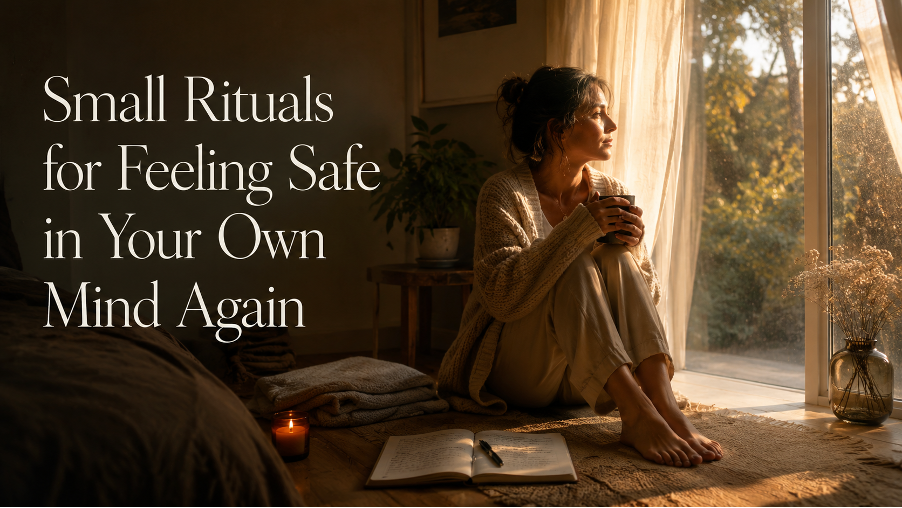
Small Rituals for Feeling Safe in Your Own Mind Again
By E. W. Hamilton
Fear can make the mind feel less like a private refuge than a room whose furniture has been rearranged in the dark. For people living with trauma, anxiety or prolonged stress, recovery is rarely a single breakthrough. More often, it is the slow, repeated work of teaching the body that the present is not always an ambush.
The Hour Before the Day Begins
The phone is face-down beside the bed, though its silence already feels accusatory. Somewhere outside, a car door shuts with a blunt metallic sound, and the body receives it before the mind has decided what it means. The room is ordinary: curtains holding a weak seam of morning light, a glass of water furred with tiny bubbles, yesterday’s jumper collapsed over a chair. Nothing is happening. Still, the chest has tightened as if news has arrived.
This is one of the private indignities of fear: it does not wait for evidence. For someone living with trauma, anxiety, panic or the residue of long stress, the day can begin before the day has asked anything. The body rises into readiness without permission. It checks the weather in another person’s face, the possible meaning of a delayed reply, the shape of a task not yet begun. The mind becomes a place of surveillance. Thoughts no longer pass through it cleanly; they linger, gather force, acquire the false authority of warnings.
To say that it is possible to feel safe in one’s own mind again can sound too neat, especially to someone still waking inside dread. The phrase risks sounding like something printed on pale stationery beside a picture of a washed linen bed. Safety, when it has gone missing internally, is not decorative. It is not the same as comfort, optimism or having a quiet morning. It is a physiological, psychological and social condition, and for many people it has to be rebuilt with an almost insultingly modest set of tools: breath, repetition, movement, contact, sleep, language, routine, professional support where needed, and the difficult patience to keep practising before the practice feels convincing.
The smallness of these rituals is often what makes people mistrust them. A breathing exercise can feel absurd against a history of threat. Naming objects in a room can feel childish when the mind is producing catastrophe with adult precision. A walk around the block can seem like an offence against the scale of one’s suffering. Yet fear itself is often maintained through repetition: the repeated scan, the repeated avoidance, the repeated collapse of past and present into the same alarm. Recovery asks for repetition too, though its early results are usually quiet enough to be mistaken for failure.
What Fear Learns, the Body Remembers
An anxious or traumatised mind is not necessarily an irrational mind. Often it is a mind that has become too faithful to danger. If vigilance once helped a person survive, avoid humiliation, anticipate anger, stay useful, remain invisible or prepare for impact, the nervous system may continue to treat watchfulness as wisdom long after the original conditions have changed. The body does not always update itself because life has become objectively safer. It waits for proof, and proof has to arrive more than once.
This is why shame is such poor medicine. People who are frightened of their own thoughts often accuse themselves of weakness, self-indulgence or melodrama, as though distress were a lapse in manners. They compare their suffering with someone else’s more visible wound and decide they have no right to be struggling. They become private accountants of legitimacy, forever recalculating whether they have earned help. Meanwhile, the body continues its blunt work: stomach clenched, jaw set, breath shallow, sleep interrupted, attention narrowed around imagined threat.
A neutral psychological perspective offers a more useful frame. Anxiety, panic and trauma symptoms are not character defects; they are patterns involving attention, memory, physiology, interpretation and behaviour. The mind predicts danger partly because prediction is one of its jobs. The problem begins when the system becomes overprotective, mis calibrated, or unable to distinguish between a present risk and a remembered one. A person may know, with the articulate part of the mind, that they are sitting in their own kitchen. Another part may be living in a different hour entirely.
Good clinical care matters because it gives this experience structure without reducing a person to symptoms. Evidence-based therapies do not pretend that fear is imaginary; they help people work with the way fear is stored, triggered, interpreted and avoided. But much of daily recovery happens between appointments, in the unremarkable spaces where a person learns whether they can answer the phone, leave the house, sleep with the light off, open a bill, sit with a memory, or notice a sensation without turning it into a prophecy.
The Present Tense Has to Be Made Physical
Thought is often the wrong doorway at first. In high anxiety, the mind can become too quick for persuasion, producing arguments, counterarguments and terrible little forecasts before the person has had breakfast. Trying to reason with panic from inside panic can be like trying to tidy a room while the ceiling is falling in. The body needs to be addressed in a language it can understand.
Breathing is one such language, though it has been made faintly ridiculous by the culture that surrounds it. Breathwork is now sold with the same breathless certainty as skincare and productivity systems, which can make a sensible person suspicious. The useful version is plainer. Sit, if sitting feels tolerable, with the body supported. Let the breath enter gently, without dragging it into the chest as a performance. Let it leave slowly. Count if counting steadies attention; abandon counting if it becomes another demand. The point is not to become serene on command, but to give the nervous system a repeated experience of de-escalation.
It is better practised before crisis than saved for the hour when terror has already filled the room. A person might breathe this way while waiting for the kettle, before opening their laptop, after coming in from the street, or in the pause between getting into bed and reaching for the phone. The practice may feel mechanical for a long time. That does not make it useless. Much of recovery begins as behaviour performed before belief catches up.
Grounding works by another route, bringing attention back to sensory evidence. A frightened mind travels; it moves through memory, anticipation, imagined accusation, rehearsed disaster. Grounding gives it a less glamorous assignment. Find the green spine of a book. Feel the seam of a sleeve. Hear the low electrical hum of the fridge. Notice the flat pressure of both feet against the floor. Taste the mint left by toothpaste, the tannin at the back of the tongue, the mineral edge of tap water. None of these details is profound by itself. Their power lies in their refusal of elsewhere.
For some people, closing the eyes or sitting still is too much. Stillness can feel like exposure, especially for those whose bodies associate quiet with danger. The safer ritual may involve motion: washing a mug slowly, folding laundry, walking to the end of the street, pressing palms against a wall, brushing hair, watering a plant, taking the bins out and feeling the cold handle cut into the fingers. These are not quaint domestic consolations. They are ways of giving the body evidence that it is here, now, engaged with a material world that can be touched rather than merely feared.
Ritual Is Not the Same as Control
There is a danger in writing about ritual as though life can be made safe by arranging it properly. People in pain are already vulnerable to the tyranny of self-management, especially in a culture that loves to translate suffering into routines, trackers and personal responsibility. The point of a ritual is not to control every variable until nothing hurts. That fantasy easily becomes another form of imprisonment. The point is to create a repeatable act of return.
A useful ritual has a beginning and an end. It does not sprawl across the day or demand moral purity. It might be ten minutes of no phone after waking, not because phones are evil, but because the mind is porous in the morning and should not be required to metabolise war, gossip, invoices, headlines and other people’s emergencies before the body has located itself. It might be the same breakfast on difficult days, chosen not for aesthetic virtue but because decision-making has become expensive. It might be a lamp switched on at dusk, a particular chair used for journaling rather than rumination in bed, a short walk taken at the hour when the walls begin to seem too close.
Repetition matters here because fear will often test the practice before it trusts it. The first attempts may appear to do very little. The person breathes and remains anxious; walks and remains sad; writes and remains unconvinced; attends therapy and leaves feeling disassembled. This is the discouraging middle of recovery, the stage in which effort is visible but reward is not. It is also the point at which many people abandon what might have helped had it been allowed to accumulate.
Progress often arrives without theatre. The panic still comes, but it crests more quickly. The thought still appears, but the person does not immediately obey it. The bad morning lasts until lunch rather than bedtime. A memory surfaces and the body tightens, yet some observing part remains present enough to say: this is a memory arriving in the body, not proof that the past has returned. Such changes may look unimpressive from outside, but inside a life they are structural. They alter what becomes possible.
Writing Without Feeding the Spiral
Writing can be a door or a trap. Many people are told to journal, fewer are told how easily a notebook can become a theatre for rehearsed dread. Pages fill with the same accusations, the same imagined conversations, the same attempt to solve an emotional state by interrogating it until dawn. Rumination often borrows the costume of insight. It sounds serious, because it is repetitive and intense; it is not always wise.
A safer ritual is more disciplined and less literary. Write down the body first: tight throat, hot face, trembling hands, heavy stomach. Then write the thought attached to it, without granting it the status of truth. Then write what is known in the room: the date, the place, the locked door, the light under the curtain, the fact that no message has yet been answered because it has not yet been opened. Finally, write one action small enough to be done without heroics. Drink water. Put both feet on the floor. Send the appointment request. Eat toast. Step outside for three minutes. The prose need not be beautiful. Beauty is not the requirement; separation is.
For trauma survivors, writing directly and vividly about traumatic events without adequate support can be destabilising. There are times when the mind needs a container stronger than a private notebook. The ritual may need to stay at the edges: recording sleep, weather, meals, triggers, neutral bodily sensations, moments of relief, words that helped, places that did not make things worse. There is no moral superiority in forcing oneself into the centre of pain before there is enough steadiness to leave it again.
The most useful writing often creates a small legal distinction inside the mind. A thought is entered into the record, but it is not appointed judge. “I feel unsafe” is allowed to exist on the page. Beside it, another sentence can be placed: “I am in my flat, it is Tuesday morning, the door is locked, and I do not have to decide my whole life before breakfast.” This may not sound dramatic. It is more useful than drama.
Safety Has a Social Life
The language of self-regulation can make recovery sound solitary, as though a person ought to become a closed circuit of excellent coping. Human beings are not built like that. A steady voice can change the body. A reliable appointment can lend shape to a week. A friend who does not panic at distress can make distress less contagious. A support group, therapist, GP, community worker, colleague or relative may become part of the scaffolding by which someone returns to themselves.
Fear complicates this, because anxiety and trauma can distort social instinct. Some people become ashamed of needing anything and retreat into competence until they are nearly unreachable. Others seek reassurance with an urgency that briefly soothes and then humiliates them. Many people move between the two, desperate to be known and equally desperate not to be a burden. The work is not to confess everything to everyone, nor to vanish behind a locked face. It is to build forms of contact precise enough to be survivable.
A social ritual might be a weekly walk with someone who understands that silence is not rejection. It might be a standing message sent on difficult evenings, a therapy appointment protected from cancellation, a phrase agreed in advance with a trusted person: “I am having a hard hour; I do not need fixing, just steadiness.” The wording matters because frightened people often lose access to nuance. A prepared sentence can do what the overwhelmed mind cannot.
There is also a political and economic reality under all of this. Safety is easier to practise in a home where the door locks, in a body that has eaten enough, in work that does not punish illness, in a neighbourhood where the walk around the block is not itself a calculation of risk. Privacy, time, therapy, green space, transport, warmth, secure housing and sympathetic healthcare are not evenly distributed. Any serious article about feeling safe must admit that some people are asked to heal while still living in conditions that keep the alarm system active.
This does not make small rituals meaningless. It makes them more complicated, and perhaps more necessary. A ritual cannot repair insecure housing, racialised fear, domestic abuse, poverty, grief, disability discrimination, waiting lists, family estrangement or the low-grade violence of being constantly overstretched. It can offer a narrow but real strip of agency within circumstances a person did not choose. Sometimes that strip is where the next decision becomes possible.
When Self-Help Is Not Enough
There is a line between encouraging agency and leaving people alone with symptoms that require proper care. Small rituals can support recovery, but they should not be asked to carry what belongs in clinical treatment, crisis support or social protection. If someone is experiencing flashbacks, nightmares, panic attacks, severe avoidance, dissociation, self-harm urges, suicidal thoughts, substance misuse, profound sleep disruption or a sense that daily functioning is becoming unmanageable, the next step should not be another private attempt to cope beautifully.
A GP can be a point of entry. NHS talking therapies may be available through self-referral in many parts of England, while routes differ across the UK. Trauma-focused therapy should be delivered by trained practitioners, and approaches such as trauma-focused CBT or EMDR are not internet exercises to be improvised alone after midnight. Medication may also have a role for some people, depending on symptoms, preference, history and clinical advice. None of this makes a person less resilient. It means the problem is being treated at the level it deserves.
The same caution applies to practices that are usually safe but not universally suitable. Breathwork should be gentle, especially for people prone to panic, dizziness, respiratory issues or feeling trapped by bodily sensations. Mindfulness may help some people notice thoughts without being consumed by them, but unguided inward focus can be difficult for others, particularly when trauma is active. Movement is often beneficial, though pain, disability, fatigue, unsafe streets, caring duties and depression all affect what is realistic. The best ritual is not the one that sounds impressive; it is the one that can be repeated without turning recovery into another site of failure.
The Slow Return of Choice
To feel safe in your own mind again is not to become untouched by fear. It is not to erase memory, become permanently calm, forgive what harmed you, or prove that you have transcended the conditions that shaped your distress. The aim is more modest and more profound: to recover a margin of choice between sensation and conclusion, between memory and obedience, between alarm and action.
At first, that margin may be tiny. A breath before the spiral. A hand on the table. A sentence on the page. A walk taken badly but taken. A message sent before the hour becomes dangerous. A therapy appointment kept after three days of wanting to cancel it. These acts do not look like transformation, especially while they are happening. They look like ordinary life performed under difficult conditions.
Over time, repetition can begin to alter the atmosphere of the mind. The room is not suddenly flooded with light; more often, the person learns where the switches are. There will still be mornings when fear arrives early, before language, before evidence, before the kettle has finished its small domestic labour. Yet the body may not believe the fear quite so completely. The mind may still produce its warnings, but another part of the self has begun to answer with practised authority: I know this feeling, I know this room, I know the next small thing.
That is not a slogan. It is the hard-earned grammar of return. Safety comes back unevenly, through methods too ordinary to flatter anyone’s idea of healing, and through support that should never have to be begged for. There is dignity in the repetition. There is intelligence in beginning again. At some point, often quietly enough that it can be missed, the mind stops being only a place where fear speaks and becomes once more a place where life can gather.
Bibliography
Fincham, G.W., Strauss, C., Montero-Marin, J. and Cavanagh, K. (2023) ‘Effect of breathwork on stress and mental health: A meta-analysis of randomised-controlled trials’, Scientific Reports, 13, Article 432. Available at: https://www.nature.com/articles/s41598-022-27247-y (Accessed: 16 June 2026).
Hilton, L., Maher, A.R., Colaiaco, B., Apaydin, E., Sorbero, M.E., Booth, M., Shanman, R.M. and Hempel, S. (2017) ‘Meditation for posttraumatic stress: Systematic review and meta-analysis’, Psychological Trauma: Theory, Research, Practice, and Policy, 9(4), pp. 453–460. Available at: https://pubmed.ncbi.nlm.nih.gov/27537781/ (Accessed: 16 June 2026).
NHS (2022) Breathing exercises for stress. Available at: https://www.nhs.uk/mental-health/self-help/guides-tools-and-activities/breathing-exercises-for-stress/ (Accessed: 16 June 2026).
NHS (2024) Find NHS talking therapies for anxiety and depression. Available at: https://www.nhs.uk/nhs-services/mental-health-services/find-nhs-talking-therapies-for-anxiety-and-depression/ (Accessed: 16 June 2026).
NHS (2025) Talking therapies. Available at: https://www.nhs.uk/tests-and-treatments/talking-therapies/ (Accessed: 16 June 2026).
NHS (n.d.) PTSD: Post-traumatic stress disorder. Available at: https://www.nhs.uk/mental-health/conditions/ptsd-post-traumatic-stress-disorder/ (Accessed: 16 June 2026).
NHS (n.d.) Where to get urgent help for mental health. Available at: https://www.nhs.uk/nhs-services/mental-health-services/where-to-get-urgent-help-for-mental-health/ (Accessed: 16 June 2026).
NHS Inform (2025) Grounding exercises. Available at: https://www.nhsinform.scot/healthy-living/mental-wellbeing/breathing-and-relaxation-exercises/grounding-exercises/ (Accessed: 16 June 2026).
National Institute for Health and Care Excellence (NICE) (2011) Generalised anxiety disorder and panic disorder in adults: Management. Clinical guideline [CG113]. Available at: https://www.nice.org.uk/guidance/cg113 (Accessed: 16 June 2026).
National Institute for Health and Care Excellence (NICE) (2018) Post-traumatic stress disorder. NICE guideline [NG116]. Available at: https://www.nice.org.uk/guidance/ng116 (Accessed: 16 June 2026).
Pavlacic, J.M., Buchanan, E.M., Maxwell, N.P., Hopke, T.G. and Schulenberg, S.E. (2019) ‘A meta-analysis of expressive writing on posttraumatic stress, posttraumatic growth, and quality of life’, Review of General Psychology, 23(2), pp. 230–250. Available at: https://journals.sagepub.com/doi/abs/10.1177/1089268019831645 (Accessed: 16 June 2026).
Scheer, J.R., et al. (2023) ‘Expressive writing treatments to reduce PTSD symptom severity: A systematic review and meta-analysis’, Journal of Traumatic Stress. Available at: https://pmc.ncbi.nlm.nih.gov/articles/PMC10475481/ (Accessed: 16 June 2026).
Singh, B., Olds, T., Curtis, R., Dumuid, D., Virgara, R., Watson, A., Szeto, K., O’Connor, E., Ferguson, T., Eglitis, E., Miatke, A., Simpson, C.E.M. and Maher, C. (2023) ‘Effectiveness of physical activity interventions for improving depression, anxiety and distress: An overview of systematic reviews’, British Journal of Sports Medicine, 57(18), pp. 1203–1209. Available at: https://bjsm.bmj.com/content/57/18/1203 (Accessed: 16 June 2026).
Taylor, J., McLean, L., Korner, A., Stratton, E. and Glozier, N. (2020) ‘Mindfulness and yoga for psychological trauma: Systematic review and meta-analysis’, Journal of Trauma & Dissociation, 21(5), pp. 536–573. Available at: https://www.tandfonline.com/doi/abs/10.1080/15299732.2020.1760167 (Accessed: 16 June 2026).
World Health Organization (WHO) (2026) Self-care for health and well-being. Available at: https://www.who.int/news-room/fact-sheets/detail/self-care-health-interventions (Accessed: 16 June 2026).
World Health Organization (WHO) (n.d.) Self-care for health and well-being. Available at: https://www.who.int/health-topics/self-care (Accessed: 16 June 2026).